Natatorium Park—there was no other park quite like it in the Pacific Northwest.
“Nat Park” as it was affectionately known was a scenic picnic area along the Spokane River several miles from the center of the city at the west end of Boone Avenue.
The park opened on July 26, 1890, and was originally known as Twickenham Park for the tract of land called Twickenham West and adjacent additions in Spokane.


Later the park was renamed Natatorium due to the huge popularity of the swimming pool that was opened July 15, 1893. A Natatorium is a building that houses a swimming pool.
Three highly successful enterprises (land speculation, streetcars, and baseball) took root in Spokane’s early history which brought about the park.
Evolution of an Amusement Park
Natatorium Park was first and foremost a Spokane Street Railway park. Street railways entered the amusement business to further their profits. What had begun as a method of transporting workers to and from their places of business had evolved into a means of pleasure seeking.
At the time, electrical companies often charged transit firms a flat monthly rate regardless of how much or how little electricity was used. So the streetcar owners sought to increase riders during the slow weekends and evenings. It followed then that there should be a pleasant destination spot for the public. Thus, the park concept was born.
Also at the time, Spokane was growing and with the sale of suburban land a convenient means of travel was needed to and from the heart of the city. Real estate entrepreneurs followed the examples of others and introduced street railways. The city’s first streetcar line was the horse-drawn Spokane Street Railway.
A successful developer in Spokane’s early history, John D. Sherwood, financed the first streetcar line carrying passenger traffic from the Northern Pacific station across the Monroe Street Bridge. The bridge spanned the Spokane River and the streetcar line continued for the length of Boone Avenue to the forested ridge above the park.
By 1889, Spokane Falls—as the city was called at that time—had become the county seat and was emerging as an urban center. The population had grown from 350 people in 1880 to 19,922 in 1890. Herbert Bolster platted 12 blocks of lots for sale in what was known as the Twickenham West and adjacent additions near the park. The lots were divided by a bend in the Spokane River. Herbert Bolster also built the Twickenham Bridge. The name Twickenham came from a beautiful garden in England outside of London.
Herbert Bolster was also a real estate agent for the Twickenham additions who came to Spokane Falls in 1885. He was one of the organizers of the Washington Water Power Company (WWP) who provided power for the streetcar railway.
The streetcar line continued and crossed the Spokane River on the wood and iron double-decker Twickenham bridge at the west end of Boone Avenue to easily access the planned Twickenham additions. The top deck supported cable cars and the bottom was a roadway for horses and carriages.

A selling point for the lots was the streetcars. Riders on the ten mile-per hour streetcars reached Twickenham just twenty minutes after leaving downtown which made travel convenient. It eliminated the need for the public to have to feed, harness, and hitch up their own horses. The Twickenham additions were intended to entice the riders seeking respite from the bustling city.

In 1892, three years after a fire that burned much of the downtown area, the Spokane Street Railroad Company (a subsidiary of Washington Water Power Company) purchased the park with 51 acres, the Monroe Street Bridge, and Herbert Bolster’s streetcar route. It sought revenue from the “end of the line” park that was built in the spirit of New York’s Coney Island to increase passenger traffic during evenings and weekends. The park was leased to Ernest I. W. Eggert and Henry Stege who further expanded the entertainments offered by the park.
The park would change hands many times over the span of its existence. The first transfer was from the Spokane Cable Railway to the Spokane Street Railway. In order to understand the transition, it is important to mention the corporate relationships between the early companies related to the park: 1) Herbert Bolster & Company; 2) Spokane Falls Land and Improvement Company; 3) Spokane Cable Railway; 4) Spokane Street Railway, and 5) Washington Water Power Company.
These companies were related to one another through their owners’ shared financial interests in Spokane’s developing real estate markets, street railways, and electrical power plants. By 1899, they would consolidate into the Washington Water Power Company (WWP).
In 1903, Jay P. Graves became a competitor in Spokane’s streetcar business. He bought the Spokane and Montrose—the only city line not owned by WWP and reorganized it as the Spokane Traction Company. The City of Spokane granted Jay P. Graves a franchise which allowed him to compete with the Spokane Street Railway Company. He continued to run in stiff competition with WWP. He merged the Inland Empire Railroad with the Spokane Traction Company.
He also attempted to force a merger with WWP and tried to entice the City League baseball away from Natatorium Park to a site near his own Recreation Park but the move was turned down by the league.
Washington Water Power’s goal was to close the park down, plat the land, and sell it as soon as real estate prices warranted the move. According to a WWP official, the park had outlived the purpose for which it was built.
By 1914, the park had still not been sold when a change in the state of the world further affected WWP’s plans to do so. Most of the world was already at war and the United States was now being drawn in as well.
Activities at Natatorium Park were influenced by the attitudes of the general public as they sought to avoid, come to accept, and then gear up for World War I. The park made things more normal and less threatening. It satisfied the need to play which resulted in increased attendance.
Baseball
To attract riders and more people to the park, baseball was the attraction that overshadowed all others and became a national craze relieving city dwellers of their dull work, cramped quarters, and isolated lives.
In 1890 a baseball field was added and the Spokane Baseball Club was formally incorporated March 29, 1890. Herbert Bolster was the first president of the Spokane Baseball Club and most likely an influential force in securing the location of the baseball grounds.
After a fire in 1899, in the following year of 1900 the Spokane Amateur Athletic Club (SAAC) removed stumps and cleared a field to make it suitable for baseball and football. They also built a grandstand and fence which met with Washington Water Power’s approval.

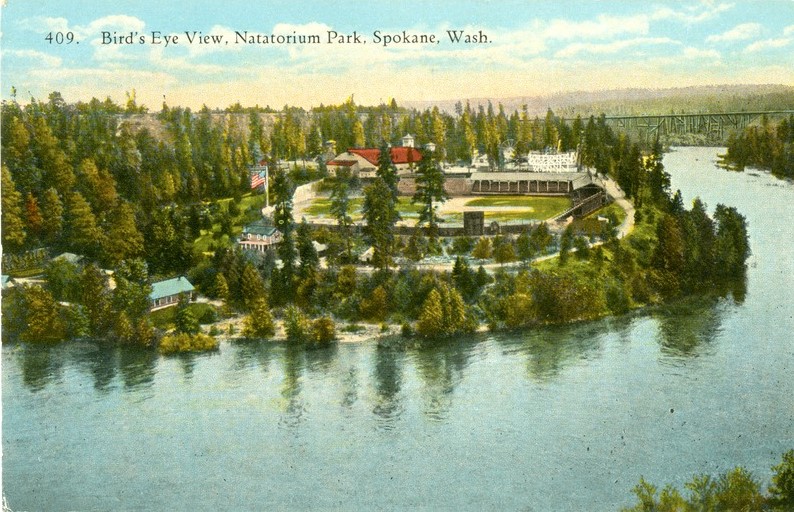
On weekends and holidays, May through October, baseball games were a park mainstay. Capacity crowds were always on hand and betting on games was also very popular. The Spokane team for a time became part of the Pacific Northwest League. In addition, a city league made up of teams sponsored by local business firms also played a schedule of games. The players received free transportation to the ball park on game days and earned salaries from $30 to $100 a season in addition to free uniforms and equipment.

In 1908, the WWP athletic grounds at Natatorium Park were doing very well. WWP had retained the baseball diamond and the city league was playing semi-professional ball competing for fans with the professionals at J.P. Grave’s Recreation Park.
Not until 1918 did Natatorium Park become tainted by war. Baseball was also threatened at that time when Newton D. Baker, Secretary of War, attempted to reduce it to just big leagues, as he felt if players were healthy enough to play ball they could certainly march to war. However, that attempt was overturned.
Barnstorming semi-professional teams became a staple on the park ball field. Black teams did very well on the circuit such as the Chicago Union Giants and the Kansas City Monarchs. They all put Spokane on their schedules. Babe Ruth also played an exhibition game on October 17, 1924. He hit a ball over the sign on the centerfield fence in the eighth inning.

The depression did not diminish the enthusiasm of sports fans. The grandstand crowds continued to number two to five thousand strong particularly for the barnstormers.
The Plunge

At the far end of the park at the Spokane River’s edge, a huge open swimming pool was built which opened on July 15, 1893. It was a big hit with soldiers from nearby Fort George Wright, kids, and adults. There was both public swimming as well as races.
In 1910, the original pool was replaced with what was referred to as the Plunge. It was an Olympic-size swimming pool which sloped from 2 to 12 feet deep, had a domed roof, and was surrounded by 300 changing rooms. The first year it took 319 tons of coal to heat it. The Plunge was filled with well water which tapped the same underground water flow that supplied Spokane’s water. It quickly capitalized on its pure swimming pool water supply and it never lacked for patronage throughout the summer.
Rides and Other Amusements
In 1907, Audley Ingersoll took over Natatorium Park. At that time, J.P. Graves was advocating for what was termed a “White City”. The White City name came from the title that was given to the Chicago Columbian Exposition of 1893. That exposition offered hope that urbanization could provide a “satisfying, clean, and habitable” form of life.
Besides integrating technology with fun, the Chicago World’s Fair influenced the future development of the amusement park. Visitors would pass from the black grime of the dirty city through the portals of a glistening White City and be invited to imagine a better world in the future. It gave hope and fed the dreams of a nation beleaguered by the harsh realities of the struggles of urbanization. The amusement park provided a temporary emotional escape from the cares of the world.

Audley Ingersoll was one of the members of a large eastern amusement company and would lease all of Natatorium Park’s grounds from WWP with the exception of the baseball grounds and the Dutch Jake Goetz movie picture stand. The lease was issued in order to emphasize the amusement aspect of the park with the influence of the ideals of the White City. Many new attractions were added during his involvement with the park but by the end of 1908 Mr. Ingersoll was heavily in debt and WWP became the beneficiary of his efforts.
Audley Ingersoll had installed the scenic railway and Ye Old Mill rides and would greatly expand his operations. There was the scenic railway roller coaster (also known as a figure-eight); a three-way toboggan slide; Dutch Jake’s open-air theater showing of the first full-length feature film in 1903, “The Great Train Robbery”; and “polite vaudeville” played in the new rustic theater.
The other park concessions included a wooden roller coaster called the Jack Rabbit which was the loudest and most popular ride in the park.

There was also a Joy Wheel which was a spinning wheel in which you were required to laugh, later renamed the Nut House.
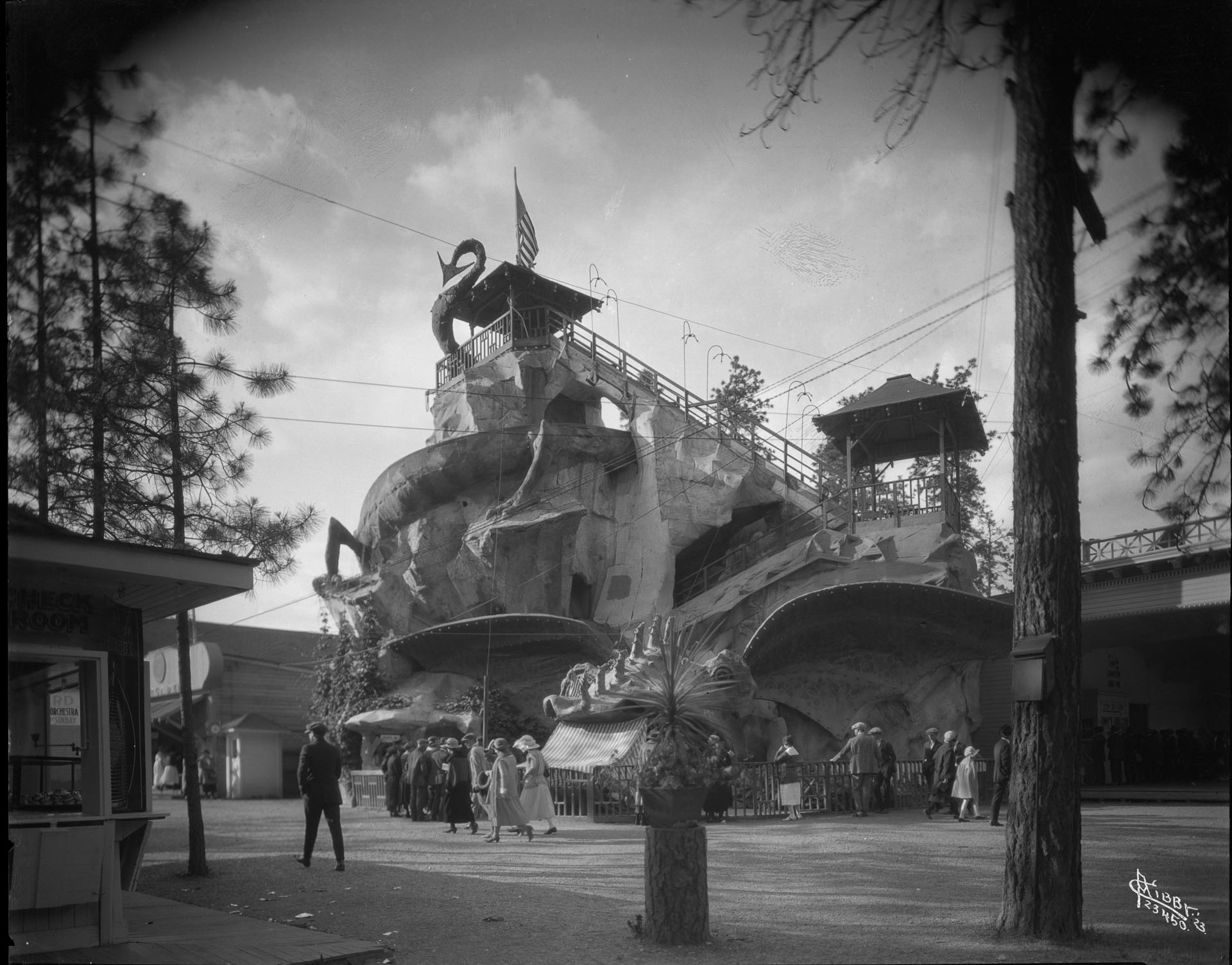
The Dragon Slide which was a long, curvy wooden slide that was a fire-breathing monster with its curled green tail and open fanged mouth.
There was also the Tunnel of Love; Dodgem cars; Custer Speedway; Fun in the Dark; the Rock-o-Plane; and the Shoot-the-Chutes.


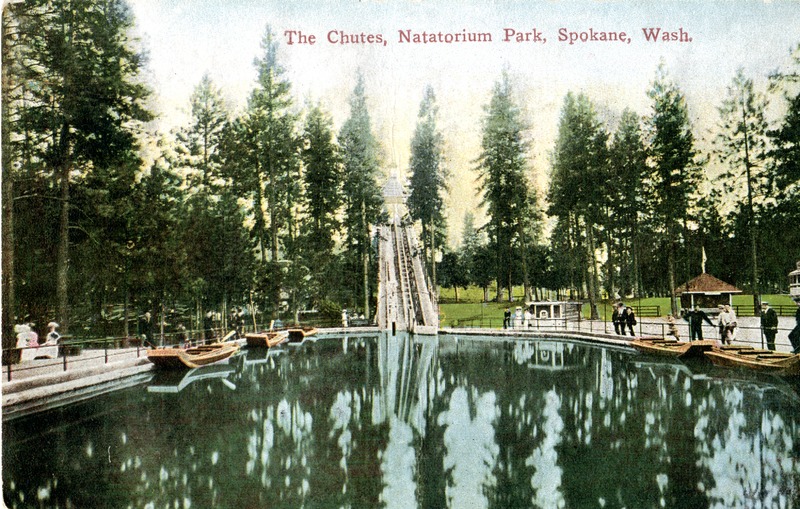
At the top of the Shoot-the-Chutes, a flat-bottomed boat was brought around by a turn table and slid down a track into a huge artificial pool with the bottom of it lit with colored lights. The pool was surrounded by a lighted six-foot walkway and was the centerpiece of the park. It proved to be one of the most popular rides in the concession area.
A “Galveston Flood” building was built near the old figure eight which showed in miniature the heavy rain, rising, and sweeping away houses. There was the “darkness to dawn” building that was supposed to emulate creation. Next to that was the Foolish House with its twisting passages, moving floors, and inclines. There was also the House of Trouble which was a maze.
Smaller concessions included a shooting gallery, a Japanese ball game, glass blowing, a laughing gallery with distorted mirrors and a penny arcade. There was Jacob Goetz’ Hale’s Tour of the World building which contained two imitation trains where moving pictures from all over the world were seen as well as a number of slot machines for pictures and stamps. There was an open air theater with seating for twelve hundred.
In addition, weekly balloon launches were offered. The Ye Old Mill was updated with new scenes including a Japanese flower garden, pastoral scenes, an Indian camp, cotton fields, and a hall where a small orchestra played every day. An artificial menagerie with moving animals completed the effects.

The Scenic Railway continued its 2,200 feet run. A Lover’s Lane was designed to run along the Spokane River toward the old Twickenham Bridge to Fort George Wright.
Dancing had been gaining in popularity and in 1914 the ball room also known as the dance pavilion was enlarged and refurbished.

Band concerts were held in the park in the afternoon and orchestras played at night.


Impact of World War I and Beyond
Due to the war, WWP decreased its services to conserve manpower and resources needed for battle, consolidated its enterprises, and focused more on furnishing electric power alone. On November 11, 1918, the war ended which resulted in changes impacting Natatorium Park.
Automobiles increasingly forced adaptations upon the city’s former transportation systems. Jitneys were posing a controversial challenge for Spokane and the street railways. They were the primitive version of the modern bus and they began to seriously compete for fares in the early 1920s. There were 77 licensed jitneys on Spokane’s streets in 1921; and in 1922, WWP applied for its own jitney permit.
The advent of the jitneys raised the population’s consciousness to the plight of its railways and civic action groups began to divide into two camps: jitney and street railways. All tended to agree in order to survive the street railway company’s would have to merge. The Spokane and Inland Empire (formerly Spokane Traction Company) continued to fail and was finally merged into WWP’s Spokane Street Railway to form the Spokane United Railway in 1922. At that time, WWP also sold Natatorium Park to the Spokane United Railway company.
Throughout the 1920s the park was forced to deal with ever increasing competition from the widely expanding varieties of entertainment being offered by the city’s park system, Down River Golf Course, public pools, moving picture and vaudeville theaters.
Improved communications and transportation were rapidly expanding the boundaries of the local recreational opportunities. Now sports fans could fly or go by train to their favorite pastimes. National parks also became increasingly popular due to automobiles.
By 1926, the park was forced to increase its available parking space and built a new road from Boone to accommodate the growing automobile traffic. Dusty cars from areas beyond paved roads expanded attendance at the park. However, with the Stock Market Crash of 1929, the Spokane United Railway decided that the positives of park ownership did not outweigh the negatives.
On March 15, 1929, the Spokane United Railway decided to sell the park. On April 14, 1929, Louis Vogel purchased 42 acres of land, the dancing pavilion, the Plunge and the airplane ride. He already owned the Whip, the carousel, and the Caterpillar.
Louis Vogel had married Emma Looff, daughter of Charles Looff, who built the beautiful carousel with 54 horses. The carousel was given to them as a wedding present and installed in the park. Louis Vogel took over operation of the carousel and all other concessions at the park.

With the purchase by Louis Vogel, Natatorium Park was no longer a streetcar park. Now it was simply a private park owned by an individual and it happened to be located on a streetcar line.
The park’s primary purpose was to be a place where people could temporarily leave reality behind and enjoy themselves. It was Louis Vogel’s job to provide his patrons with pleasurable experiences and he did not fail them. Louis Vogel continued to add and improve existing ride concessions.
The park was legally deeded to Louis Vogel in 1933. He survived the depression well and was able to adapt to the automobile by creating a larger parking lot.
The park was an athlete’s and sports fan’s paradise. Other entertainments included concerts, dances, picnics, orators, vaudeville shows, plays, and movies. There was also the midway with its penny arcades, games of skill and chance, and the thrilling rides.
Another reason for the increase in popularity of amusement parks in general was industrialization and the rise of organized labor. They dramatically reduced the hours of the work week that resulted in a complimentary increase in dollars spent on recreational pursuits.
Streetcar Legacy
For the streetcar lines, Natatorium Park was a natural terminal. The Broadway line turned off at Broadway and Monroe, traveled to approximately where St. Lukes’s hospital was located, and then swung north to switch onto the Boone Avenue tracks and travel on down the river-bank slope to the park. There, the cars swung around a huge rail loop for their return to town.
However, even as early as 1929 the Washington Water Power Company became well aware of a more economical means of passenger traffic transportation with auto buses. In 1933, the streetcars and tracks through Spokane were abandoned as auto buses began taking over.
On August 27, 1936, the old veteran car No. 202 was moved to its final resting place at Natatorium Park and ceremoniously burned which represented Spokane’s streetcar park going up in flames. It had been on the line since 1911, reportedly logged more than 1.6 million miles during its 26 years of service, and was the last of its kind.

One of the streetcars wasn’t burned and was eventually restored. It is the former Washington Water Power Company/Spokane United Railways Brill Streetcar No. 140. It is part of the restored collection at the Inland Northwest Rail Museum in Rearden, Washington, just outside Spokane.
World War II and Changing Times
The World War II days of 1940 to 1946 during the “Big Band Era” proved to be the “heydays” for the Vogels. With the troops at Ft. George Wright, Geiger Field airmen, and U.S. Navy sailors at Farragut on Pend Oreille Lake, weekend “liberty” leave in Spokane was very popular which included Natatorium Park.
When Louis Vogel died in June, 1952, his son Lloyd and his wife carried on afterwards. Lloyd took after his father and was also a born showman. It was Lloyd who arranged for such name bands as Kay Kayser in 1941 and Harry James in 1952 when a record for a dance pavilion was set with a crowd of 5,000. Other well-known band leaders as Benny Goodman, Tommy Dorsey, and Ted Fio Rito played at the pavilion.
In 1956, Lloyd purchased a pair of live seals from the Homer Snow Company of Oakland. Immediately they became one of the park’s most popular attractions. Lloyd would say he made more money selling food for tossing to the seals than some park concessions showed as a profit.
As in any venture, time must be reckoned with in the permanency of any type of recreational attraction. With the ease of auto transportation to the surrounding lakes and the opening of many city swimming pools, they took business away from the park. The list of destinations included: Liberty Lake, Coeur d’Alene, Hayden Lake, St. Joe River, Spirit Lake, Newport, Medical Lake, Cheney, Loon Lake, and Sandpoint. Natatorium Park still exceeded attendance over Coeur d’Alene Lake. Always looking for another way to gain more riders for its streetcar lines, WWP invested in Medical Lake’s resort, Camp Comfort.
The invention of television for entertainment became a competing option even over novelty amusement attractions such as the parachute jump.
Operational costs continued to increase and Lloyd Vogel decided to sell his entire park holdings, the concessions, and the land to the El Katif Shrine of Spokane. The Shriners purchased the land for $75,000 in 1962. They did not open the park for the 1963 season. It was re-opened in 1964 following some refurbishment and repainting. Bill Oliver took over running the park for the Shriners from 1965 to 1968. An incident took place in 1965 in which a new park employee was killed on the Jack Rabbit. The park did not do well in those years and no further improvements were made to attract customers.
In November 1967, the park rides and equipment were offered for sale. In 1968, the park rides were dismantled, and the Jack Rabbit was burned on site. A rocket ride in the park was relocated to the playground of the Shoe House Nursery on North Maple Street in Spokane and set on springs. The Rock-O-Plane was moved to Thrill-Ville USA, an Oregon amusement park in Turner, Oregon.
In 1968, the El Katif Shrine closed the park, cleared the land and made it into a mobile home retirement village called San Souci West.
The citizens of Spokane didn’t want to lose the Looff Carousel and established an organization to buy it. The asking price was $40,000. Plastic gold rings and “Save the Carousel” buttons were sold to raise the money to buy it. It remained in storage for seven years after the park closed. Riverfront Park in Spokane was selected for its new home. In 1975 it re-opened in the park after the Expo ’74 World’s Fair ended in what had been the German pavilion.
Lasting Legacy
Much was learned from the park: its purpose; its deep roots into Spokane’s athletic and recreational foundations; its relationships to the early urban utility and transportation systems; and the many diverse recreational opportunities the park served in Spokane.
Natatorium Park was the first streetcar park in Spokane to be developed in the rich tradition of American streetcar parks as a recreational amusement center. Spokane’s first professional baseball team was initiated on its grounds and the first swimming pool was located there.
Natatorium Park will forever be a cherished memory for the citizens of Spokane.
Sources
- Marla L. Hyde and Douglas R. Johnson, “Dear Old Nat . . . Spokane’s Playground”, Nostalgia Magazine, 2003, pages 8-21, 41-117;
- Gary Nance, “Natatorium Park”, 2005-2024, website accessed July 8, 2024, (https://natpark.org);
- Karen DeSeve, “Spokane’s Natatorium Trolley Park”, Master’s Thesis, Eastern Washington University, 1994, Spokane Central Public Library Northwest Room;
- Nicholas Deshais, “50 Years On, Remembering Spokane’s Natatorium Park”, Spokesman Review, August 25, 2018, p. 1;
- Jay J. Kalez, “Nat Park: Where $5 Made You a Big Spender”, Spokane Daily Chronicle, July 30, 1969, p. 23;
- PdxHistory.com, “Remembering Natatorium Park”, May 5, 2018, http://www.pdxhistory.com/html/amusement_parks.html.
Image Sources
- Natatorium Park 1913 postcard, Spokane Public Library, accessed January 15, 2026 (https://lange.spokanelibrary.org/items/show/4328).
- Twickenham Park with Wooden Bridge, Northwest Museum of Arts & Culture/Eastern Washington State Historical Society, Charles Libby Collection, 1889, L86-1389.
- Wooden Bridge with Streetcar going over Spokane River, Northwest Museum of Arts & Culture/Eastern Washington State Historical Society, Charles Libby Collection, 1889, L87-261.
- Monroe Street Bridge with Streetcar, Northwest Museum of Arts & Culture/Eastern Washington State Historical Society, Charles Libby Collection, 1900-1905, L87-1.164.
- Spokane United Railways Streetcar, Northwest Museum of Arts & Culture/Eastern Washington State Historical Society, Charles Libby Collection, 1934, L87-1.4307-34.
- Natatorium Park Baseball, Northwest Museum of Arts & Culture/Eastern Washington State Historical Society, Charles Libby Collection, 1901, L87-1.126.
- Bird’s Eye View of Natatorium Park, postcard showing baseball field, circa 1910, Spokane Public Library accessed January 14, 2026 (https://lange.spokanelibrary.org/items/show/4339).
- Natatorium Park Baseball, 1900, Archives/The Spokesman Review.
- Portland Post No. 1 Baseball Team at Natatorium Baseball Field, Northwest Museum of Arts & Culture/Eastern Washington State Historical Society, Charles Libby Collection, 1929, L87-1.40217-29.
- The Plunge Pool postcard; Interior of the Plunge Natatorium Park, Spokane Wash., 1910-1920, “Interior of Plunge, Natatorium Park, Spokane, Wash.,” Spokane Public Library, accessed July 13, 2024, https://lange.spokanelibrary.org/items/show/4319.
- Jack Rabbit Wooden Roller Coaster, Northwest Museum of Arts & Culture/Eastern Washington State Historical Society, Charles Libby Collection, 1939, L87-1.16680-39.
- Amusement area at Natatorium Park showing the Jack Rabbit Wooden Roller Coaster, The Whip, and crowds, 1924, Northwest Museum of Arts & Culture/Eastern Washington State Historical Society, Charles Libby Collection, L87-1.26912-24.
- Dragon Slide, Northwest Museum of Arts & Culture/Eastern Washington State Historical Society, Charles Libby Collection, 1923, L87-1.23450-23.
- Natatorium Park Grounds Showing Custer Car Race Track and Ball Room Building, Northwest Museum of Arts & Culture/Eastern Washington State Historical Society, Charles Libby Collection, 1941, L87-1.20777-41.
- Rock-o-Plane in Background, Natatorium Park, 1949, Northwest Museum of Arts & Culture/Eastern Washington State Historical Society, Charles Libby Collection, L87-1.60102-49.
- The Chutes (Shoot-the-Chutes) postcard, Natatorium Park, Spokane, Wash., 1900/1910, “The Chutes, Natatorium Park, Spokane, Wash.,” Spokane Public Library, accessed July 13, 2024, (https://lange.spokanelibrary.org/items/show/4323).
- Rustic Arch and Japanese Pagoda postcard, 1919, Spokane Public Library, accessed January 15, 2026 (https://lange.spokanelibrary.org/items/show/4322).
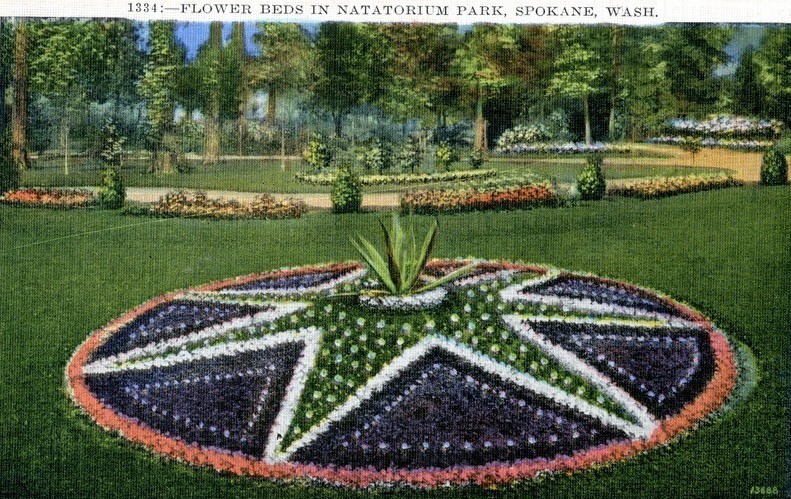
- Natatorium Park Flower Beds postcard, Spokane Public Library, accessed January 15, 2026 (https://lange.spokanelibrary.org/items/show/4318).
- Natatorium Park Ball Room, Northwest Museum of Arts & Culture/Eastern Washington State Historical Society, Charles Libby Collection, 1938, L87-1.14711A-38.
- John Philip Sousa and His Band poster, 1915, Washington State Historical Society (1999.88.32).
- Natatorium Park Band Concert postcard, 1900-1910, Spokane Public Library accessed January 15, 2026 (https://lange.spokanelibrary.org/items/show/4325).
- Charles Looff Carousel Natatorium Park 1910, CarouselHistory.com, accessed January 15, 2026 (https://carouselhistory.com), Charles Looff Carousel Archives.
- Spokane United Railways Streetcar Parade Before Burning, 1936, Northwest Museum of Arts & Culture/Eastern Washington State Historical Society, Charles Libby Collection, L87-1.9578-36.