
When in downtown Spokane, an impressive and not to be missed historical gem is the Federal Building and U. S. Post Office located at 904 W. Riverside Avenue.
Before the Thomas S. Foley United States Courthouse was opened next to it in 1967, the building’s original title was the U.S. Post Office, Courthouse, and Custom House.
History
With the arrival of the railroad in 1883, Spokane’s future was secured. Letters no longer took months to reach Spokane from the East Coast. The improved mail service in Spokane facilitated business transactions with loans quickly approved for local companies by East Coast banks. National businesses established local offices with new jobs which opened up every day. No longer was Spokane an out-of-the-way town with no future. Spokane became an important link between the Midwest and the West Coast.
The Need Expressed for a Public Building in Spokane
On January 29, 1902, the construction of a public building in Spokane was recommended by the Committee on Public Buildings and Grounds in Report 256 which accompanied Senate Bill 1447.
At that time, the city was considered the largest railroad center on the Pacific Coast. It was connected with four different transcontinental railroads with five local railroads leading into and opening up the mining and agricultural regions’ tributary to it. The population of Spokane was about 50,000 with a projected growth rate of 8,000 to 10,000 per year and to reach 100,000 in the next 10 years.
Spokane’s distributing point, its geographical position, and its rail facilities made it the natural trade center of the entire basin between the Rocky Mountains on the one side and the Cascade range of mountains on the other.
Spokane was also a good location for a Custom House given the close proximity to the Canadian border and multiple railroad linkages. The Custom House office was responsible for overseeing the importing and exporting of goods and collecting customs duties on imported goods.
Further support was given for a government building to be built. Government business was already being conducted in Spokane. There was a U.S. land office, an Internal Revenue Service office, a U.S. Deputy Marshal, a U.S. Post Office Inspection headquarters, a railway mail headquarters, and court cases being held.
Another reason for a public building was that U.S. Post Office receipts far exceeded those of any other point in the state except Seattle. A government building should be built instead of paying for office rentals from $5,000 to $7,000 per year which was the amount being paid in 1902.
Thus, there was an urgent need for a public building to support the needs of the community.
The New U.S. Post Office, Courthouse, and Custom House Opens in 1909
With the growth in mind to meet the needs of its citizens for a larger post office and space for federal offices, the new building opened on October 4, 1909. It was initially referred to as the U.S. Post Office, Courthouse, and Custom House. That was the name referenced on the National Register of Historic Places Inventory – Nomination Form when the application was being made to be added to it.
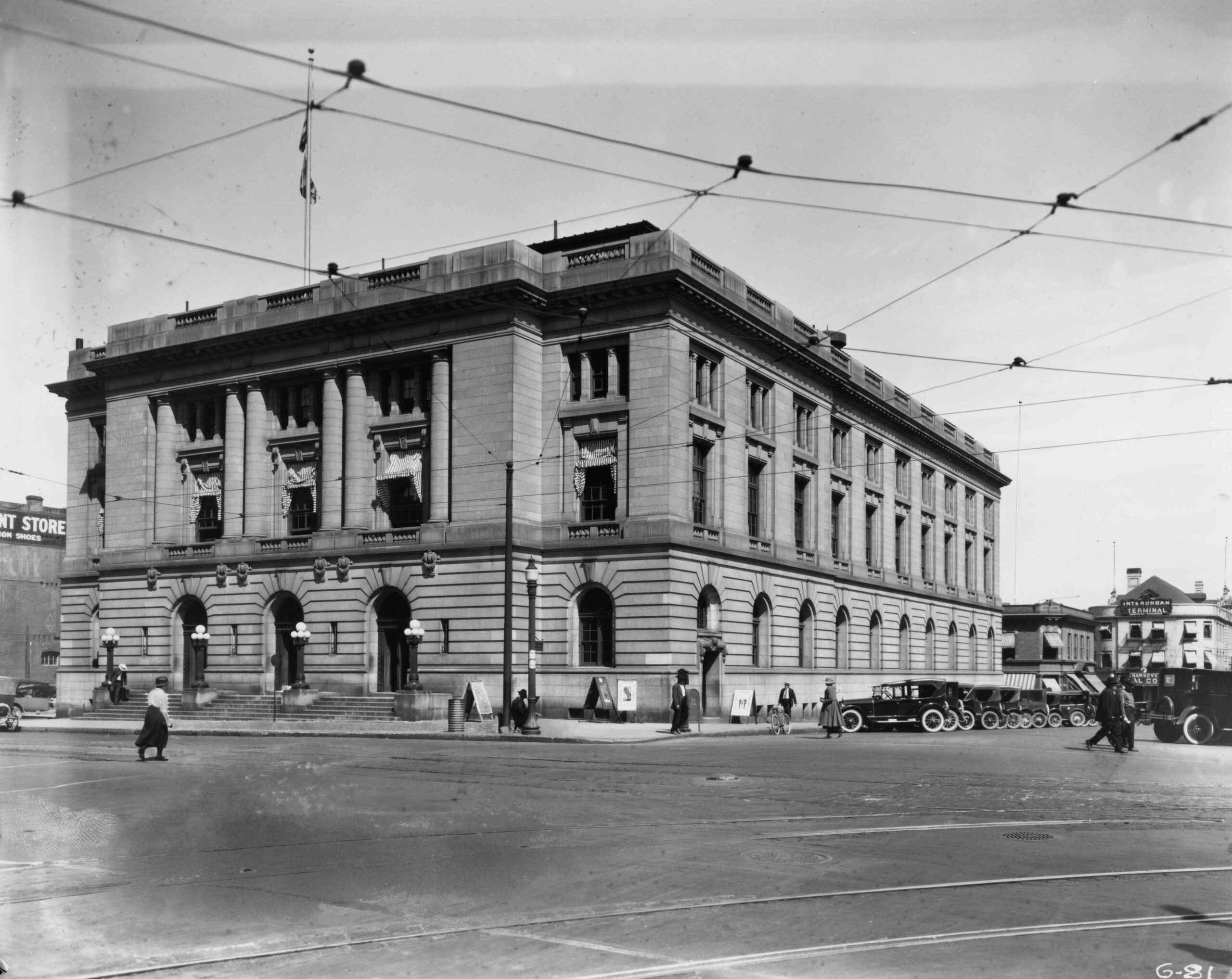
It was the first major federal building constructed in what was known as the “Inland Empire” encompassing portions of Washington, Oregon, Idaho, and Montana.
The federal government acquired the W. Riverside Avenue and N. Lincoln Street site in 1903 for a cost of $100,000. It was a prime location in the heart of the central business district in downtown Spokane.
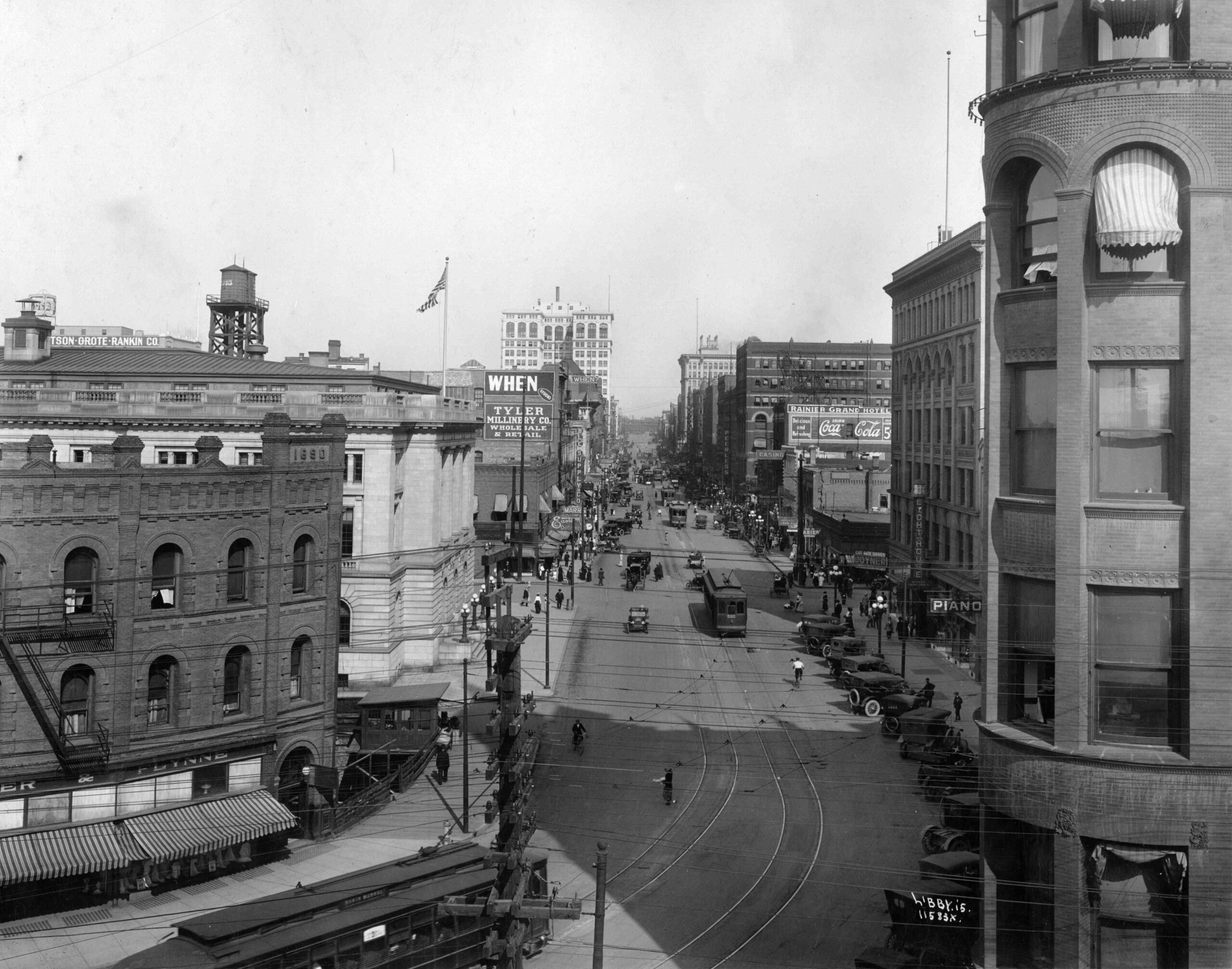
The building cost was $600,000. There were first, second, and third floors built along with an attic and a basement.
Architecture and Building Materials
The building was designed by James Knox Taylor, the Supervising Architect of the U.S. Department of the Treasury, in 1906 and 1907. It represented the design ideals of the time with a combination of Beaux Arts classicism and Renaissance Revival architectural styles. The materials used were granite, marble, brick, and timber. They were readily available which kept costs down and were easily transported.
The exterior is finely detailed and proportioned. The Renaissance architectural elements are seen on the south-facing entry arches as well as the window arches. The Beaux Arts design is shown on the second and third floors. Bedford, Indiana, limestone adorns the exterior on top of Little Spokane River granite. The limestone comes from a source used in the Lincoln Memorial and the Empire State Building. The interior has white Alaskan marble walls with green veining along with quarter-sawn dark stained oak panels, frames, trim, and doors.
The building’s horizontal divisions are emphasized by the treatment of the stone facing: The raised basement is of smooth gray granite; the ground story is of smooth Bedford, Indiana, limestone with banded rustication; and the second and third stories are also of smooth Bedford limestone.
The “striking” interior features include the public and postal lobby and the third floor U.S. Bankruptcy Courtroom.
On the first floor there is marble and ornamental plaster work. The cornice contains a dentil course of small squares which is a common feature on classical buildings.
The “Sneak Hole”
In addition to the ornate spaces, the building contained a common feature in post offices of that era which was a “sneak hole”. It was a specially constructed enclosed gallery located above the postal workroom that allowed inspectors to secretly observe the actions of employees through strategically placed peep holes! It is no longer in use today.
Praise from the President and the Move from the Old to the New Building
President William Taft visited the building just prior to its public opening in the fall of 1909. He praised the building’s “simplicity, beauty, and solidity”.
In early October, postal workers closed the old facility at Post Street and Monroe Avenue. They moved records and equipment to the new building in approximately two days with only minimal interruptions to patrons.
Rats Discovered!
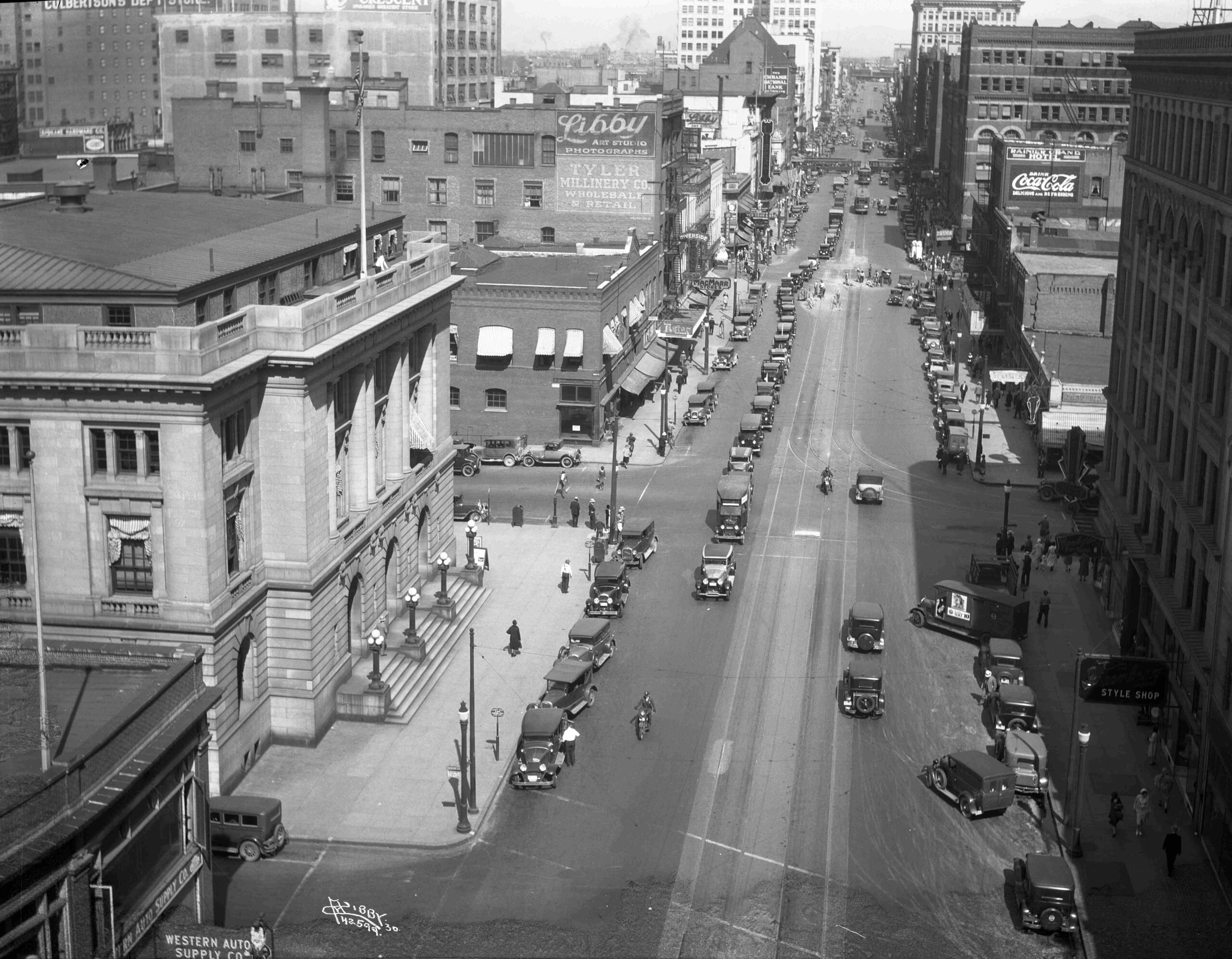
Only four months after the U.S. Post Office opened, rats were discovered in the basement. To remedy the problem, seven cats were brought in who were allowed to live in the building for over a year. The annual cost for the care and feeding was $18 per cat.
The Partnership with the Great Northern Railroad in Mail Handling
There was a partnership over the years with the Great Northern Railroad and the U.S. Post Office as to mail handling. In 1940, Spokane was one of the largest railway junctions west of Omaha, Nebraska.
Spokane also had one of the largest mail terminals in the west. There was only one other city in the west, Ogden, Utah, that had such a terminal.
Spokane also had one of the longest mail routes in the country—a 1,500 mile stretch between Williston, North Dakota, and Portland, Oregon. In order to cover large sections of Montana, Idaho, Washington and Oregon, trains operated at all times of the day and night.
An example of the volume of mail handled was in 1940 when the Great Northern No. 27 night train of 24 cars was coming from Chicago and bound for Seattle. There were six cars for Spokane and mail was sorted on the train in preparation for the arrival at the depot. Upon arriving, a speedy delivery on rail wagons was made to the U.S. Post Office at the W. Main Avenue entrance which had a loading platform for mail.
My grandfather, Cornelius McGillicuddy, was the Great Northern Station Master at the time and one of his many responsibilities was to oversee the mail coming and going from the depot.
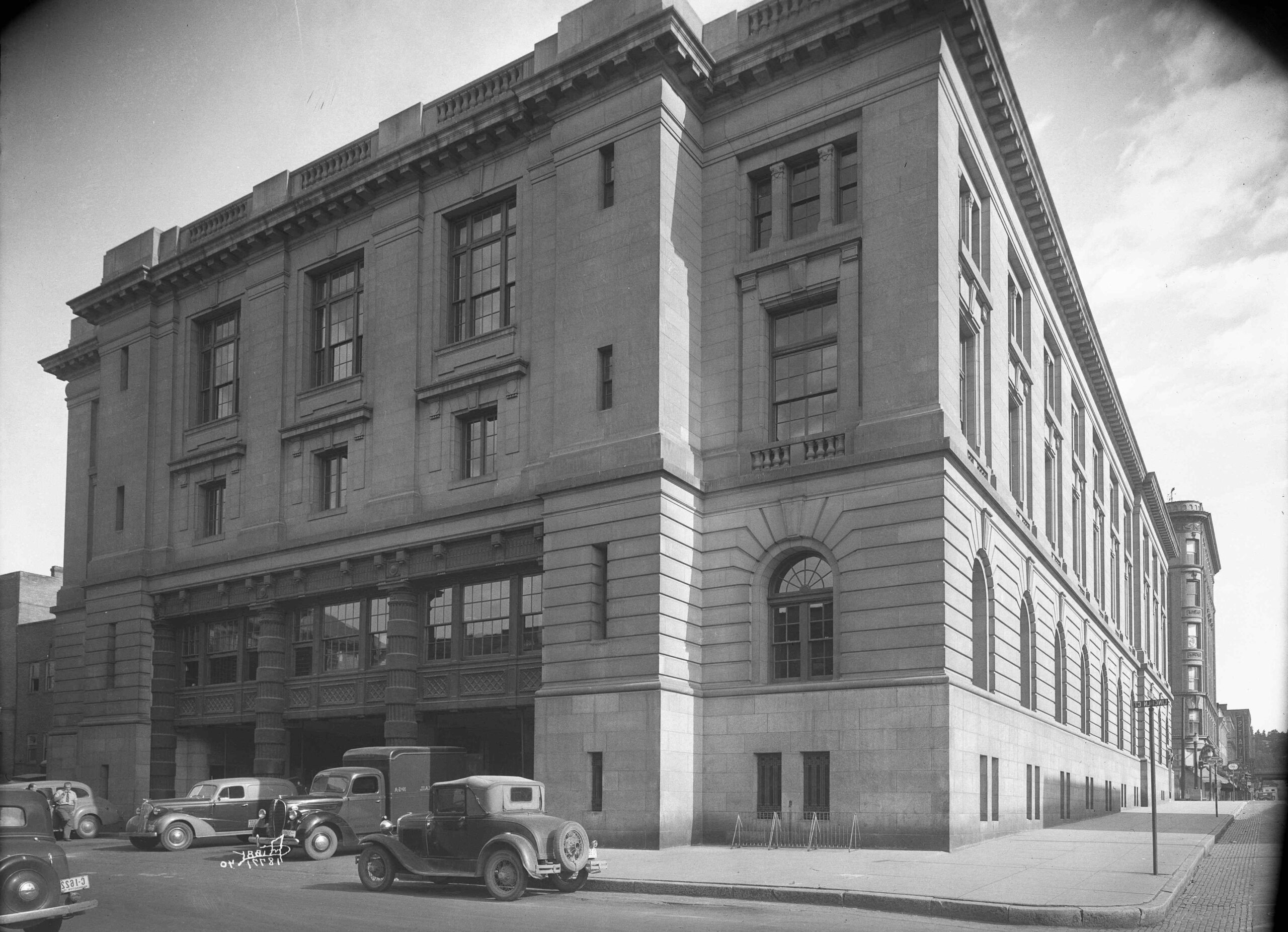
A Building Addition Completed in 1941
As Spokane continued to grow and postal activity expanded, city officials realized the need for additional federal department space. John W. Philip, Fourth Assistant Postmaster General, came to Spokane on August 2, 1930, to make a special survey of the situation. He agreed more space was needed because of the crowded conditions that resulted in having to lease office space in other buildings.
The site directly north of the U.S. Post Office building was purchased from the Home Securities Company and the two-story brick building occupying that site was demolished in 1938-1939.
For the building addition, the designers and builders kept the integrity and appearance of the original building in mind along with the materials that were used. Louis A. Simon was the Supervising Architect of the Federal Works Administration and W.G. Noll was the Chief Architect who signed and approved the plans. Mr. Simon designed the addition using Beaux Arts Classicism and Second Renaissance Revival styles to complement the existing building.
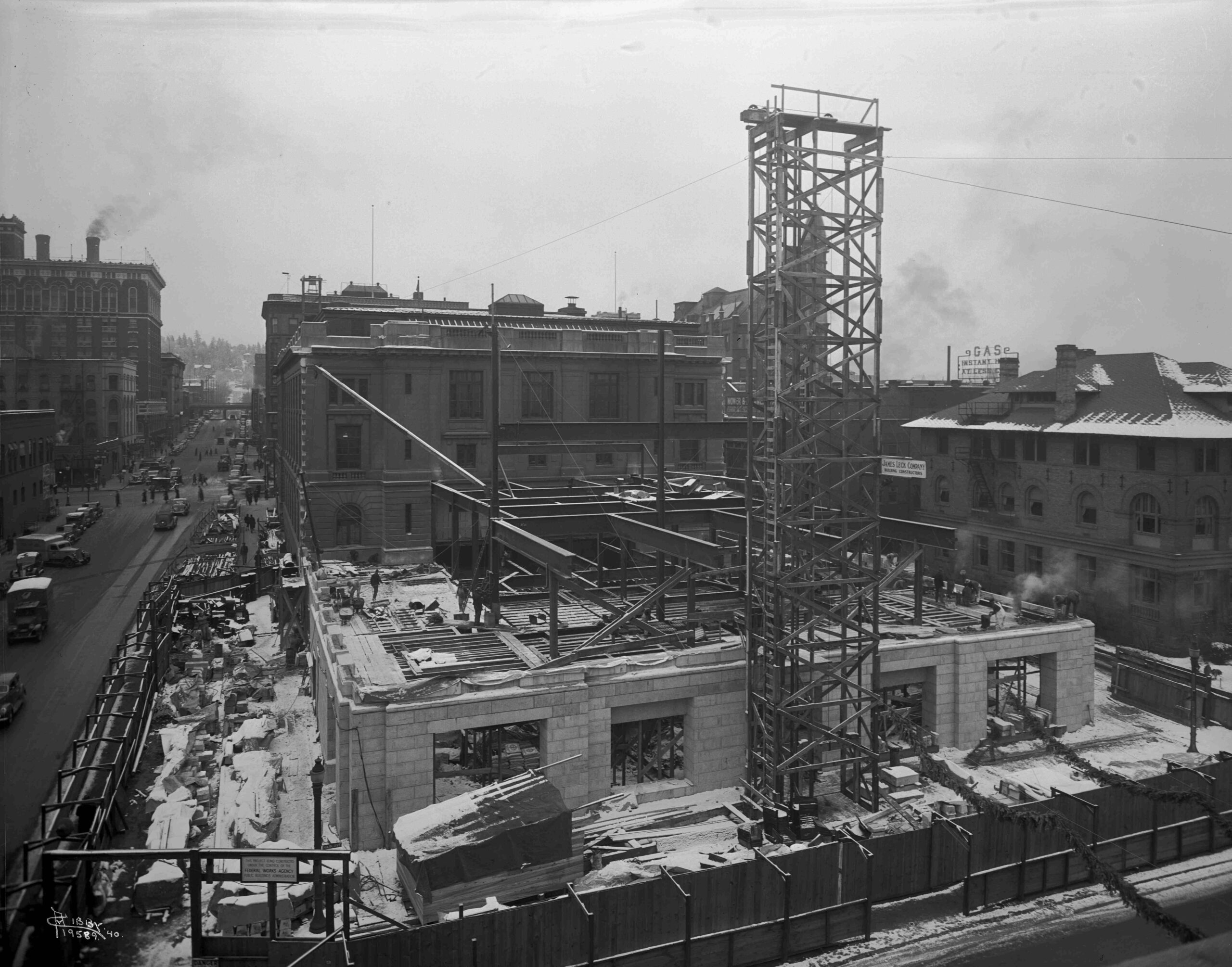
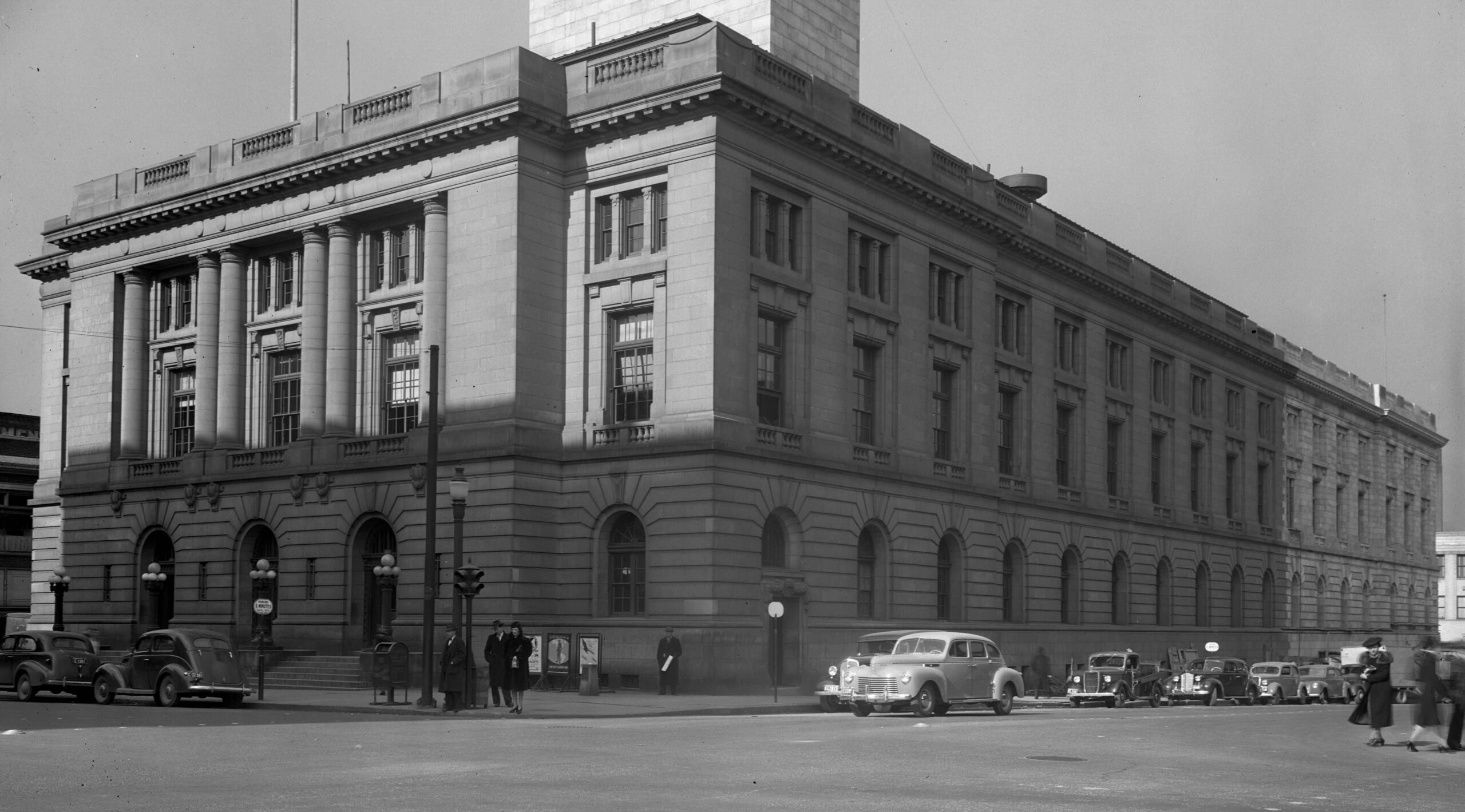
The addition was completed in 1941 to match the original architecture. While gaining in size, it lost nothing in appearance. Little visible division exists between the exterior walls of the original building and the addition. The line of demarcation between the old and the new was barely visible after a thorough cleaning. The historical integrity of the U.S. Post Office building has remained intact to a degree that is unusual compared to other buildings of its age, type, and geographic location.
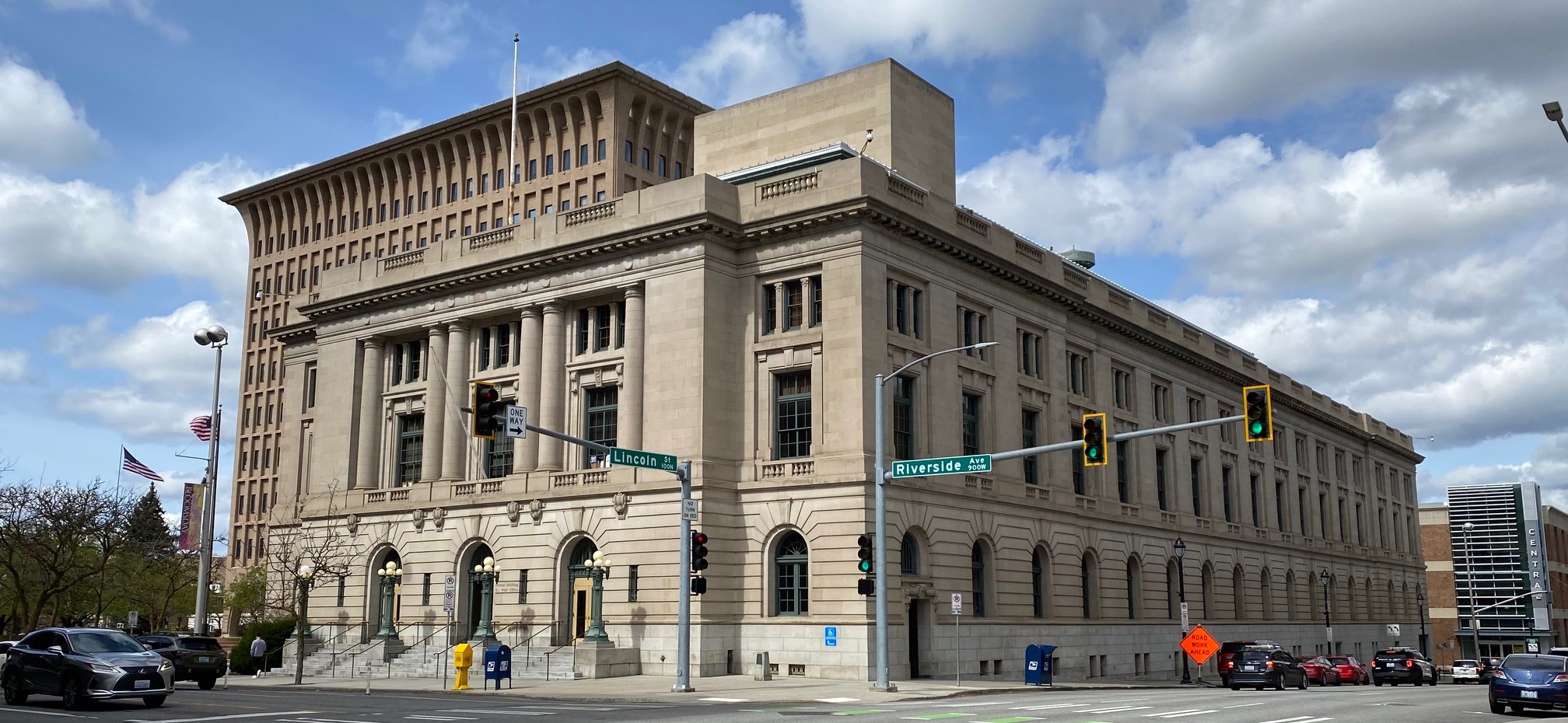
Street View Today
When walking up to the Federal Building and U.S. Post Office, one can see it has been well taken care of and has stood the test of time. It is stately and timeless in appearance with its elegant architectural lines and details.
The Riverside Avenue entrance has wide granite steps surrounded by ornamental iron lamps with clusters of opulent globes. At the top of the steps, one can enter the building through the oak and glass revolving doors.
Interior Details
The interior of the first floor is quite striking with extensive detailing and quality of workmanship from a bygone era.
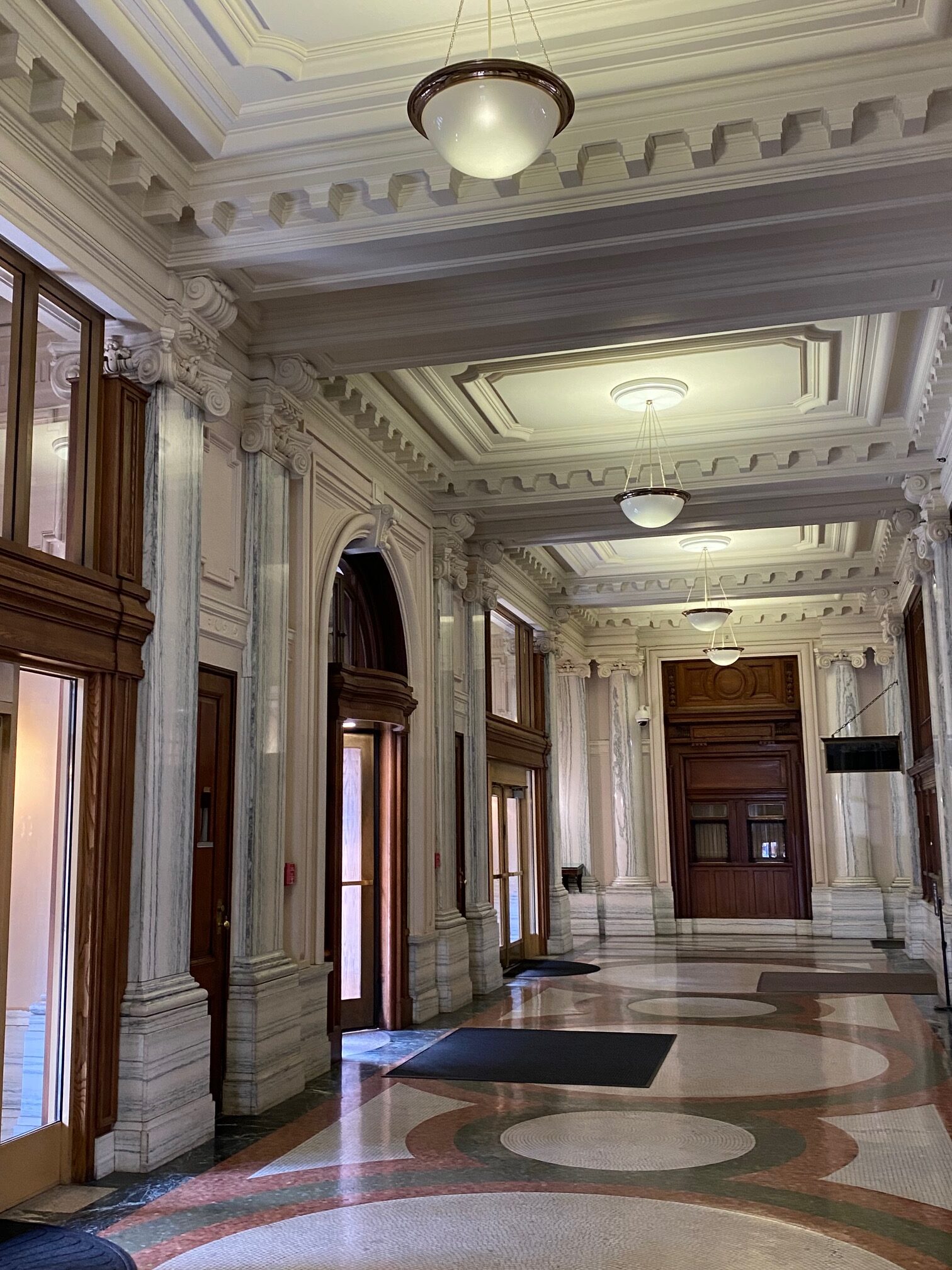
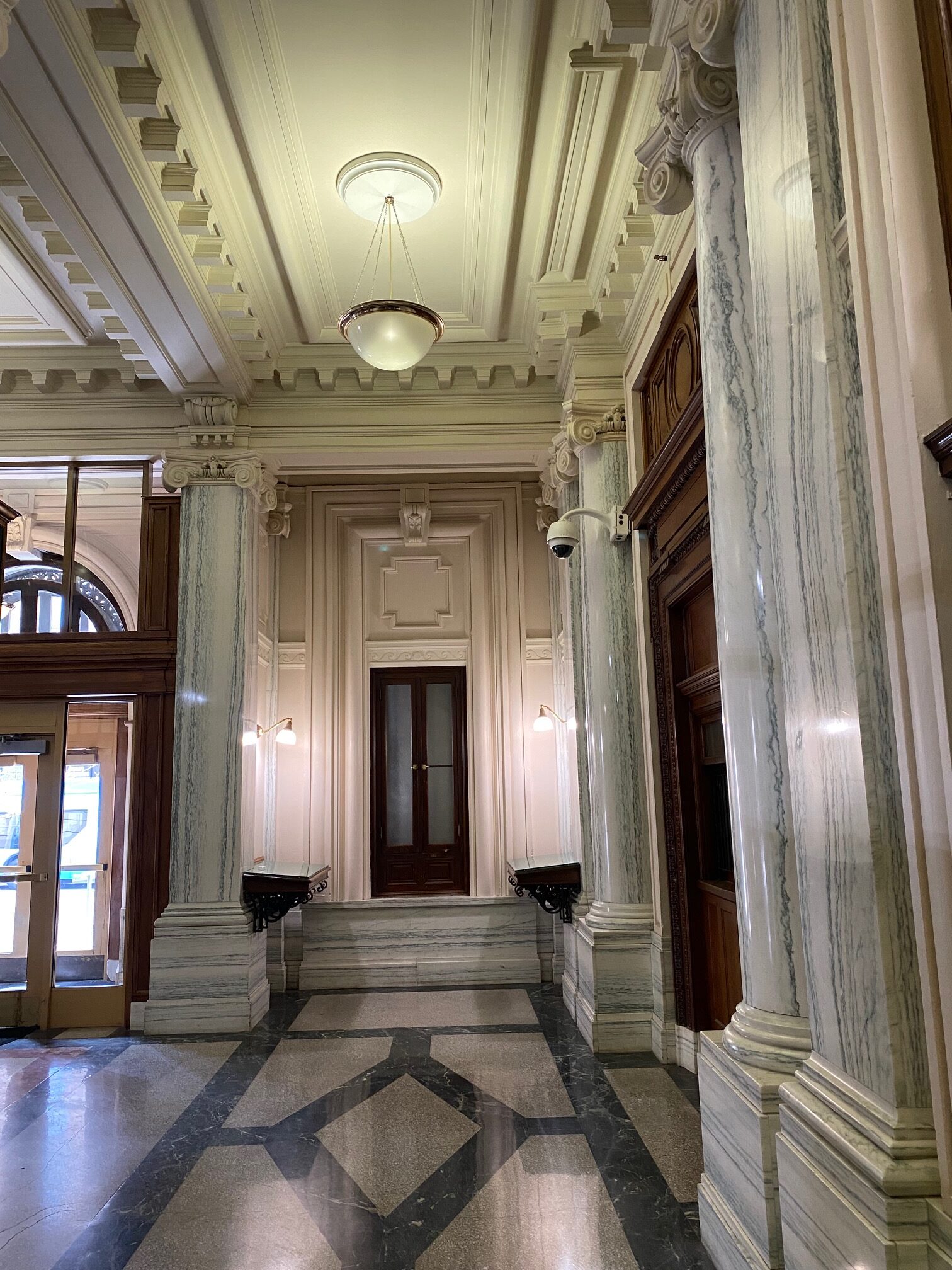
The building has an open, airy feeling with tall ceilings and large windows. There are marble columns all around that branch into beautifully imposing arches, crown moldings on the ceiling, immaculate black, white, gray and red marble mosaic and terrazzo floors, and beautifully preserved dark-stained oak detailing. The lobby walls are made of plaster formed in geometric ornamental panels interspersed with the marble columns.
The Formal Entrances
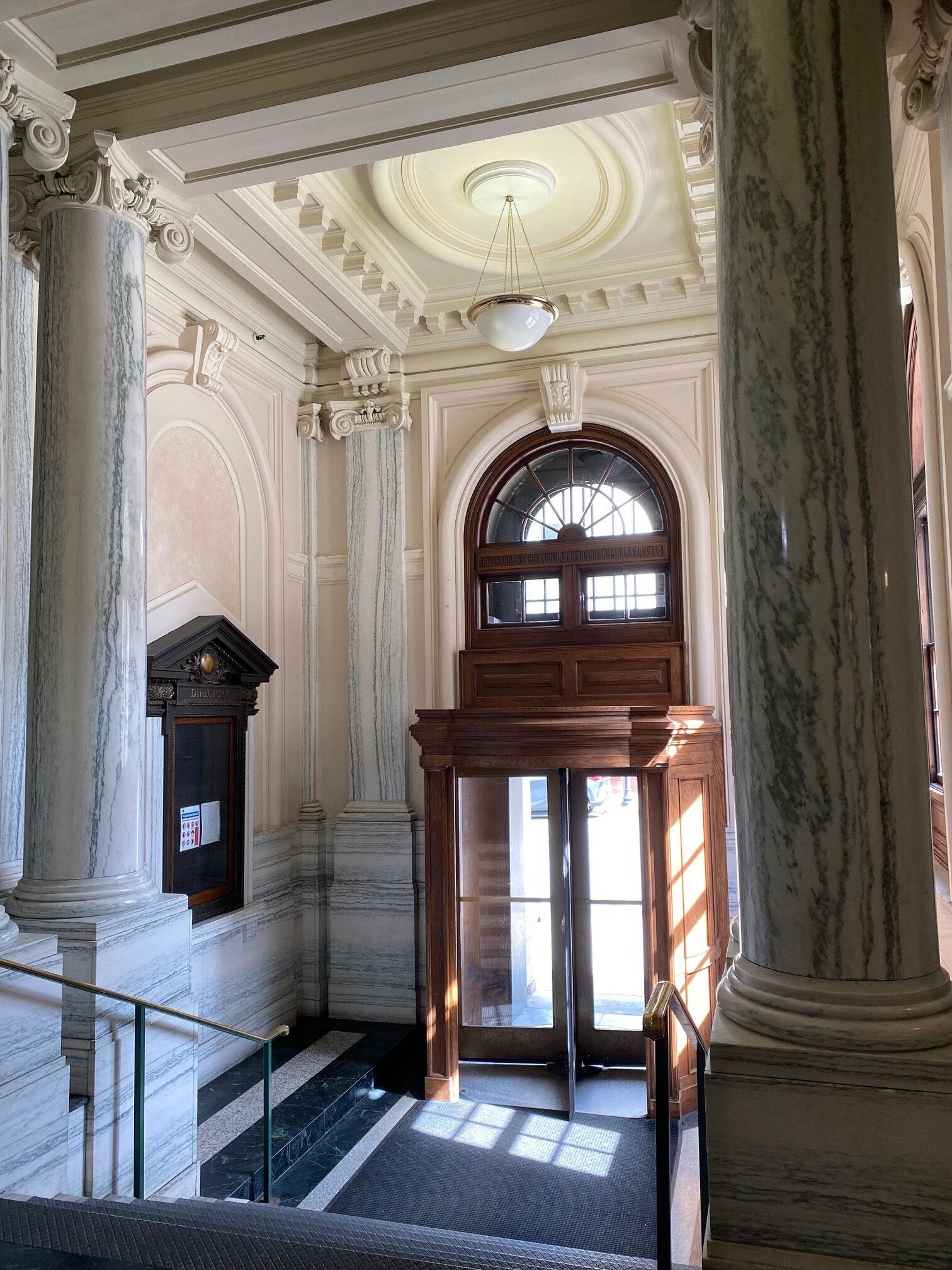
There are oak and glass revolving doors original to the building at both the W. Riverside Avenue and N. Lincoln Street entrances. They complement the arched openings to the building.
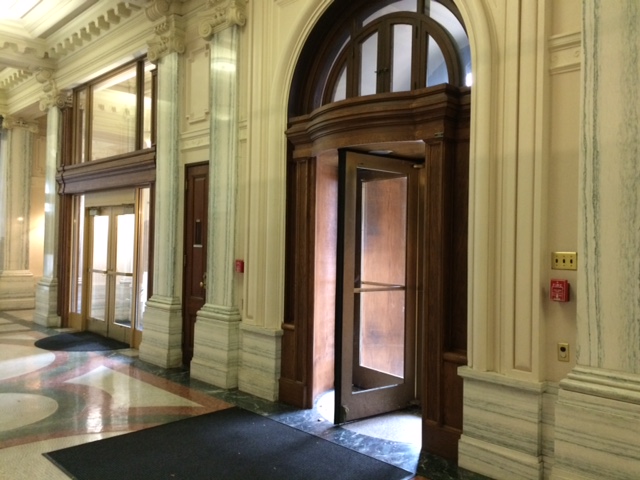
There is also an alcove that is beautifully lit with two dark-stained oak writing ledges at the end of the hall on the left side from the main entrance.
The N. Lincoln Street entrance to the building is on a lower level set off from the main corridor by four massive marble columns.
First Floor Mail Handling, Postal Services, and Distinctive Mailboxes
The main workroom where the mail is received and sorted takes up more than half of the first floor area.
At the rear of the main workroom, there are two hydraulic elevators that originally were designed to receive the incoming mail that was transferred from the Great Northern depot. At that time, the rail wagons would off load mail directly to the elevators at the north end of the building.
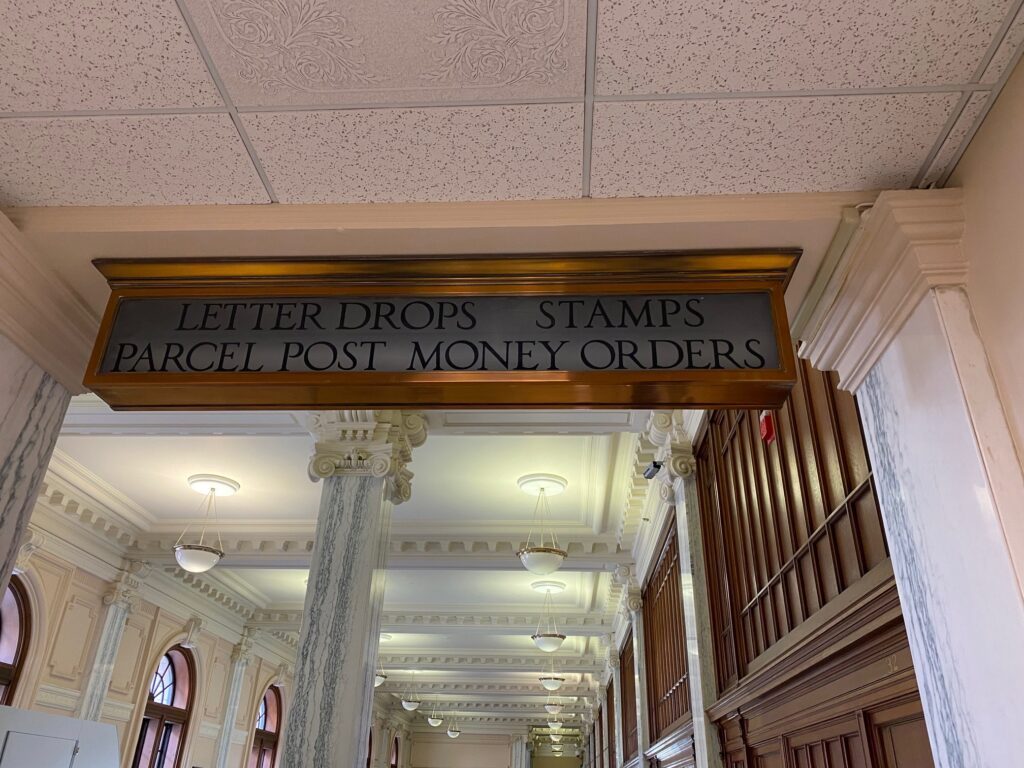
On the first floor, there are well-preserved signs to direct the public for postal assistance. One of the signs provides help with mailing letters, obtaining stamps, sending packages via Parcel Post, and purchasing money orders.
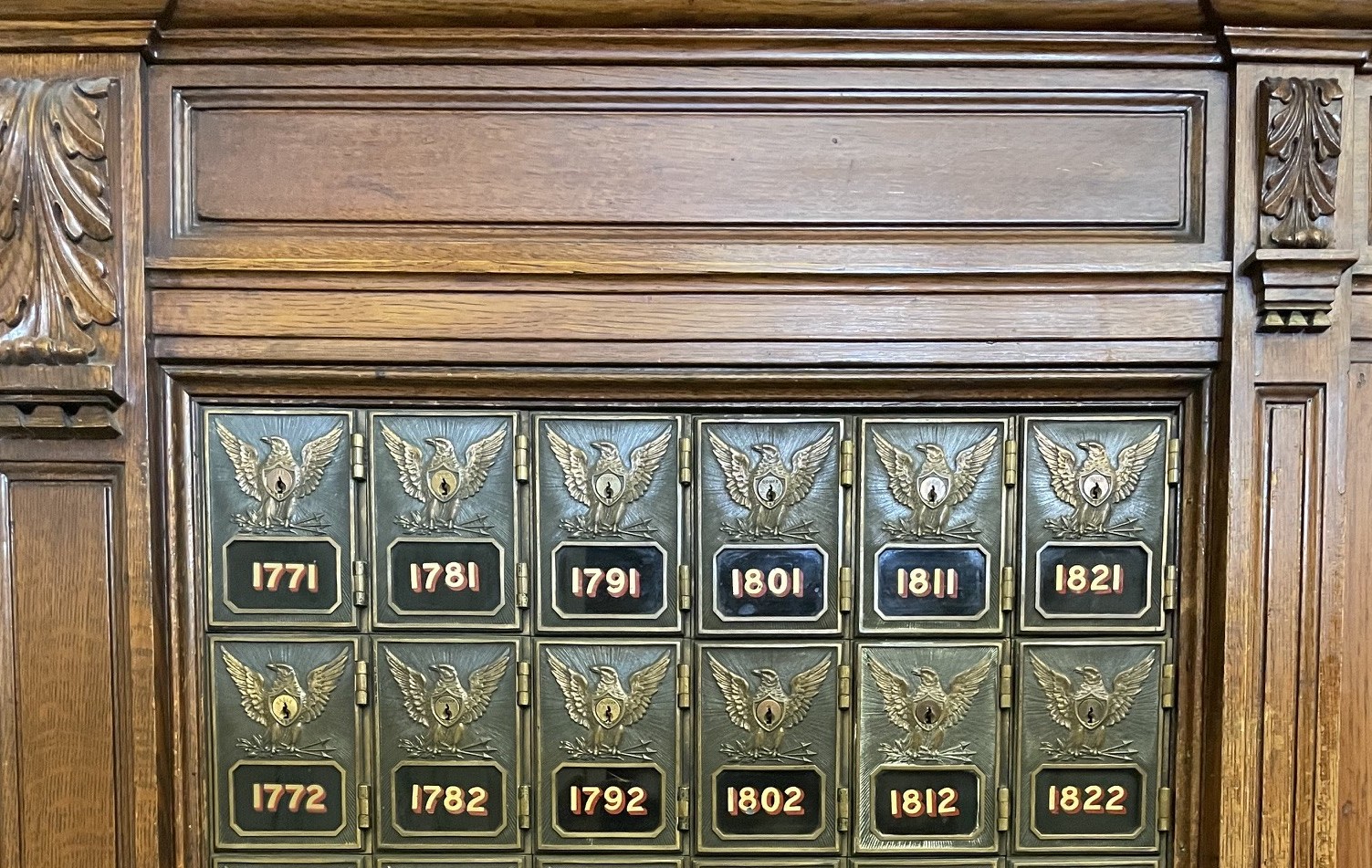
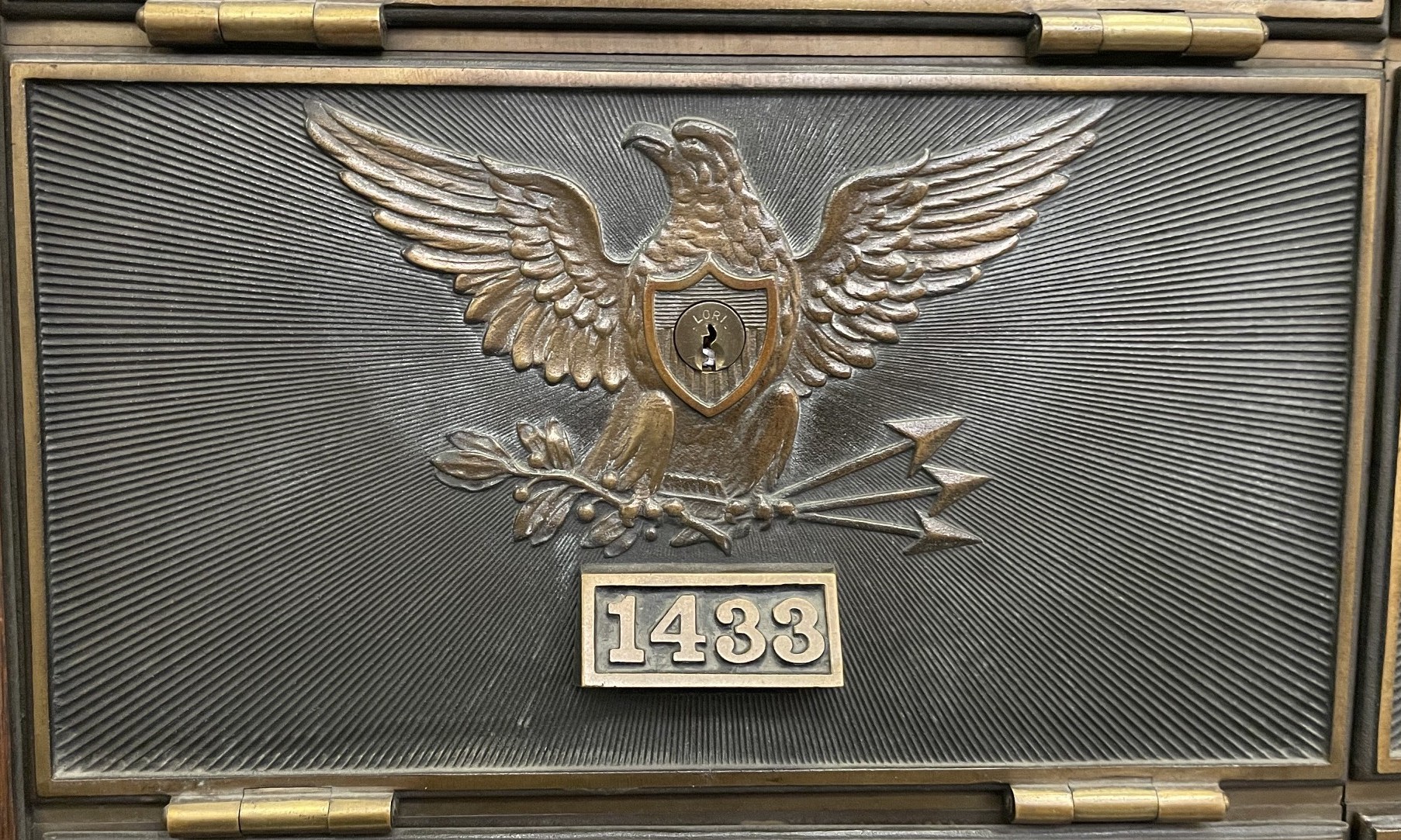
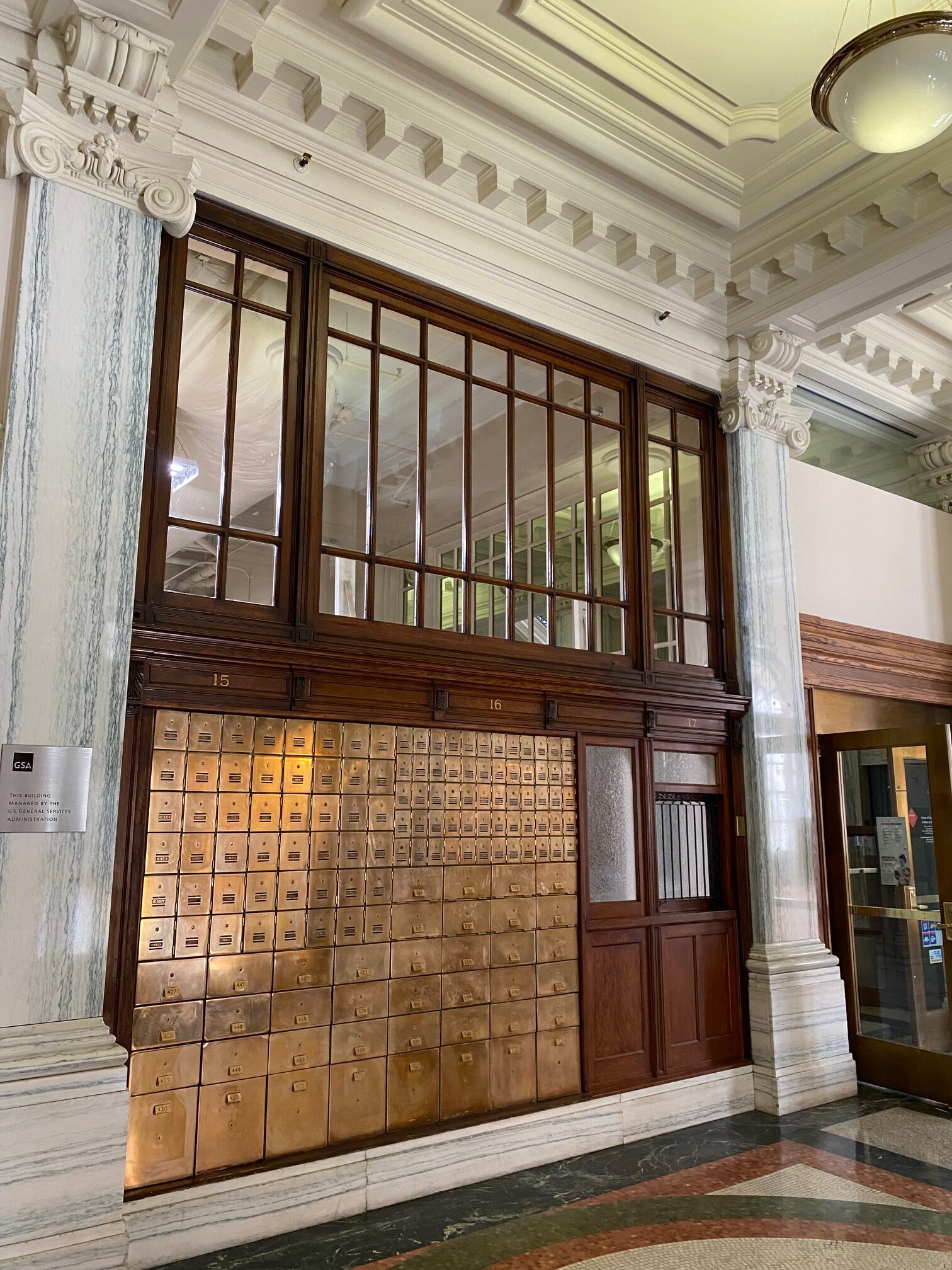
The western corridor on the first floor has mailboxes for the public to rent. They are quite impressive in three different types and sizes. Two are made of dark metal that have eagles on them. The third type in a shiny brass metal tone does not have a design.
Those Impressive Marble Stairs
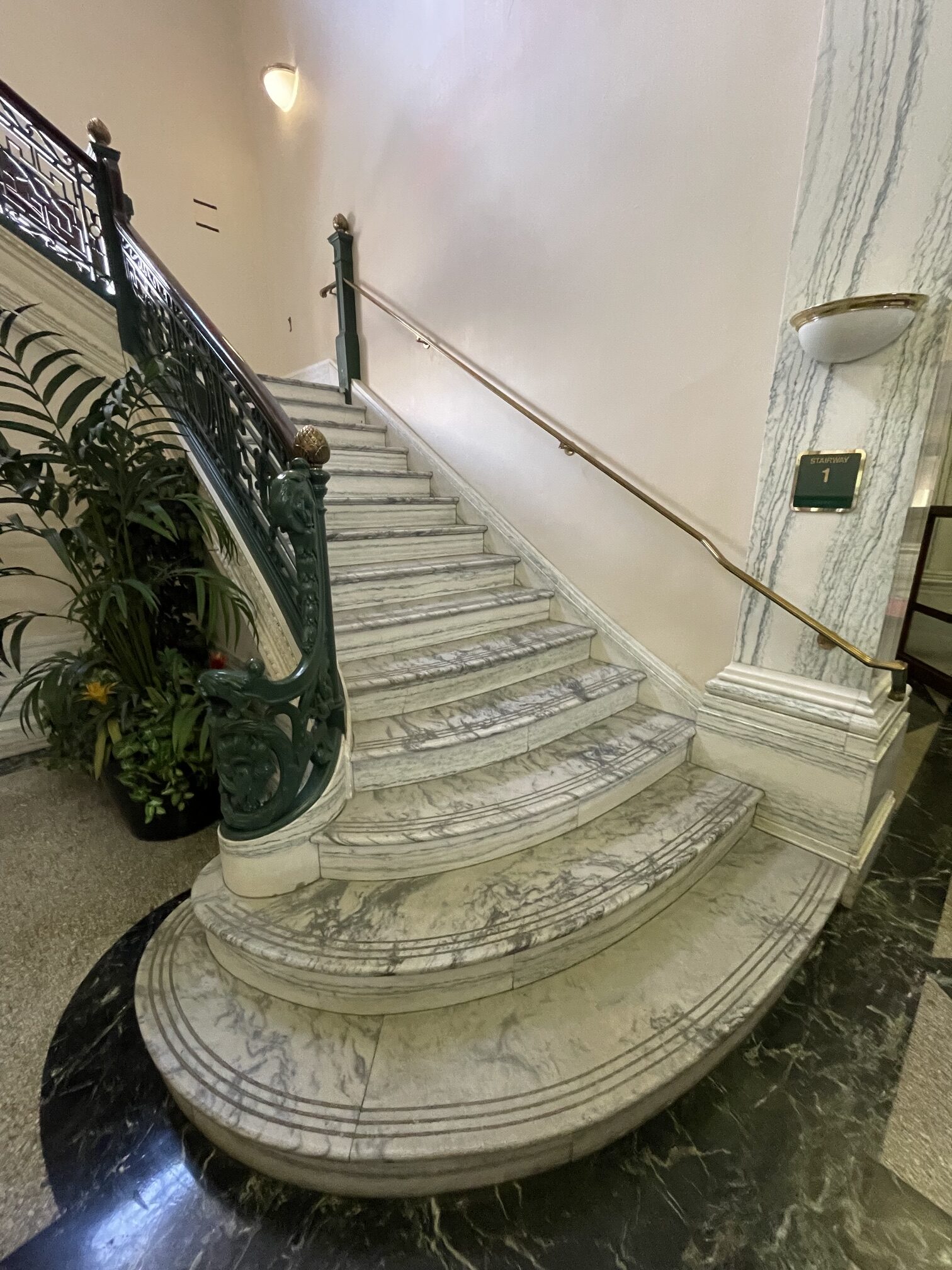
On the first floor, one can’t help but notice the impressive marble stairs to the second and third floors of the building. The first few steps of the stairs are beautifully curved. They are complemented by an intricately ornamented metal railing painted in dark green.
The Floors of the Building
The original design of the building included the first, second, and third floors along with an attic and a basement.
Second Floor Offices
The second floor is used for offices and work space. Still intact are the wood floors in the offices with plaster on the walls and ceilings. The corridor floors have terrazzo and marble borders.
Originally, the second floor even included a railway mail service dormitory, toilet, and shower in the northwest corner. The dormitory was used by mail clerks who would get in on late trains. After the mail clerks finished work, they could sleep in the building as well as take a shower.
In addition, originally there was office space for the Customs Collector, Internal Revenue Service, Postal Service, and the Land Office.
Third Floor U.S. Bankruptcy Court
The third floor has also contained an arrangement of offices and corridors similar to that of the second floor. Originally, the offices were occupied by the Weather Bureau, the District Attorney, and the Marshal and Deputy Marshal. The Marshal’s office also contained a holding cell. There were also Witness and Jury rooms, Office of the Clerk of Court, Grand Jury room, Judge’s chambers and a library.
What distinguishes the third floor from the other floors is the U.S. Bankruptcy Court with its oval domed ceiling. The court handles bankruptcy cases east of the Cascades in Washington State.
The Beautiful Oval Domed Ceiling Uncovered that was Previously Hidden
During the building renovation and restoration that was done in 1994, a hidden oval domed ceiling was discovered above the courtroom and brought back to life. It had been covered over with the installation of a gray-suspended acoustical ceiling and the skylight was painted black during WWII. Painting the skylight black was consistent with the blackout policies prevalent at the time.
With the restoration work done in 1994, the original courtroom detailed features including the Ionic columns and decorative plasterwork, stained oak rails, benches, and desks were preserved.
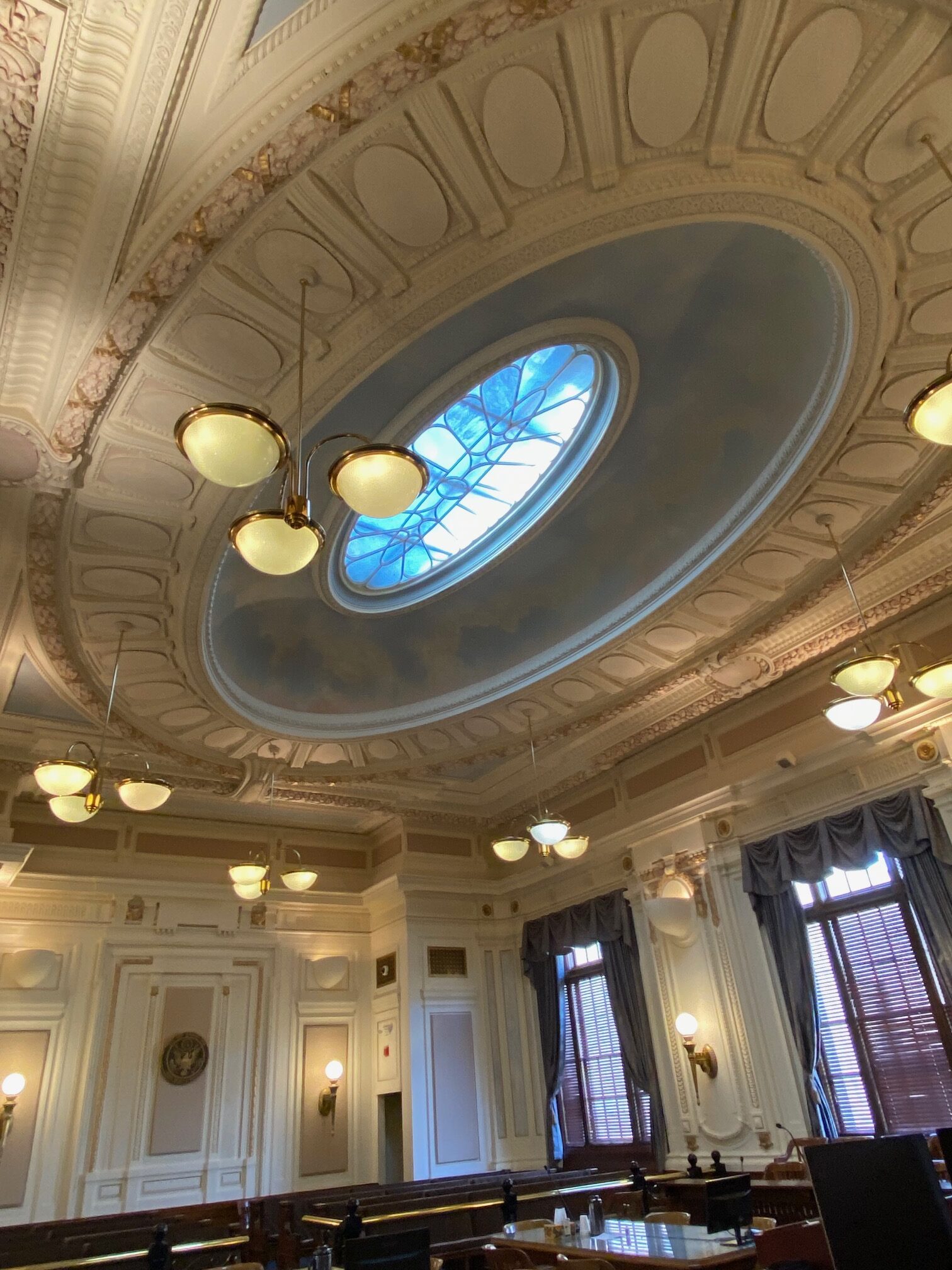
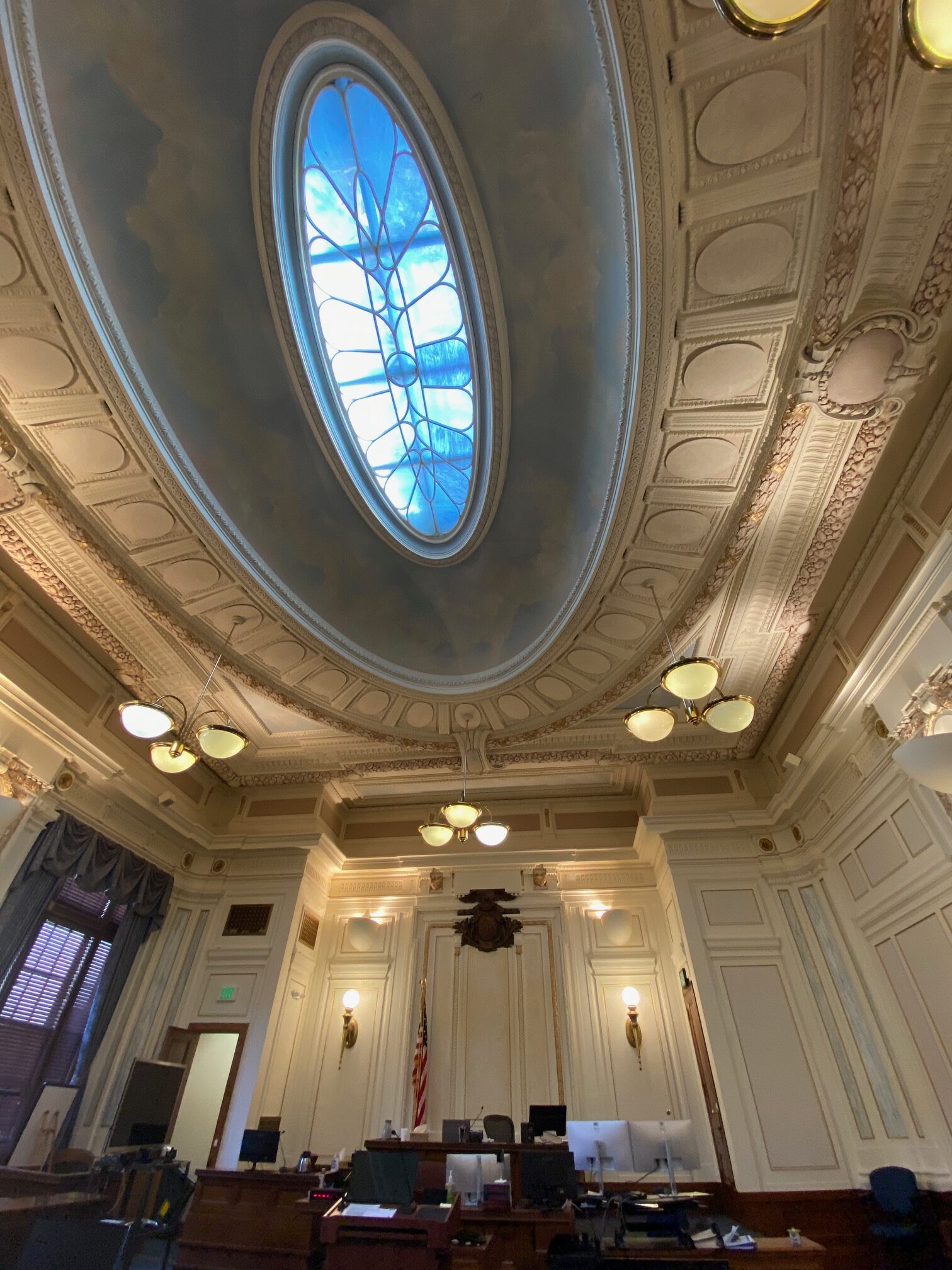
The oval domed ceiling is made of ornamental cast plaster with a translucent glass skylight in a metal frame. The courtroom woodwork is dark-stained oak. The dividing rail is made of brass tubing with a wrought iron gate mounted on square ornamental cast iron posts. The courtroom doors are covered in pigskin with brass tacks and oval beveled plate glass windows.
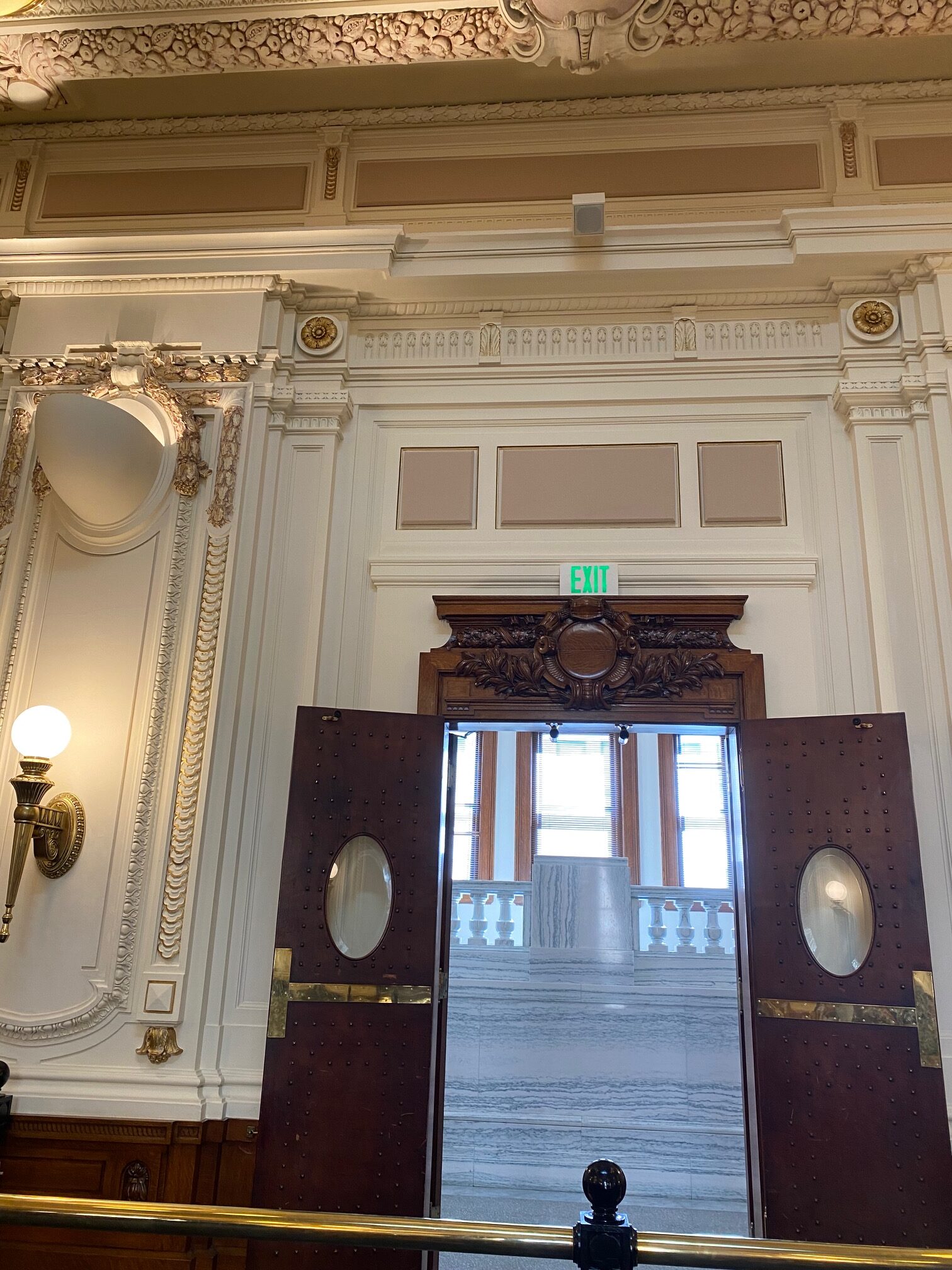
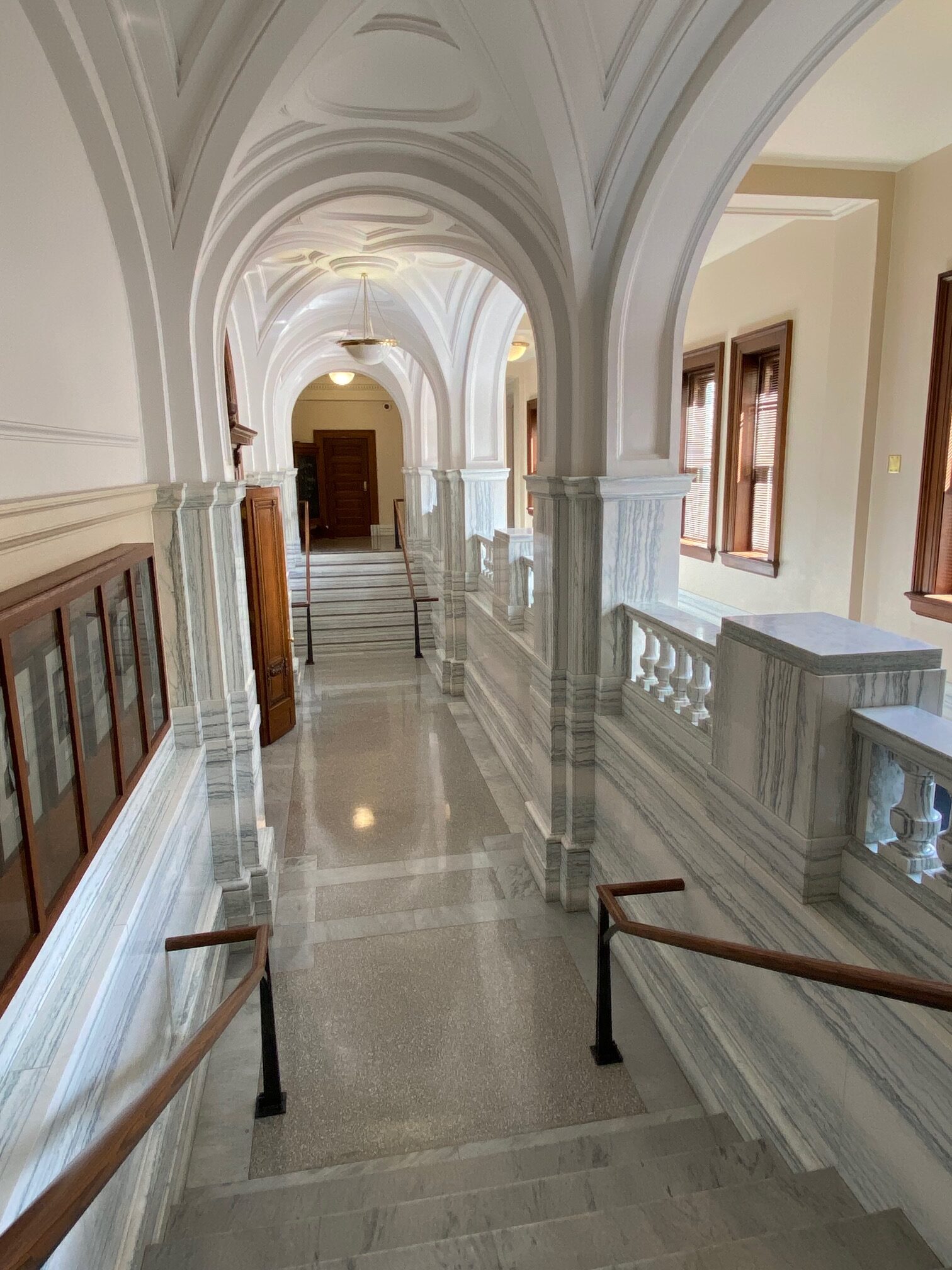
The courtroom lobby floor is terrazzo with marble borders. Marble is also on the moldings, wainscoting, and columns. The walls, arches, and the ceiling are of ornamental plaster.
Attic Space
The attic contains the upper part of the courtroom oval domed ceiling, the elevator shaft, and stair landing.
Basement Use
Originally, the basement was used for storage rooms, an engineer’s room, a mail room, the offices of the Superintendent of Mails, and a “swing room” also known as the breakroom and the toilet for mail carriers. The north end of the basement—actually at ground level due to the slope of the earth—opened onto a recessed mailing platform and driveway. Similar first floor finishes were used for the breakroom and the Office of the Superintendent of Mails. The basement is being used in a similar manner today as in the past.
U.S. Post Office, Courthouse, and Custom House Ranked Second Best in 1966
In 1966, the building was ranked second in the Pacific Northwest region of Washington, Oregon, Montana, Idaho, and Alaska in efficient utilization of manpower. The recognition was based on the volume of mail processed by local postal employees in an environment of high employee morale and low turnover.
Thomas S. Foley United States Courthouse Opened Next Door in 1967
The Thomas S. Foley United States Courthouse was built next door and opened in 1967. The U.S. Post Office, Courthouse, and Custom House came to be known as the Federal Building and U.S. Post Office. The two buildings are connected by a second-level enclosed skywalk.
The Federal Building and U.S. Post Office Added to the National Register of Historic Places in 1983
In 1983, the building was approved to be added to the National Register of Historic Places. The explanation provided in support of the nomination emphasized the Federal Building and U.S. Post Office is at the heart of the busy Central Business District, Riverfront Park, and the Civic Center. Spokane is not only a commercial center but a cultural center as well.
Although it is overshadowed in height by the adjacent United States Courthouse, the Federal Building and U.S. Post Office commands attention by virtue of the outstanding quality of its design, detailing, and building materials. Because of this, few works of formal architecture of substantial quality can be found between Spokane, Portland, and Seattle. The building’s history as the first major work of federal architecture in the Inland Empire was also indicated on the nomination form.
As a result of the many attributes listed on the form, the building was approved on October 26, 1983, to be added to the list of the National Register of Historic Places.
Two Year Renovation Completed in 1994 for $7.7 Million
Renovation was needed for the Federal Building and U.S. Post Office in order to preserve its heritage and use. The renovation was approved in the late 1980s. The building was one of the few turn-of-the-century Treasury Department designs in the Northwest.
The renovation plans had been debated for at least 20 years. The upper floors were largely abandoned in the late 1960s and 1970s after the United States Courthouse was built next door.
Most of the changes to the building that were done in the renovation are not visible from the street or postal lobby. The major transformations were in the building’s mechanical workings and revamped federal offices upstairs.
In addition to the U.S. Bankruptcy Courtroom restoration, the renovation also modernized the building. The updating was done to meet the fire codes and handicap access laws, removed asbestos, replaced sprinklers, and added new heating, ventilation, and air conditioning systems.
Honors Bestowed
In 2004, the building won The Office Building of the Year Award in the historic category by the Building Owners and Managers Association Northwest Region.
In 2009, Rebecca Nielsen, Historic Preservation Specialist for the U.S. General Services Administration, stated the building is ranked among the best of nearly two dozen historic federal buildings in Washington, Oregon, Idaho, and Alaska.
Closing Remarks
Since 1909, the solid and stately Spokane Federal Building and U.S. Post Office has stood proudly at the corner of W. Riverside Avenue and N. Lincoln Street.
The building provides an elegant presence for the federal government’s business activities including Postal Service, a U.S. Bankruptcy Court, and other federal agencies. The historic lobby and mailbox areas are open to the public during business hours. There is also access to the upper floors by going through security screening during business hours.
The Federal Building and U.S. Post Office is truly a historical gem and definitely worth a visit.
Sources
- U.S. Post Office, Courthouse, and Custom House – Spokane, WA – U.S. National Register of Historic Places on Waymarking.com, accessed April 2, 2026 (https://www.waymarking.com/waymarks/WMJQRV_US_Post_Office_Courthouse_and_Custom_House_Spokane_WA);
- “Spokane’s New Federal Building to be Occupied Today”, The Spokesman-Review, September 6, 1909, page 1, accessed April 2, 2026 (https://spokesman.newspapers.com/image/566302378/?match=1&terms=Federal%20Building);
- Mike Prager, “Downtown Post Office Marks 100 Years”, October 5, 2009, page B1, The Spokesman-Review, accessed April 2, 2026 (https://spokesman.newspapers.com/image/579275152/?terms=United%20States%20Post%20Office); page A6 accessed April 2, 2026 (https://spokesman.newspapers.com/image/579275289/?terms=Downtown%20post%20office);
- “Keeping U.S. Mails on Time, Spokane Terminal Building and Railway Mail Clerks Serve 1500 Miles”, The Spokesman-Review, February 23, 1941, page 45, accessed April 2, 2026 (https://spokesman.newspapers.com/image/567659761/?match=1&terms=Great%20Northern%20Railroad);
- Hope Kimbrough, “Postal Services and Express Aid Santa Claus” and “Railway Mail Service and Express Play Roles”, December 22, 1940, The Spokesman-Review, page 78, accessed April 2, 2026 (https://spokesman.newspapers.com/image/567697558/?match=1&terms=mail%20);
- “Spokane Post Office Said Second Best in the Northwest”, The Spokesman-Review, May 29, 1966, page 1, accessed April 2, 2026 (https://spokesman.newspapers.com/image/569858332/?match=1&terms=Spokane%20post%20office%20);
- Jim Lynch, “Post Office Renovation $1 Million Over Budget”, The Spokesman-Review, July 25, 1993, page 1, accessed April 2, 2026 (https://spokesman.newspapers.com/image/574158069/?match=1&terms=Spokane%20post%20office%20renovation); page A15: (https://spokesman.newspapers.com/image/574155836/?match=1&terms=architect%20for%20Spokane%20post%20office%20renovation);
- Spokane Post Office Celebrates 100 Years of Service 1872 to 1972, U.S. Post Office Department, U.S. Mail, brochure, Spokane Public Library, Northwest Room;
- Senate Calendar No. 281, Senate Report 256 by the Committee on Public Buildings and Grounds, submitted January 29, 1902, Spokane Public Library, Northwest Room;
- Historic Property Report, Mid-Century Spokane, September 18, 2017, accessed April 2, 2026 (HistoricProperty);
- Move 14 US Offices Today, The Spokesman-Review, June 16, 1941 page 20;
- “Philip is Shown Need of Post Office Space”, The Spokesman-Review, August 2, 1930, page 3;
- Wikipedia, United States Post Office, Courthouse, and Custom House, accessed April 2, 2026 (https://en.wikipedia.org/wiki/United_States_Post_Office,_Courthouse,_and_Custom_House(Spokane,_Washington);
- U.S. General Services Administration (GSA) Federal Building/USPO, Spokane, Washington, accessed April 4, 2026 (https://www.gsa.gov/real-estate/find-a-historic-federal-building/federal-buildinguspo-spokane-wa);
- National Register of Historic Places Inventory – Nomination Form, HistoricSpokane.org, Spokane City/County Historic Preservation office, accessed April 1, 2026 (https://properties.historicspokane.org/property/?PropertyID=2019); Nomination PDF (https://properties.historicspokane.org/_pdf/properties/property-2019.pdf).
Image Sources
- U.S. Post Office, Courthouse, and Custom House, 904 W. Riverside Avenue, Christmas Time, 1941, Northwest Museum of Arts & Culture/Eastern Washington State Historical Society, Charles Libby, L87-1.22070-41;
- U.S. Post Office, Courthouse, and Custom House with overhead lines and streetcar tracks in foreground, 904 W. Riverside Avenue, 1922, Northwest Museum of Arts & Culture/Eastern Washington State Historical Society, Frank Guilbert, L95-111.153;
- U.S. Post Office, Courthouse, and Custom House, 1915, looking east on W. Riverside Avenue with Streetcars and The Spokesman-Review Building in the Foreground, Northwest Museum of Arts & Culture/Eastern Washington State Historical Society, Charles Libby, L87-1.11583X-15;
- U.S. Post Office, Courthouse, and Custom House, 1930, Entrance with Views Facing East on Riverside Avenue with Streetcar Tracks and Parade of Ford Automobiles in 1930, Northwest Museum of Arts & Culture/Eastern Washington State Historical Society, Charles Libby, L87-1.42599-30;
- U.S. Post Office, Courthouse, and Custom House loading dock on W. Main Avenue, 1940, Northwest Museum of Arts & Culture/Eastern Washington State Historical Society, Charles Libby, L87-1.18771-40;
- U.S. Post Office, Courthouse, and Custom House, construction of new addition,1940, Northwest Museum of Arts & Culture/Eastern Washington State Historical Society, Charles Libby, L87-1.19589-40;
- U.S. Post Office, Courthouse, and Custom House after completion of new addition, 1941, Northwest Museum of Arts & Culture/Eastern Washington State Historical Society, Charles Libby, L87-1.20091-41;
- Street View of the Federal Building and U.S. Post Office at the Corner of W. Riverside Avenue and S. Lincoln Street, author’s image;
- 904 W. Riverside Avenue Main Entrance with Revolving Doors and Terrazzo Floors with Marble Borders, author’s image;
- 904 W. Riverside Avenue Main Entrance Showing Revolving Doors and Ornamental Plaster Ceiling with Terrazzo Floors with Marble Borders, author’s image;
- 904 W. Riverside Avenue Main Entrance with Ledges in Alcove for Writing at End of Hall on Left Side, author’s image;
- S. Lincoln Street Entrance with Revolving Door and Directory on Side Wall, author’s image;
- Sign for Letter Drops, Stamps, Parcel Post, and Money Orders, author’s image;
- Federal Building and U.S. Post Office Small Mailboxes with Eagle Emblem, author’s image;
- Federal Building and U.S. Post Office Large Mailbox with Eagle Emblem, author’s image;
- Federal Building and U.S. Post Office Polished Brass Mailboxes, author’s image,
- Federal Building and U.S. Post Office First Floor Marble Stairs with Metal Railings to Upper Levels, author’s image;
- U.S. Bankruptcy Courtroom on Third Floor of Federal Building and U.S. Post Office with Public Seating Area, author’s image;
- Front of U.S. Bankruptcy Courtroom, author’s image;
- U.S. Bankruptcy Courtroom Entrance with Pigskin Doors, author’s image;
- U.S. Bankruptcy Courtroom Lobby, author’s image.