
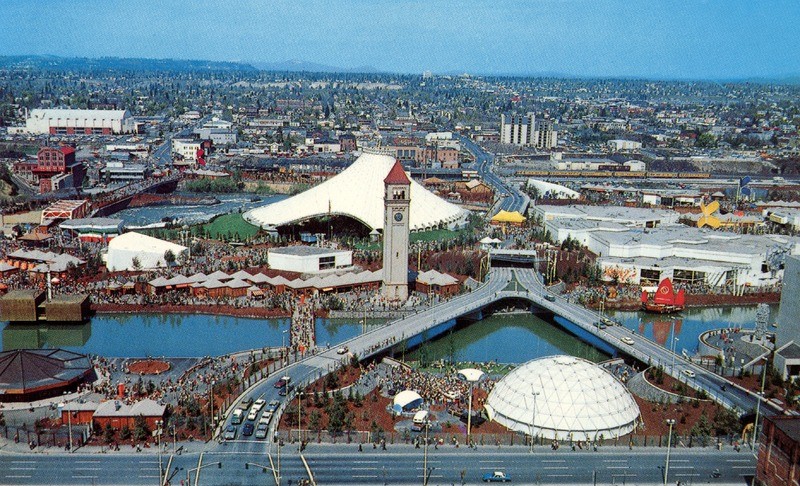
It’s hard to imagine Spokane without the 160-foot clock tower which is a prominent fixture on the skyline and was the Great Northern Depot’s most outstanding feature. It was kept as a reminder during Expo ’74 and afterwards of the part that the railroads played in Spokane’s history. It is also a reminder of the two railroad depots which held a commanding and competing presence in Spokane during the first half of the twentieth century.
Early Area History of What Became Riverfront Park
The area which became Riverfront Park grew throughout the 1880s becoming a bustling commercial and residential neighborhood with hotels, shops, a red-light district and Chinatown. Factories and expanding industrial production provided opportunities for jobs for the residents. The fire of 1889 drastically changed the landscape by leveling multiple blocks. With the help of investors, the downtown and the area along the Spokane River was able to fully recover.
In the early 1900s, many of the most influential buildings constructed in the Riverfront Park area were built when the area reached its height of occupancy. The construction in 1902 of the Great Northern Depot with its iconic clock tower and railroad tracks was the beginning of the golden era of rail transport in Spokane.
During the 1910s, several of the early cabins and residences on Havermale Island were moved to make way for the construction of factories and large industrial operations as technology and commerce continued to evolve.
The construction of the Union Pacific Depot in 1914 radically changed the area along the south bank of the river across from the Great Northern Depot. The four blocks along Front Street where Riverfront Park is today were leveled for construction of the depot and the elevated tracks which were dimly lit underneath. The residents and businesses in the four-block area had to relocate to make way for the large structure and tracks.
The City of Spokane has long been guided by civic leaders seeking to preserve the natural beauty of the striking local geography in city planning efforts. The earliest leaders embraced the Progressive Era’s City Beautiful movement.
In 1913, the landscape architecture design firm, the Olmstead Brothers, produced a report which recommended creating a public park at the Spokane River falls. They compared the future park to New York’s Riverside Park along the Hudson River and envisioned what they referred to as “Gorge Park” noting the falls was a tremendous feature of the landscape and one which is rarer in a large city”. They predicted that one day Spokane would decide to reclaim the area for the park from commercial development on the banks of the Spokane River.
The area used for Expo ’74 changed and evolved with the times over the years. Even before the fair was even thought of, there was movement of residents and businesses to make way for new development.
The Need for Downtown Revitalization Identified
In 1959, a group of downtown business and property owners started an organization called Spokane Unlimited with the goal of revitalizing Spokane’s downtown. The downtown was facing problems like many cities across the nation. Stores were moving out to the malls and people were moving to the suburbs.
Spokane Unlimited was helped by large downtown businesses to raise enough money to commission an urban renewal plan from EBASCO Services Inc, a New York consulting firm. Their 1961 report called for removing the train trestles and elevated tracks and opening up the Spokane River and Havermale Island as integral parts of downtown. The report advocated recapturing the beauty and attractiveness of the central business district’s natural setting.

At the time of the EBASCO report, the concept of a world’s fair was beyond anyone’s imagination as well as how to accomplish restoring the natural beauty of the location. The firm recommended passing general obligation bonds, a gas-tax increase, and acquiring federal urban renewal money. However, those ideas were defeated in bond issues in 1962 and 1963.
In 1963, the leaders of Spokane Unlimited hired King Cole who was an executive with urban renewal and planning experience. His goal was to turn the EBASCO plan into reality. He recognized voters were unwilling to be dictated to by downtown money interests. He created a citizen’s group, Associations for a Better Community (ABC), as a grass-roots partner to Spokane Unlimited. As the 1960s progressed, the community began to come to agreement on riverfront beautification where the railroads were and turning the area into the open public space envisioned in the Olmstead Brothers’ 1913 report.
The Idea of a World’s Fair in Spokane Was Born
The citizens of Spokane had been thinking about holding a celebration to commemorate the centennial of its founding in 1873 and that perhaps it could finance the riverfront restoration. Spokane Unlimited commissioned a feasibility study from the Economics Research Associates (ERA). The report findings showed it would not be a good use of money for a strictly local centennial celebration. The recommendation was to think about an international exposition so that the city could get federal and state dollars and attract visitors from all over the world with the goal of a completely transformed riverfront.
Thus, the idea of Spokane having a world’s fair as Seattle had in 1962 was born. Members of Spokane Unlimited became excited about having a world’s fair in which they thought the theme should be the environment. The theme reflected the rising attention in the 1970s to ecological matters and the exhibits staged would give expression to environmental issues.
The area was ideal for a fair with a spectacular waterfall running through its middle. The intention was to reclaim the site’s natural beauty with a theme of “celebrating tomorrow’s fresh new environment” and to provide greater public awareness of man’s true relationship to his environment.

The ERA was also commissioned to do a further study on the economics and logistics of an exposition after a positive response from the Bureau of International Expositions in Paris which governed such events. The results of the second report issued in September 1970 reinforced the idea that a world’s fair would solve the city’s urban renewal problem and recapture the natural setting of the falls.
Financing the World’s Fair
A tax was voted for on September 20, 1971 with support from the Chamber of Commerce and downtown businesses which were solidly committed to supporting Expo ’74. The tax raised the necessary $5.7 million to make it possible. Additional monies were also raised for the fair.
The Challenge of Fitting a World’s Fair Into a Small Area

Spokane was the smallest city ever to hold a world exposition. The compact number of acres available for the fair was a small amount of space in which to fit the state, national, and corporate entries as well as the 10 participating international countries with their exhibits, food, and shopping.
A controversy arose around the removal of the Great Northern and Union Pacific Depots, as their space was needed for the fair. The “Save Our Stations” (SOS) campaign was brought by concerned citizens who worked with the Spokane Ad Club to produce a billboard and transit campaign to save the depots. The outcome was the decision in 1971 to save the Great Northern Clock Tower in recognition of the part the railroads played in Spokane’s history helping build the city it is today. The support that was generated also weighed in the decision to save it.
The depots and elevated tracks were taken down to make way for the Expo ’74 planned locations of the International Bazar where the Great Northern Depot was and the Ford Pavilion where the Union Pacific Depot was.
Focus on the Future
The Great Northern clock tower has a special significance to me, as my grandfather, Cornelius McGillicuddy, was the Station Master of the Great Northern Depot from 1940 to 1968. He was not only the Station Master but he was also involved in numerous business interests in Spokane. He focused on the future economic development of Spokane and would have supported the decision to tear down the Great Northern and Union Pacific depots. He would have acknowledged times had changed with the consolidation of the railroads and rerouting rail traffic and would have supported the gift of the land for Expo ’74.
Thus, history continued to repeat itself in the movement of occupants from the area of the fair site in the 1910s, 1920s, and in the 1970s. Residents and businesses were forced to move and relocate as Spokane grew. In the 1970s, there was movement again as buildings and the railroad depots with their tracks had to be torn down to make way for Expo ’74.
Transformation from a World’s Fair Into a Park
After the fair, work began on transforming the site in keeping with the environmental theme of creating a public park the Olmstead Brothers envisioned. The new Riverfront Park was dedicated by President Jimmy Carter in 1978.

After more than 100 years since it was built and over 50 years since it was saved, the Great Northern Clock Tower is still one of the most recognizable icons on the Spokane skyline. It is a reminder of the city’s railroad heritage, as the Riverfront Park grows and evolves with the community.
Sources
- “The 1970s: The World Visits Spokane”, Historic Preservation Office, website accessed October 25, 2021 (https://www.historicspokane.org/riverfront-park-history-1970).
- “The 1910s: Growth of a Modern Spokane”, website accessed October 25, 2021 (https://www.historicspokane.org/riverfront-park-history-1910).
- “The 1960s: A Time of Change”, website accessed October 25, 2021 (https://www.historicspokane.org/riverfront-park-history-1960).
- Doug Clark, “The Railroad Man”, The Spokesman-Review, May 1, 2014, page a1.
- “Save the Depot”, The Spokesman-Review, November 8, 1971, page 5.
- Frank Bartel, “Depot, Bridges Donated by BN”, Spokane Daily Chronicle, May 12, 1971, page 22.
- “Father Laid Union Depot Floor”, The Spokesman-Review, March 11, 1972, page 5.
- Tom Burnett, “2 Spokane Depots Favored”, The Spokesman-Review, May 20, 1972, page 6.
- Joel Ream, “Union Depot Plan Pushed”, The Spokesman-Review, November 24, 1971, page 6.
- Fred Leeson, “Preservation Fight Poses Tough Problems”, The Spokesman-Review, August 6, 1972, page 19.
- “Depot’s Raising Starts Soon”, The Spokesman-Review, January 31, 1973, page 6.
- Jim Humphrey, “Spokane Almost Leveled Clock Tower”, accessed October 15, 2021 (https://my.spokanecity.org/news/stories/2021/10/15/Spokane-almost-leveled-clock-tower/).
- Spokane Riverfront Park Historic Property Inventory of Pre-1975 Resources, Spokane, Washington, February 22, 2016, CH2MHill Engineers, riverfrontparknow.com, accessed December 29, 2021 (https://dahp.wa.gov/sites/default/files/Spokane%20Riverfront%20HPI%20Report_Expo74.pdf).
- Jerry Wigen, “City Council Rejects Pleas on Stations”, The Spokesman-Review, July 18, 1972, page 11.
- “The 1880s: Early Settlement & Pioneer Life”, Historic Preservation Office, website accessed September 8, 2021 (https://www.historicspokane.org/riverfront-park-history-1880).
- Jim Kershner, “Expo ’74: Spokane World’s Fair”, Historylink.org Essay, accessed May 28, 2014 (https://www.historylink.org/file/10791).
Image Sources
- Middle and Upper falls showing the Spokane River, Howard Street, and surrounding lumber mills and bridges, 1900-1905, Northwest Museum of Arts & Culture/Eastern Washington State Historical Society, Charles Libby Collection, L87-1.132.
- The Legacy of Expo ’74 and Riverfront Park, Spokane Parks and Playgrounds, Riverfront Park (#22), 1976, Spokane Public Library, accessed December 16, 2025, https://lange.spokanelibrary.org/items/show/2822.
- Aerial Pre Expo ’74 Grounds Showing GN and UP Depot Footprints, 1971, Northwest Museum of Arts & Culture/Eastern Washington State Historical Society, Charles Libby Collection, L87-1.71-1308A-4.
- Expo ’74 Aerial View from Helicopter, Spokane Public Library, Northwest Room, accessed February 20, 2026 (https://lange.spokanelibrary.org/items/show/5269).
- Save Our Station (S.O.S), Great Northern Clock Tower, 1971, The Spokesman-Review
- The Great Northern train station surrounded by train trellises in 1971, The Spokesman-Review Photo Archive, May 24, 2021, page c1.