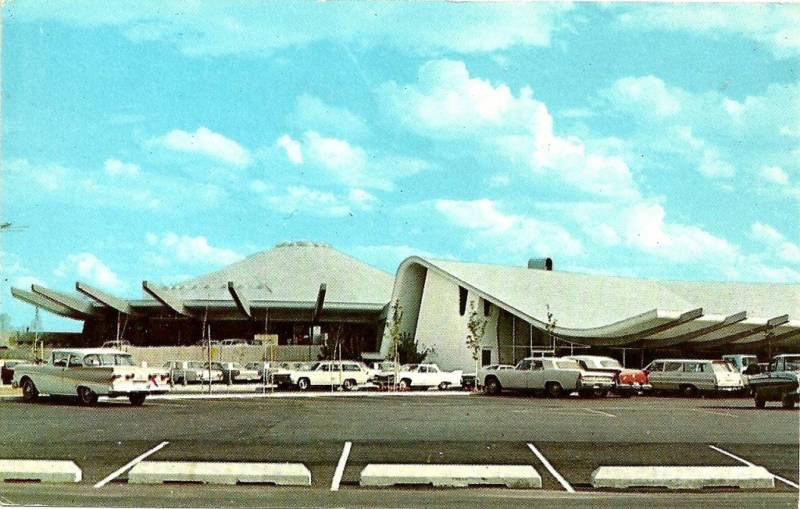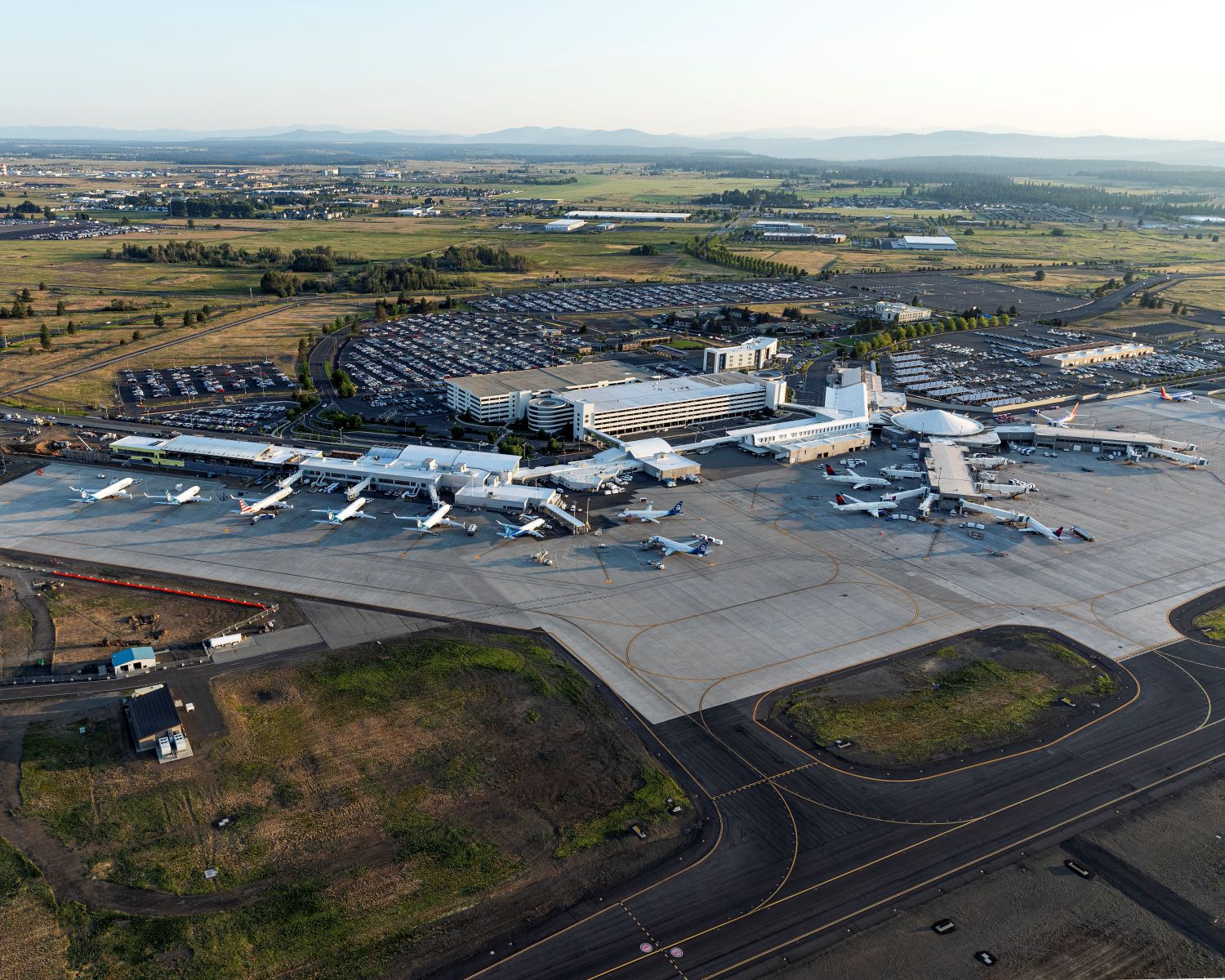
In passing through the Spokane International Airport, you cannot help but notice it’s unique design. What is also interesting to note is that it is on land that has evolved over many years.
Historic Ground
The area of the present-day Spokane airport was once occupied by ancestors of the Spokane Tribe of Indians for at least the past 11,000 years. They lived a semi-nomadic lifestyle through hunting, fishing, and gathering.
With the coming of the railroad in the late 1800’s, homesteaders arrived and the small community of Hayford developed. Some of the nearly 100-year-old homes are still located southwest of the airport boundary.
Airport Wanted
In April 1936, the army began evaluation for an air base near Spokane. It would be an airport capable of all-weather use under conditions of reduced visibility with safe approaches from such directions as wind rose may prove necessary. Wind rose is a weather bureau method of computing wind direction and speed in the immediate vicinity of an airport. The consensus was that Felts Field could not meet the general requirements needed for all-weather use due to its layout and surrounding obstacles.
On December 18, 1937, Earl C. Popp, Representative at the Bureau of Air Commerce in Portland, Oregon, advised “Felts Field should be kept in condition satisfactory for use of airline equipment until a better airport is provided”. Northwest Airlines reported loose gravel at Felts Field was damaging their aircraft and believed Spokane was warranted in taking measures as would prove necessary to accomplish a satisfactory runway.
Felts Field also proved undesirable because of its hills immediately to the north for fear of planes crashing into them and the weather was better in the Sunset site area west of Spokane. Felts Field could not be used for the larger DC4 size planes and the even larger aircraft that would be built by transcontinental airlines in the future.
The concern was that unless another airport was built, Spokane would be left off transcontinental routes. At that time, “blind flying” by means of radio beams was the newest aviation development. It was only a question of time before transcontinental lines would take over and Spokane would need to have an airport suitable for blind flying.
The Bureau of Air Commerce also required that such a field have no obstructions for at least two miles square and for greater safety it should be larger. Harold G. Jones, Chairman of the Chamber of Aviation Committee, indicated the larger aircraft could not come into the present Spokane field. Louis Wasmer, Chairman of the Advisory Council, called for the immediate need of a “super-airport”.
In 1937, Colonel Sumpter Smith, Principal Engineer for the Federal Works Progress Administration, commented that five years ago Felts Field was an “A-1 airport” of outstanding prominence in the United States. He went on to say Felts Field had gone backward and aviation had gone forward. The new type of airline transports could not use fields that were less than approximately a mile square and free from hazard. He commended Spokane for its “far-sightedness” in seeking out an airport to meet future requirements.
Colonel Smith and his team were inspecting airports throughout the United States. Sixteen airports throughout the country had been checked off the list because of conditions surrounding their fields. He said it is regrettable that communities have invested so much money in airports only to find them inadequate because of the present and coming type of equipment.
In 1938, The Bureau of Air Commerce officials working with the Aviation Committee of the Chamber of Commerce proposed three sites for another airport which included the general area of the Sunset Highway-Cheney junction (about nine miles west from Spokane), Five Mile prairie, and Deer Park. The criteria for selection included: a site clear of obstructions, weather, and distance from Spokane.
Later in 1938, those same organizations selected the site near the Sunset Highway-Cheney Junction as the best of the three proposed airport locations. Plans called for an actual landing area one mile square around which an additional mile of land would be included as a prevention against construction of any hazards to instrument landings. Also, it was announced at that time by the Aeronautic Division of the Works Progress Administration (WPA) that airport construction was a very important part of the new program. The timing was good for Spokane to get a super-airport with the backing support of the government.
With the war in Europe in 1939, the discussion shifted from just a new super-airport for commercial aircraft for landing to a discussion of an air corps base.
In 1940, it was made clear by the War Department to the Spokane City Council that there were no plans for converting Felts Field into an air corps base. Felts Field would continue to serve an important need for the National Guard air corps and private flying organizations as well as student training.
From Sunset Field to Geiger Field
The focus for the future was on the Sunset Highway-Cheney junction area. It was a natural location and would play an important part in the national defense system. With that site in mind, railway companies had conducted surveys in preparation for them to link to it such as the Great Northern Railroad. James A. Ford, Executive Secretary of the Chamber of Commerce, advised Spokane County should take immediate steps to secure more land for Sunset Field to include a new road from Spokane to it.
Mr. Ford was just one of many civic leaders who saw Spokane not only as a natural air base center but as the strategic terminal for communications and transportation to and from Alaska. He had made several trips to Washington D.C. where he worked with military officials for establishment of Army air force units in Spokane.
In August 1940, the US government announced that it was proceeding with the development of a major air base west of Spokane. Construction began in October 1940. It was known as Sunset Field which comprised 6,140 acres.
Sunset Field was purchased from Spokane County by the War Department on June 25, 1941. Official notification was given of the renaming from Sunset Field to Geiger Field which was designated the principal base with Fort George Wright and Felts Field designated as sub-bases.

The renaming to Geiger Field was for Major Harold Geiger, an Army aviation pioneer, who died in a crash in 1927. The name of Geiger Field was one of the recommendations submitted by Major General John F. Curry, Commander of the Second Air Force. Major Geiger was a classmate of General Curry at West Point. Both men graduated from the military academy in 1908.
There was a policy at the time of naming Army air bases in honor of Army aviators who had lost their lives in the performance of duty. According to General Curry, there was no such officer from Spokane nor in the northwest who met that criterion.
Earlier, there had been some discussion of naming the field in honor of Major Jack Fancher who lost his life in a premature bomb explosion in Wenatchee or Lieutenant Nick Mamer killed in a Northwest Airlines crash. Both served overseas during the war and made aviation history in the northwest.
However, officers at Fort Wright pointed out that at the time of his death Major Fancher was a National Guard officer and Lieutenant Mamer was engaged in piloting a commercial airplane and they didn’t qualify. Another name which won considerable local support was that of Lieutenant Henry B. Twohy, a Naval aviator, who lost his life in a collision of two planes over Boeing Field in November 1937. Comments from air corps officers, however, indicated it was extremely unlikely the Army board in Washington D.C. would consider the name of a Navy flyer for an Army air field.
County Engineer Griggs expressed that with all due respect to Major Geiger, he felt the name should have remained Sunset Field and doubted if the major had ever been to Washington state.
However, the name of Geiger Field would continue to be used until the name of the airport was changed to the Spokane International Airport in 1960.
During World War II, Geiger Field was a training base for the Second Air Force as a group training airfield for Boeing B-17 Flying Fortress heavy bombardment units. Geiger Field was also used by the Air Technical Service Command as an aircraft maintenance and supply depot.

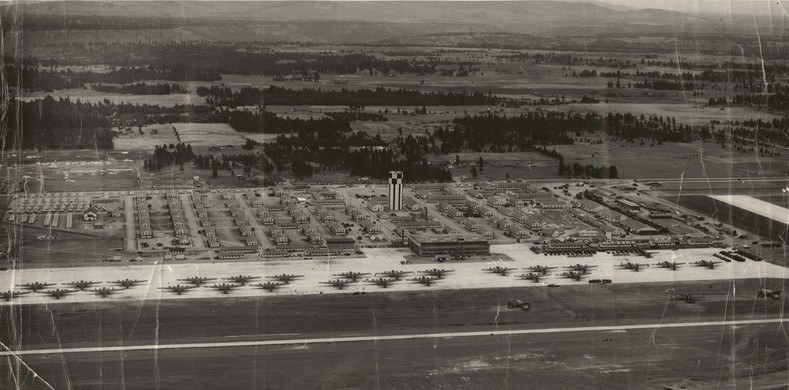
After the end of World War II in 1945, Geiger Field closed and was turned over to the War Assets Administration. The War Assets Administration was created to dispose of US government owned surplus material and property from the war.
Geiger Field was then transferred to Spokane County and developed into a commercial airport. United and Northwest Airlines began operations at Geiger Field on July 22, 1946.
The Navy activated an air base at Geiger Field in 1948 for the purpose of training reserve enlisted personnel and officers for the Navy and the Marine Corps. Orders were issued by the Department of the Navy for decommissioning of the facility on June 30, 1956.
During the Cold War, the government reopened it as the Geiger Air Force Base under the Air Defense Command (ADC) which operated from 1953 to 1963.

Geiger Field was used by the Air Force with the 84th Fighter Group operating Convair F-106 Delta Dart interceptors for air defense of Hanford Nuclear Reservation and Grand Coulee Dam. The base continued to operate alongside civilian commercial aviation. ADC moved to McCord Air Force Base in Tacoma in 1963.

Geiger Field Becomes Spokane International Airport
In 1960, the airport name became the Spokane International Airport after the City of Spokane was allotted Geiger Field by the Surplus Property Act. It was a law that provided for the disposal of surplus government property. The International Air Transport Association (IATA) geographic code of “GEG” in honor of Major Geiger was retained and is still in use to this day.
Also at that time, Air Canada started service to Calgary based on an approved extension of airline service between Spokane and Calgary.
A change in status to an international airport brought with it new areas of importance to be addressed which included the need for customs, immigration, mail, and freight facilities which resulted in the need for a new airport terminal.
New Airport Design
The approach to building a new airport terminal involved careful and sound planning to ensure the citizens of Spokane would accept the design to have a modern airport the whole community deserved. The terminal is a unique building classified in the category of Mid-Century Modern which was popular in the 1960s.
It was designed by Warren C. Heylman and William Henry Trogdon. They were the named architects in 1961 for the terminal building, field improvement, landscaping, and interior decorating.
Mr. Heylman was particularly known for his Neo-Expressionist architecture which included the airport as well as other Spokane projects such as: Sacred Heart Catholic Church at 219 E. Rockwood Boulevard; the Salvation Army Headquarters and Community Center at 2223 E. Nora Avenue; the IBM building at 799 S. Stevens Street; and the Parkade at 511 W. Main Avenue. He designed more than 20 homes and several apartment and commercial buildings which were hallmark examples of the Mid-Century Modern architectural style.
Neo-Expressionism generally reflects the reinvention of pre-World War II Expressionism in the mid-twentieth century or post-World War II era. It is often seen in religious and public buildings from that period.
The airport terminal was designed featuring exposed concrete as well as distinct sculpted, monolithic architectural shapes and forms. A dramatic visual statement and soaring forms are key characteristics with sweeping and curved wall surfaces and rooflines, the bold use of geometric forms (often with faceted, concave, or convex surfaces) and arched or vaulted spaces. The new terminal has been recognized for its architecture and design as part of the “Nifty from the Last Fifty” Washington State Historic Inventory.

Dedication of New Airport

The $4.6 million airport was dedicated on May 8, 1965. More than 200 guests attended the opening which included Senators Warren Magnuson and Henry Jackson, Mayor Neal Fosseen, Congressman Thomas Foley, and Civil Aeronautics Board Chairman, Alan Boyd.
There was an afternoon reception in an upper lounge of the terminal hosted by Northwest, United, West Coast Airlines, and Canada Pacific Airlines. The reception was followed by a dinner at the Davenport Hotel honoring Jerrie Mock from Columbus, Ohio, who was the first woman to fly solo around the world. She became a lecturer and television personality. Jerrie was an expert on trans-world aviation providing testimonials for products from 20 companies.
There were flattering comments given by dignitaries who attended the dedication such as “this structure’s design will be copied by many future terminal builders”, “this terminal can be just the beginning of a big complex”. However, Chairman Alan Boyd asked in his dedication speech, “did you build this aesthetically striking and highly functional terminal big enough?”
Airport Terminal Growth Through the Years
Initially, the airport terminal had two concourses, A and B, that formed a hub and spoke facility which were linked by a central rotunda area with dining and shopping. They are still in use today and have been expanded incrementally over the years to meet the needs of increased travelers.


As passenger volumes grew, the airport needed to expand to meet demand and they looked to the local Spokane firm of Bernardo-Wills Architects (Gary Bernardo and Bob Wills) to design Concourse C. Bob Wills worked for Warren C. Heylman and Associates, the architects who designed Concourses A and B. Warren was Bob’s mentor.

Bernardo-Wills has designed numerous projects in addition to Concourse C including the Davenport Tower, the North Bank Playground at Riverfront Park, and eight to 10 projects at Fairchild Air Force Base. The architectural firm celebrated their 30th anniversary in 2021.
In 1998, ground was broken for Concourse C to add 80,000 square feet to the concourse area including a new baggage claim, a two-story passenger facility and ticketing area. The new concourse was connected to Concourses A and B via a long corridor.
The Bernardo-Wills firm also designed the skybridge connecting the parking garage to the airport. Concourse C was opened in 2000 as a result of over a $20 million redevelopment and expansion project.
Interior renovations in the mid-2000s replaced many of the Concourse A and B original sculpted forms and monolithic materials with more rectilinear forms and contemporary finish materials. However, many original architectural elements remain integral to the space such as the exposed concrete roof trusses and concrete columns placed next to each other for comparison and contrast between the newer elements.
In November 2006, a project called the Terminal, Rotunda, and Concourse C Enhancement Project (TRACE) was completed by Bernardo/Wills Architects. Retail space and expanded security checkpoints in the airport’s three concourses were added along with an aesthetic renovation to the rotunda.
Concourse C has a more contemporary architectural style with metal cladding and large curtain window walls on the exterior of the building. It does draw inspiration from the Neo-Expressionist 1960’s A and B Concourses by also architecturally expressing a modular, repetitive, and exposed structural grid through the outside front of the building and the interior lobby areas.
The airport covers 6,140 acres and operates two paved runways (Runway 3/21: 11,002 ft x 150 ft asphalt/concrete; Runway 8/26: 8,199 ft x 150 ft asphalt). In 2010, 2,000 feet were added to Runway 3-21 and parallel taxiways ‘A’ and ‘G’ to enable heavier aircraft departures in the summer months.
Also in 2010, a new control tower south of the airport replaced the one near Concourse C. It is the tallest one in Washington state and it is believed to be the only one named for a person. The honor was given to Ray Daves. He was a radioman who survived Pearl Harbor and Midway and went on to serve as an air traffic controller in Spokane until the 1970s.
Further Airport Expansion through TREX
The Spokane International Airport (also known as SIA) continues to remain financially self-sufficient facilitating the further expansion of Concourse C through the Terminal Renovation and Expansion (TREX) program.
SIA is owned by Spokane County and the City of Spokane. It is governed by the Spokane Airport Board which includes representatives of both municipalities. This level of control has allowed it to operate sustainably without extra funding from either municipality. The bulk of the revenue comes from system users, grants, and other revenue streams rather than general fund tax dollars.
In October 2022, the airport broke ground on the first phase of the project. The first portion of the expanded concourse which includes three gates at the west end and six new ticketing counters was completed in May 2024.

The second phase of the TREX program will be focused on a centralized Transportation Security Administration (TSA) screening checkpoint and baggage claim as well as an improved operations center. This centralized connection will allow easier navigation between Concourses A, B, and C. Other projects planned in the TREX program include relocation of the rental car facilities and renovation of Concourses A and B.
Continued Growth in the Future
The Spokane International Airport has served the area for over 75 years. It is an important transportation hub and economic engine for Spokane as well as much of Eastern Washington, North Idaho, and parts of Montana and Canada. The airport provides both non-stop and connecting service to airports across the United States, Canada, and internationally. It has both the available land and infrastructure to support growth in the region for the foreseeable future.
The airport expansion projects will allow it to capitalize on and accommodate growing passenger and cargo traffic. It will also enable Spokane to continue to be a viable competitor for hosting future events and for attracting businesses to the area.
Sources
- “Airport’s Name Honors Geiger”, Spokane Daily Chronicle, June 11, 1941, page 3.
- “Move from Fort to Geiger Field”, The Spokesman-Review, June 25, 1941, page 6.
- “Griggs Discusses Sunset Airport”, Spokane Daily Chronicle, January 17, 1939, page 5.
- “Felts Field Out as Army Air Base”, Spokane Daily Chronicle, October 24, 1940, page 3.
- “Tentative Plan Calls for Landing Field Mile Square”, Spokane Daily Chronicle, May 3, 1938, page 27.
- “Hope Day Will Serve for Preliminary Survey”, Spokane Daily Chronicle, November 24, 1937, page 3.
- “Spokane Needs Better Airport”, The Spokesman-Review, October 23, 1937, page 5.
- “Asks City Keep Up Felts Field”, The Spokesman-Review, December 18, 1937, page 7.
- “Airport Needs Given Hearing”, The Spokesman-Review, August 27, 1938, page 6.
- Spokane Chamber of Commerce, letter from L.W. Markham, General Manager, to Honorable James E. Murray, Senator, March 2, 1956, from the Northwest Museum of Arts & Culture/Eastern Washington State Historical Society.
- “Geiger Lawn Party is Social Highlight”, Spokane Daily Chronicle, May 11, 1963, page 20.
- “Navy Changes Geiger Status”, Spokane Daily Chronicle, June 30, 1956, page 13.
- “Navy’s Friends Rally to Help”, The Spokesman-Review, March 3, 1956, page 6.
- “Much Heavy WPA Construction in Spokane, The Spokesman-Review, January 4, 1942, page 59.
- “Geiger’s Fast Interceptors Protecting Area and Nation”, The Spokesman-Review, January 6, 1963, page 6.
- “Remove 3,000,000 Cubic Yards of Dirt to Make Geiger Field Base”, The Spokesman-Review, August 31, 1941, page 70.
- Jerry J. Hopkins, “History of Geiger Field’s Development”, Fall Quarter 1963, Northwest Museum of Arts & Culture/Eastern Washington State Historical Society, pages 7–28.
- “National Guard Problem Solved by Geiger Field”, Spokane Daily Chronicle, March 15, 1948, page 3.
- “Idaho Air Chief Proud of Pilots’ Flying Records”, Spokane Daily Chronicle, January 2, 1948, page 3.
- “Huge New Field Here, CAA Goal, May Be 5-Mile”, Spokane Daily Chronicle, June 21, 1941, page 1.
- “Geiger Runway Near Completion”, Spokane Daily Chronicle, June 27, 1941, page 5.
- “Will Transfer Troops to New Flying Field”, Spokane Daily Chronicle, June 30, 1941, page 5.
- “Agree on Rents at Felts Field”, The Spokesman-Review, December 18, 1937, page 6.
- Tim Clouser, “Spokane International Airport Remains Self-Sufficient with $215M Budget for 2025”, The Center Square, October 28, 2024 (https://www.thecentersquare.com).
- Spokane City/County Historic Preservation Office, Spokane Mid-20th Century Architectural Survey Report; Historic Spokane site (https://www.historicspokane.org/), (http://midcenturyspokane.org/wp-content/uploads/2017/10/MCM_Survey_082417.pdf), pages 6, 23, 38, and 40.
- Spokane International Airport (GEG) Master Plan 2014, (https://business.spokaneairports.net/airport-master-plan/), Chapter 1 page 17, 19, 42; Chapter 3 pages 5, 12, 37–39.
- Dylan Steele, “The Evolution of Sunset Field,” Spokane Historical, accessed February 21, 2025, https://spokanehistorical.org/items/show/870.
- GEG TREX, Spokane International Airport (https://gegtrex.com/what-is-trex/).
- “Sunset Payroll May Be Million”, The Spokesman-Review, July 28, 1940, page 6.
- “Geiger Gets Going”, Spokane Daily Chronicle, July 22, 1946, page 11.
- “Prophets in their Own Country”, Spokane Daily Chronicle, June 11, 1941, page 4.
- “County Waives Geiger Rights”, The Spokesman-Review, March 20, 1947, page 1.
- Associated Press, “Rename Sunset Geiger Field”, The Spokesman-Review, June 11, 1941, page 1.
- “New Super-Airport Boasts the Highest Possible Rating”, Spokane Daily Chronicle, February 18, 1939, page 3.
- Amy Edelen, “Design for Success, The Spokesman-Review, June 27, 2021, page 1.
- “Flight Memories Linger”, Spokane Daily Chronicle, May 8, 1965, page 5.
- “City Airport Name Now International”, The Spokesman-Review, March 31, 1960, page 7.
- “New Needs of Airport to Be Eyed”, The Spokesman-Review, April 3, 1960, page 23.
- “Careful Airport Planning Needed”, The Spokesman-Review, August 5, 1961, page 4.
- “Port Contractor Takes Out Permit”, The Spokesman-Review, August 28, 1963, page 6.
- “New Airline Terminal Seen as Investment for Future”, Spokane Daily Chronicle, May 7, 1965, page 41.
- “Contract, Consultants for Airport Approved”, The Spokesman-Review, September 28, 1961, page 7.
- “Airport Job to Begin Soon”, Spokane Daily Chronicle, February 13, 1963, page 1.
Image Sources
- Geiger Field and Spokane International Airport, 1964, Northwest Museum of Arts & Culture/Eastern Washington State Historical Society, Charles Libby, L87-1.1975-64.
- Picture of Major Harold Geiger from The Spokane Daily Chronicle, June 14, 1941, page 1.
- Geiger Field Army Air Forces postcard “Greetings from Geiger Field”, circa 1945, Wikipedia article on the Spokane International Airport: (https://en.wikipedia.org/wiki/Spokane_International_Airport).
- Geiger Field during World War II served as a training base for new B-17 Bomber crews in 1940; picture from the Northwest Museum of Arts & Culture/Eastern Washington State Historical Society, Charles Libby Collection, L2003-21.1.
- Geiger Field Aerial View 1962, Northwest Museum of Arts & Culture/Eastern Washington State Historical Society, Charles Libby Collection, L87-1.194-62.
- Geiger Field F-106 Fighter Planes from “The Evolution of Sunset Field” article by Dylan Steele in the Spokane Historical photo: The Evolution of Sunset Field – How the United States Military Repurposed Spokane’s Airfield | Spokane Historical. The photo is of the aircraft and crew taken in 1963 right before the 84th Fighter group was deactivated. The aircraft are F-106s which is a fighter designed for interception missions in any weather conditions. Image courtesy of fortwiki.com.
- Spokane International Airport opening in 1965; picture from the Northwest Museum of Arts & Culture/Eastern Washington State Historical Society, Charles Libby Collection, L87-1.1099-65.
- Airport picture from 1965 outside of terminal from HistoricSpokane.org, courtesy of Michael Houser, accessed January 1, 2026 (https://www.historicspokane.org/HeritageTours/images/modern/Tour%207.jpg).
- Spokane International Airport inside of terminal rotunda passenger waiting area in 1966 from the Northwest Museum of Arts & Culture/Eastern Washington State Historical Society, Charles Libby Collection, L2003-14.916.
- Airport picture from 1965 of inside terminal showing a central rotunda area linking the A and B Concourses from the Historic Spokane site (https://www.historicspokane.org/), Spokane City/County Historic Preservation Office, 2017 Mid-Century Survey Report with picture on page 6 of the document: MCM_Survey_082417.indd. Spokane International Airport Warren Cummings Heylman & William Trogdon, 1965 photograph courtesy of helveticka.
- Aerial view of the Spokane International Airport in 1979 from the Northwest Museum of Arts & Culture/Eastern Washington State Historical Society, Charles Libby Collection, L87-1.79-905E-1.
- Spokane International Airport showing Concourses A and B along with the view in 2025 showing the development of Concourse C on the left side of the picture. Spokane International Airport picture reflecting the Terminal Renovation and Expansion (TREX) program (https://gegtrex.com/what-is-trex/); SIA Aerial 1.jpg (1500×1200).