
Through Andrew Carnegie’s generosity, 14 free libraries were built in Eastern and Central Washington. There were four in Spokane (Downtown, North Monroe, Heath, and East Side), as well as in Ritzville, Wenatchee, Pasco, Walla Walla, North Yakima, Sunnyside, Clarkston, Prosser, Ellensburg, and Goldendale. They are the focus of this article and each has an interesting history.
These libraries are listed in the National Register of Historic Places along with those on the west side of Washington State.
Why did Andrew Carnegie become involved in libraries and what led to his generous funding through grants of them?
Andrew’s Early Life Experiences and Free Libraries

Andrew Carnegie was born in 1835 in Dunfermline, Scotland, and educated at a free school there which had been given as a gift by philanthropist, Adam Rolland.
He came with his family in 1848 to the United States at the age of 12 and settled in Allegheny, Pennsylvania. The family was poor and Andrew became the major breadwinner at the age of 12.
Andrew was a 17-year-old laborer oiling machines at a textile mill in Allegheny, Pennsylvania, when he sought to improve himself by visiting the local library. However, the library required a “subscription” be paid of $2 to get in. Andrew sent a letter to the library administrator to request access but was denied. He was told only apprentices and unemployed men were allowed access. Andrew then sent his letter to The Pittsburgh Dispatch Newspaper administrator to request his help which led to free library privileges for all workers, not just apprentices.
Andrew Carnegie was also able to get free access to books when he was a telegraph messenger boy. He used to borrow books from the personal library of Colonel James Anderson. Colonel Anderson opened his collection to working boys every Saturday to acquire knowledge to improve themselves. Andrew Carnegie was so grateful for this opportunity that he vowed if ever wealth came to him that he would see to it that other poor boys could take advantage of opportunities similar to those he received.
Andrew Carnegie’s Philosophy
Andrew Carnegie believed in giving to the industrious and ambitious who were able to help themselves, not those who needed everything done for them.
He worked his way up from being an immigrant and became wealthy from the help of others. Andrew’s personal experience reinforced his belief in a society based on merit where anyone who worked hard could become successful. That conviction was a major factor in his philosophy of giving in general.
Qualities of a Successful Leader
Andrew Carnegie’s capacity, willingness to work hard, and his perseverance brought him career opportunities. He impressed an executive of the Pennsylvania Railroad Company and was rewarded with a secretary/telegraph operator railroad job in 1853 in which he rose rapidly and became a wealthy executive.
He became involved in various businesses including building bridges and train sleeping cars but decided to focus on iron and steel. In 1886, he was also a writer on the subject of economics. He wrote two books: the Triumphant Democracy in 1886 and The Gospel of Wealth in 1889. In 1889, he also published an essay entitled “Wealth” in the North American Review in June.

Qualification Criteria for Library Grants
Carnegie libraries were built according to “the Carnegie formula” which required financial commitments for maintenance and operation from the town that received the donation.
Andrew Carnegie required the local government to:
- demonstrate the need for a public library;
- provide the building site by having clear title to the land;
- pay staff and maintain the library;
- draw from public funds to run the library—not only use private donations;
- provide 10 percent annually from the cost of the building for operations;
- provide free service to all.
Overall, Washington cities responded enthusiastically and with deep appreciation to Carnegie’s offer of free libraries. However, there was some opposition of cities’ funding for on-going operation and maintenance costs as well as labor union issues.
The amounts of the grants varied widely with more money available for some than others. The most common amount was $10,000 which enabled communities to build large libraries that were among the most significant town amenities. There were no rules on where the libraries should be built. Many of the sites in Washington were a few blocks away from historic central business districts. Andrew Carnegie never visited the libraries in Washington. His only connection was that he paid for them—”approving with only a “nod” for their expenses.
In 1897, Andrew Carnegie hired James Bertram as his personal assistant to field requests from municipalities for funds and overseeing the dispensing of grants for libraries.
When James Bertram received a letter requesting a grant for a library, he sent the applicant a questionnaire inquiring about the town’s population, whether it had any other libraries, how large its book collection was, and what its circulation figures were. If initial requirements were met, Bertram asked the amount the town was willing to pledge for the library’s annual maintenance, whether a site was being provided, and the amount of money already available.
The effects of Andrew Carnegie’s library philanthropy coincided with a peak in new town development and library expansion in the United States. By 1890, many states had begun to take an active role in organizing public libraries, and the new buildings filled a tremendous need. It was also a time of rapid development of institutions of higher learning. Interest in libraries was also heightened at a crucial time in their early development by Carnegie’s high profile and his genuine belief in their importance.
Beginning in 1908, the cities had to submit architectural drawings to James Bertram for approval.
After 1911, the cities had to consider the suggestions and sample layouts provided in a book by James Bertram entitled Notes on Library Buildings. This book reflected the thinking of leading architects of the time on library design.
Architectural Criteria and Styles of the Carnegie Libraries
James Bertram’s architectural criteria included a lecture room, reading rooms for adults and children, a staff room, a centrally located librarian’s desk, twelve-to-fifteen-foot ceilings, and large windows six to seven feet above the floor. No architectural style was recommended for the exterior, nor was it necessary to put Andrew Carnegie’s name on the building. In the interests of efficiency, fireplaces were discouraged since that wall space could be used to house more books. There were no strict requirements about furniture but most of it came from the Library Bureau established by Melvil Dewey in 1888 which sold standardized chairs, tables, catalogs, and bookshelves.

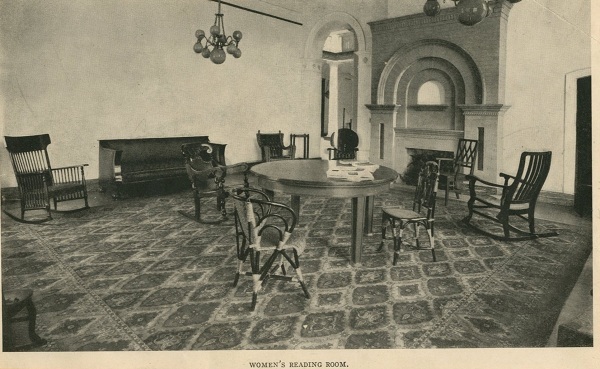


The libraries were constructed in various traditional styles such as Beaux-Arts, Italian Renaissance, Baroque, Classical Revival, and Spanish Colonial. The libraries reflected the predominant styles chosen by the communities to enhance their appearance as public buildings.
Typical Carnegie libraries were two-story buildings with elements of classical architecture such as pediments, columns, and cornices. The styles were often formal and welcomed patrons through a prominent doorway. Brick was the most common material as well as stucco and sandstone. Roof styles varied but low hip roofs were the most common.
The buildings were rectangular with impressive flights of stairs leading from ground level to the second floor entrances. The stairs symbolized a person’s elevation through learning. Also, many featured a lamppost, a lantern, or matching pairs of outdoor lamps near the entrance which were meant as symbols of enlightenment.
The windows and the doors were symmetrically arranged on both sides of the entrances. The windows in the back were often high enough to allow for the placement of bookcases underneath them.
There was natural lighting on the main floors with their high ceilings. The main floors were devoted to adult reading at one end and to children’s books at the other end; the circulation/librarian desks were between the two. The basements were for the mechanical/electrical rooms; staff rooms; men’s and women’s restrooms; and large multi-purpose/lecture rooms.
Access To and Protection of Library Books
Initially, Carnegie libraries followed a “closed stacks” policy which was the method of operation common to libraries at that time. A patron requested a book from a library staffer who would get it from closed stacks off limits to the public and bring it to a delivery desk.
To reduce operating costs, Andrew Carnegie created a revolutionary “open shelf” or “self-service policy” which allowed patrons to have open access to shelves and one librarian could oversee the entire operation.
Theft of books and other items was a major concern. This concern resulted in the placement of the library circulation desks—which replaced the delivery desks used in traditional “closed stacks” libraries—just inside the front doors. The circulation desks spanned almost the width of the lobbies and acted as physical and psychological barriers between the front entrances and the book rooms.
Eastern and Central Washington Carnegie Libraries
The 14 Carnegie libraries east of the Cascades include the following:
- In Eastern Washington, there are the four libraries in Spokane and one in Ritzville;
- In Central Washington, there is a library in Ellensburg and one in Wenatchee;
- In South Central Washington, there are libraries in Goldendale, North Yakima, and Sunnyside;
- In Southeastern Washington, there are libraries in Clarkston, Pasco, Prosser, and Walla Walla.
The Eastern Washington Carnegie Libraries
Spokane
Spokane was fortunate to have four libraries built with grants from Andrew Carnegie.
Spokane’s library history goes back to 1880 when plans for the city’s libraries were drawn. In 1891, a library was established in Spokane’s City Hall. It was financed by a $25 per month dedicated fund and from fines and subsidies collected from library patrons. The library grew but getting to it was difficult, as patrons had to pass by saloons, theaters, gambling halls and even houses of ill repute. Because of this problem, a permanent site on which a library could be built was sought.
Andrew Carnegie initially promised to donate $70,000 for the construction of two permanent branches in Spokane. The Library Board and the City Council disagreed over where the new buildings should be located. A compromise resulted in which the monies would be used for multiple branches which ultimately exceeded the initial donation amount. There was also an offer of $10,000 for a library to be built in Hillyard but the requirements for funding could not be met.
The following are historical summaries of the four Spokane Carnegie libraries that were built:
Downtown Main Branch (10 South Cedar Street)
The library was built in 1904. A gift of the grounds for the library was provided by Amasa B. Campbell. His home—known as the “Campbell House”—is adjacent to the present day Museum of Arts and Culture in Spokane. Mr. Campbell was a wealthy local businessman who made his fortune in mining and business interests.
The library was designed by Preusse and Zittel in the Neoclassical style. It was the first true library structure in the city occupying an entire block at the east end of Browne’s Addition.

It was the most expensive Spokane library built for $85,000 which included a two-story library, a ladies’ reception room (southeast corner), a general reading room (north), administrative offices (northwest), a two-story stack room (west), a study room (southwest corner), and a reference room (west). On the third floor was an assembly room (south) and a children’s reading room (north).
In 1930, an annex was added but the building was too small for library needs and was relocated in 1962. The Intercollegiate School of Nursing then occupied the building until the late 1970s.
After over a decade of vacancy, Integrus Architecture of Spokane renovated the building in the 1990s to serve as the firm’s primary office building. The building is also part of the Riverside Historic District which is listed on the National Register of Historic Places and on the Spokane Register.
The following are the other branches which followed soon thereafter which were established in response to neighborhood requests:
North Monroe Branch (925 W. Montgomery Avenue)
The two-story library was built in 1914. It was designed by Albert Held in the Classical Revival style for $17,500.

It served Spokane until 1967 when it was sold to the local chapter of the Veterans of Foreign Wars. It was then used as a meeting hall, lounge, bingo parlor, law firm, and currently serves the community as a location for the International Rescue Committee. It is listed on the National Register of Historic Places and on the Spokane Register.
Heath Branch (525 East Mission Avenue)
The library was built in 1913. It was designed by Julius Zittel in the Neoclassical style for $35,000 and served the surrounding community for nearly 70 years.

It is also a contributing property in the Mission Avenue Historic District and listed on the National Register of Historic Places and on the Spokane Register. It is currently the location for the Catholic Diocese of Spokane.
East Side Valley Branch (25 South Altamont Street)
The one-story library was built in 1913. It was designed by Albert Held in the Neoclassical style for $17,500.

For 66 years it served the East Central Spokane community and the residents of Spokane Valley. It is listed on the National Register and on the Spokane Register. The building is occupied by Naegeli Deposition and Trial services.
Ritzville
In 1902, Daniel Buchanan, a local farmer and prominent politician, donated over 550 volumes from his personal library to the City of Ritzville. The books were to be used for a free library open to all residents of Adams County, Washington. In 1903, the town allocated $1,000 toward the maintenance of the library.
The local Manhattan Club purchased furniture for $400 and the first librarian, Mr. G. Reicher, was hired for $35 per month. The first reading room and library was located over Mrs. Hallin’s millinery store. Later, donations were sought for a permanent library structure.
By 1906, the citizens of Ritzville asked Andrew Carnegie for help to build a library. He pledged $10,500 toward a permanent full-fledged library if the town secured and maintained a location for it at which they agreed to do. At that time, Ritzville was the smallest town in the United States to receive financial assistance from Andrew Carnegie for a library.
The library was built in 1907 at 302 W. Main Avenue. It was designed by the Spokane architectural firm of Preusse & Zittel and built by Shotz Shuler. It was built with bricks in a Neoclassical style.
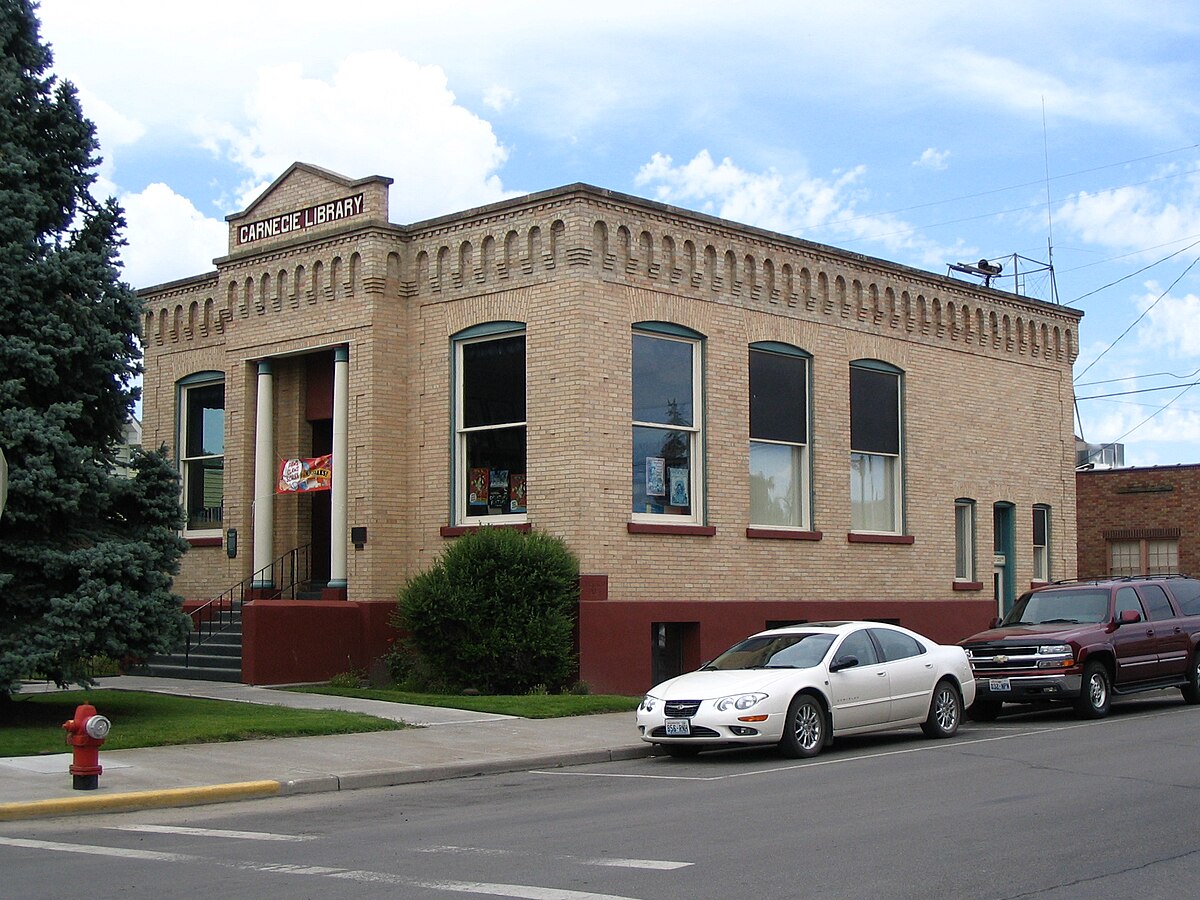
The library still operates and is listed on the National Register of Historic Places. It has undergone several interior restorations to return it to its original appearance. In 2000, the Ritzville Library District #2 was formed to ensure public library services for the areas surrounding Ritzville.
The Central Washington Carnegie Libraries
Ellensburg
The Ellensburg local community supported the need for a free public library. In 1907, local resident, Katherine Murray, sold the property she owned on North Ruby Street to the City of Ellensburg for $1.00 for the library. Her stipulation was there must always be a public library on it or the property would revert to her heirs.
J.H. Morgan, Ellensburg’s mayor, was able to get approval for a $10,000 grant from the Andrew Carnegie Foundation for construction of the library. The local community also had to commit to spending at least $1,000 annually to support the library to which they agreed to do. The library was completed in late 1909. It was designed by S.C. Irwin in a Neoclassical Revival style. The address for the library was 209 N. Ruby Street and was opened on January 20, 1910.

Since most of the budget had been spent paying for the construction of the library, a request was made to the public for donations of books from those who would be attending the opening.
The City of Ellensburg provided funding for the staff and utilities during the first few decades. The library continued to rely heavily on the support of community groups, women’s clubs, and private donations for books and periodicals.
From 1927 to 1934, the library played a very passive role in the life of the community. There were few books, hardly enough coal to heat the building, light for only portions of it, and no money for book binding. Sara L. Ryder, the librarian at the time, embarked on a vigorous publicity campaign to raise the library’s profile in the community. She spoke at local clubs and was in local newspaper articles describing the lack of resources. In May 1935, the Civic Improvement Committee of the Ellensburg Chamber of Commerce agreed to encourage women’s clubs, auxiliaries, lodges, Ellensburg Rodeo’s Boosters, and service clubs to help the library. Through Sara’s efforts, the library’s share of the city budget was increased and enough money was raised for equipment and supplies.
In the period before, during, and after World War II, the library suffered once again from lack of funding. However, that changed in 1949 when a city manager form of government was adopted and the library was made a formal city department which provided it with access to new funding resources. The library was listed on the National Register of Historic Places.
By the early 1960s, it had become apparent the Carnegie library was no longer adequate for modern needs. In 1967, it was demolished and replaced with a new Ellensburg Public Library on the same grounds at 209 N. Ruby Street which opened on June 30, 1968. In addition, in 1983 the Hal Holmes Community Center was also built on the same grounds which opened in September. A walkway between the two buildings was built in 2004.
Wenatchee
Wenatchee’s Carnegie library was built on the grounds of the City’s Memorial Park on land donated by the Wenatchee Development Company. Initially, Judge Thomas Burke, who was president of the Wenatchee Development Company, was against building the library in Memorial Park. A citizens committee was formed which proved to Judge Burke that the contributions made for the construction of the building would not pay for the purchase of another site. Judge Burke finally agreed to sign the deed for the land over to the committee.
The committee then petitioned Andrew Carnegie for $20,000 to build the new library in 1910. Andrew Carnegie offered a grant for $10,000 on the basis that the town was too small for a larger amount. The city was also required to provide $1,000 a year for library maintenance. The committee accepted Andrew Carnegie’s $10,000 grant offer and agreed to the yearly amount of $1,000 for maintenance.
On August 30, 1910, the city council approved the site on Memorial Park land and the building of the library was completed in 1911. The library was built by the architectural firm of Blackwell and Baker in the Italian Renaissance Revival style. Although a smaller structure than many Carnegie library buildings, Wenatchee’s library was constructed of brick with architectural details seen in the central entrance.

In 1911, another committee was appointed by the mayor to purchase books for the library. The library was opened to the public on January 1, 1912, with 1,500 volumes.
The library moved out of the Carnegie building in 1939 to the Neubauer Building. The Carnegie building was then used for a public museum under the sponsorship of the Columbia River Archeological Society. It was called the North Central Washington Museum.
In August 1947, the library was moved again to 18 S. Mission where it remained until it moved to the present building on 310 Douglas Street which opened in 1959. The city has used the Carnegie building for its Community Development Department. The Allied Arts group, a precursor to the City of Wenatchee Parks and Arts Commission, used the basement. The building housed the Wenatchee Valley Chamber of Commerce in the 1980s.
The Carnegie building now houses the Washington State Apple Blossom Festival offices and underwent a major exterior repair to refresh it in 2019 in preparation for the 100th Apple Blossom Festival. The building is located at 2 South Chelan Avenue. It is listed on the National Register of Historic Places and the Wenatchee Register of Historic Places.
The South Central Washington Carnegie Libraries
Goldendale
The Women’s Association of Goldendale raised $800 for a free public library which went for the purchase of three adjoining lots in 1912. The lots were located at 131 West Burgen Street. On October 14, 1912, the Goldendale City Council passed an ordinance agreeing to fund library operations and to maintain the library.
Andrew Carnegie provided an $8,000 grant for the construction of a one-story Colonial style brick building designed by the Portland, Oregon, firm of Doyle and Patterson. The Portland firm of Stebinger Brothers built the library.

On March 1, 1915, the Goldendale Free Public Library opened initiating library service for the residents. However, the collection of books numbered only 400 so a fund was established to purchase additional books.
As the only library in Klickitat County, the Goldendale Free Public Library served patrons far beyond Goldendale. In recognition of that fact, the Klickitat County Commissioners provided the library with grants varying between $200 and $800 per year. Even after the White Salmon Library opened in 1929, the Goldendale Free Public Library served as the unofficial Klickitat County Library.
In 1973, the Goldendale Free Public Library—known then as the Goldendale Community Library—became part of the Fort Vancouver Regional Library system. The Goldendale Free Public Library was annexed to the library system in 1981. This enabled library taxes collected by the city to be paid directly to the library.
The library has undergone renovations to meet the needs of the Goldendale community. The building was remodeled in 1985 and expanded in 2018. However, it had become outdated and inefficient. As of 2025, it has new improved seating, lighting, equipment, and technology which are still in keeping with the historic character of the building. The library is listed on the National Register of Historic Places.
North Yakima
In 1889, the North Yakima chapter of the Young Women’s Christian Temperance Union (YWCTU) opened a reading room attached to a coffee room on First Street, as an alternative to saloons. The YWCTU was a social club devoted to promoting temperance, morality, and social purity. It worked tirelessly to educate individuals about the harmful effects of alcohol and other vices.
Within two years, lack of funding forced the closure of the reading room. In 1891, 128 YWCTU books were used to create a membership-based circulating library proposed by Miss Anna Mattoon and Miss Hattie Sawyer. They formed the North Yakima Library Association to raise money to support and grow the new library.
By 1903, North Yakima received a Carnegie grant of $15,000. In 1904, the North Yakima Public Library was created and the City Commission passed an ordinance for a free public library. In that same year, property was bought for the library at 102 North 3rd Street and construction began. The building was designed by the architectural firm of Bebb and Mendel based on one of six layouts recommended to communities seeking grants from Andrew Carnegie.
It was completed in 1906 and opened on April 26, 1907. Its exterior displayed a Neoclassical style that promoted both function and utility.

The main floor of the library was built of Port Angeles stone and pressed brick and provided 2,133 square feet of space with a full basement below. Like other Carnegie libraries, it had a flight of stairs and a prominent light at the front entry to symbolize elevation and enlightenment through learning. It was added to the National Register of Historic Places.
In 1957, voters passed a bond to raise the necessary funds to build a larger library. The original Yakima Library Carnegie building was demolished in 1957 to make way for the current Yakima Central Library building. It was built on the same site and completed in 1959. In 2012, extensive remodeling was done to accommodate the need for increased space and services.
Sunnyside
In 1910, the City of Sunnyside also received a Carnegie library grant for $5,000. The amount of the grant was generally based on the size of the population to be served.
The Sunnyside Public Library opened in 1911 at 621 Grant Ave. The style of the library reflected the design restrictions for Carnegie library grants. The library was designed by local architect Edward H. Ragland and incorporated a broad overhanging roof, high-vaulted ceilings, and a ventilated cupola which allowed for better temperature control.

The library became affiliated with the Yakima Valley Regional Library system in 1956. The Sunnyside Carnegie Library was added to the National Register of Historic Places.
In 1965, a new library was built on the same site. In 2004, the Sunnyside Library was annexed to the Yakima Valley Rural Library District which became the Yakima Valley Libraries. It was extensively remodeled in 2015.
The Southeastern Washington Carnegie Libraries
Clarkston
In 1905, the Lewiston-Clarkston Improvement Company donated property on the southeast corner of 6th and Chestnut Streets to the City of Clarkston for the purpose of using it for a library. A small, one-room building was erected on the property for the library. However, the building was soon outgrown.
The city requested a grant of $5,000 from Andrew Carnegie but he responded by suggesting they take $10,000 instead. The larger grant required $1,000 per year to be spent on maintenance rather than $500 with the smaller grant amount. The extra expense was thought to be an excessively heavy burden for the tax payers to bear. It was suggested that the tax base be enlarged to include the school districts rather than just the city and Andrew Carnegie agreed. The approval was quite unusual since Andrew Carnegie almost always insisted that his grants be made only to city governments.
On Sept. 13, 1913, the two-story brick building designed by Lewiston, Idaho, architect, James H. Nave, in a restrained uncluttered look with simple formal design elements. It was dedicated and remained in service for almost 80 years.

The Clarkston Carnegie library building was added to the National Register of Historic Places. Although it eventually became too small for the Asotin County Library purposes, it is still in use by the Clarkston School District for career and technical education.
Pasco
The citizens of Pasco wanted a library in their community and their growth made it possible for them to receive a Carnegie grant.
On February 17, 1910, the Pasco City Council voted to buy land for the library from a Walla Walla man who offered it for $1,000. The purchase of the land was in keeping with the stipulation of the grant that a municipality had to own the land the library was to be built on. The city council also agreed to having taxpayer money available for salaries, maintenance, and book purchases.
Andrew Carnegie donated $10,000 for the construction of the library. A two-story Spanish-style building with a terra cotta roof was designed and built offering a main floor for books, magazines and newspapers. The basement was for community activities. The location of the library was at 305 N. Fourth Avenue in downtown Pasco.

On April 5, 1910, the Pasco City Council passed an ordinance officially naming the building the Carnegie Public Library. On June 30, 1911, the library was dedicated which had 1,270 books.
In April 1962, a new Pasco library opened at 1320 W. Hopkins Street replacing the 51-year-old Carnegie library after voters passed a $325,000 bond in 1960 for a replacement library.
The old Carnegie library ultimately fell into disrepair until volunteers representing the Franklin County Historical Society restored it. Today it is one of Pasco’s most historical and noteworthy buildings and serves as the Franklin County Historical Society Museum. It is on the National Register of Historic Places.
Prosser
In 1905, Benton County was created out of the eastern portions of the Yakima and Klickitat Counties. The new town of Prosser was chosen as the county seat.
In 1907, Prosser’s first reading room opened. In 1910, the city’s first library, a Carnegie library, at 902 7th Street was established from a $5,000 grant that was approved in 1909. It was designed in a Neoclassical Revival style by C.D. Walter and built by F.W. Berndt.

There is still a library at the location which is the Prosser Branch of Mid-Columbia Libraries. It is on the National Register of Historic Places and is a contributing property to the Riverside Historic District.
Walla Walla
In 1895 when the Washington legislature authorized cities to establish and maintain libraries by taxation, the Walla Walla Woman’s Reading Club raised $1,000 to accompany a petition to the City Council to implement the law. That culminated in library service in rented rooms.
In 1901, Andrew Carnegie approved a request for $25,000 for a library. In 1903, the council accepted a local gift of a site at 109 South Palouse Street for the library.
The library board commissioned Henry Osterman, a Walla Walla architect, to design the library. His plan was an adaptation of the Herrick Library building in Wellington, Ohio.
The building was made of red pressed brick, the interior finish was mainly in oak, and it was equipped with electric lights and a hot water heater. It was completed in 1905. The Woman’s Reading Club was honored with a meeting room having been built for them; they hosted the dedication reception of the library on December 3, 1905.

The Carnegie library served the community until 1970. The building then became the Carnegie Education Center which is home to the Walla Walla public schools online, Opportunity, and Homelink programs. It is on the National Register of Historic Places.
The Carnegie Legacy
Andrew Carnegie’s libraries became an institutional part of American history. Many of his libraries have survived and stood the test of time. They are great examples of classic architecture.
He also left us with a legacy of learning through free access to books in public libraries which continue to this day. Andrew Carnegie was one of the world’s richest and most generous men and his libraries were one of his best-known expressions of his philanthropy.
Sources
- National Register of Historic Places -Inventory Nomination Form, 1984, HistoricSpokane.org, accessed November 24, 2025 (https://www.historicspokane.org/wp-content/uploads/2016/11/Carnegie-Libraries-of-Washington-State-MPD-1984.pdf); Carnegie Library, Wikipedia, accessed November 24, 2025 (https://en.wikipedia.org/wiki/Carnegie_library); also Carnegie Library, Wikipedia, accessed November 26, 2025 (https://en.wikipedia.org/wiki/Andrew_Carnegie)
- Spokane Main Downtown Branch, 10 South Cedar Street, HistoricSpokane.org., includes a summary and links to the National Register of Historic Places -Nomination form 1984, Spokane Register of Historic Places Nomination Form, and Management Agreement 1992, accessed November 12, 2025 (https://properties.historicspokane.org/property/?PropertyID=1746)
- Spokane North Monroe Branch, 925 W. Montgomery Avenue, HistoricSpokane.org., includes a summary and links to National Register of Historic Places form 1984, Spokane Register of Historic Places Nomination form June 16, 1986, and Management Agreement 1992, accessed November 12, 2025 (https://properties.historicspokane.org/property/?PropertyID=1747); Survey – Inventory form, National Park Service Gallery, August 1981, accessed November 12, 2025 (https://npgallery.nps.gov/GetAsset/592c6d7f-da58-46bf-885d-d6209173635a)
- Spokane East Side Valley Branch, 25 South Altamont Street, HistoricSpokane.org, includes a summary and links to National Register of Historic Places form 1984, Spokane Register of Historic Places Nomination form 2004, and Management Agreement 2004, accessed November 12, 2025 (https://properties.historicspokane.org/property/?PropertyID=1744)
- Spokane Heath Branch, 525 East Mission Avenue, HistoricSpokane.org., includes a summary and links to National Register of Historic Places form 1984, Spokane Register of Historic Places Nomination form 1985, and Management Agreement 1992, accessed November 12, 2025 (https://properties.historicspokane.org/property/?PropertyID=1745)
- Ritzville Branch, 302 West Main Avenue, Wikipedia, Ritzville Carnegie Library, accessed November 19, 2025 (https://en.wikipedia.org/wiki/Ritzville_Carnegie_Library); East Adams Library District, History of the Library, accessed November 19, 2025 (https://www.ritzvillelibrary.org/history-library)
- Wenatchee Branch, 2 South Chelan Avenue, The Clio.com, The Carnegie Library Building, accessed November 19, 2025 (https://theclio.com/entry/109811)
- Pasco Branch, 305 North Fourth Avenue, HistoryLink.org., “Pasco Dedicates Its Carnegie Library on June 30, 1911”, Elizabeth Gibson, posted on September 13, 2005, accessed November 19, 2025 (https://www.historylink.org/File/7465); Tri-Cities Journal of Business, “A town, a dream, a $10,000 donation: How Pasco got its Carnegie library”, Gale Metcalf, June 3, 2024, accessed November 12, 2025 (https://www.tricitiesbusinessnews.com/articles/how-pasco-got-its-carnegie-library)
- Walla Walla Branch, 109 South Palouse Street, HistoryLink.org, “Walla Walla Public Library”, Michael J. Paulus Jr., posted on August 28, 2008, and “Walla Walla Public Library Building is Dedicated on December 13, 1905”, Paula Becker, posted on August 13, 2007, accessed November 12, 2025 (https://www.historylink.org/File/8727); (https://www.historylink.org/File/8254); National Park Gallery, National Park Service, National Register of Historic Places Inventory – Nomination Form, November 20, 1974, accessed November 24, 2025 (https://npgallery.nps.gov/GetAsset/638f9fee-0b91-4093-9506-02cbb7519762); Walla Walla Public Library, accessed November 24, 2025 (https://wwplfund.org)
- Yakima (North Yakima) Branch, 104 North 3rd Street, NWRR Blog Post: 1900s-1910s Carnegie Library Grants, August 22, 2023, accessed November 24, 2025 (https://www.yvl.org/nwrr-blog-post-1900s-1910s-carnegie-library-grants/); Yakima Valley Libraries, accessed November 24, 2025 (https://www.yakima.org/img/pdf/1516.pdf)
- Sunnyside Branch, 621 Grant Avenue, NWRR Blog Post: 1900s-1910s Carnegie Library Grants, August 22, 2023, accessed November 24, 2025 (https://www.yvl.org/nwrr-blog-post-1900s-1910s-carnegie-library-grants/); Yakima Valley Libraries, accessed November 24, 2025 (https://www.yakima.org/img/pdf/1516.pdf); Sunnyside’s Carnegie Library, accessed November 24, 2025 (https://yakimalocalhistory.omeka.net/exhibits/show/carnegie/ss)
- Goldendale Branch, 131 West Burgen Street, Washington Rural Heritage, Klickitat County Heritage, accessed November 24, 2025 (https://www.washingtonruralheritage.org/digital/collection/klickitat/id/21/); HistoryLink.org, “Goldendale Free Public Library, First Public Library in Klickitat County, Opens on March 1, 1915”, Paula Becker, posted on June 3, 2006, accessed November 24, 2025 (https://www.historylink.org/File/7788); Survey Inventory Form 1981, accessed November 24, 2025 (https://s3.amazonaws.com/NARAprodstorage/lz/electronic-records/rg-079/NPS_WA/82004259.pdf; Goldendale Community Library Interior Renovations, accessed November 24, 2025 (https://ffadesign.com/projects/goldendale-community-library-interior-renovations/)
- Ellensburg Branch, 209 North Ruby Street, Washington Rural Heritage – Ellensburg Heritage, accessed November 24, 2025 (https://www.washingtonruralheritage.org/digital/collection/ellensburg/id/1648/rec/1); CWU Libraries ScholarWorks, accessed November 24, 2024 (https://digitalcommons.cwu.edu/ellensburg_history/140/) and (https://digitalcommons.cwu.edu/ellensburg_history/187/); Richard Moreno, Daily Record News.com, “The Story of the ‘People’s Library’: Ellensburg Public Library to Mark Major Milestone”, November 13, 2024, accessed November 24, 2025
- Prosser Branch, 902 7th Street, Washington Rural Heritage – Prosser Heritage Collection, accessed November 24, 2025 (https://www.washingtonruralheritage.org/digital/collection/prosser/id/961/rec/1); Wikipedia, accessed November 17, 2025 (https://en.wikipedia.org/wiki/Prosser,_Washington); HistoryLink.org, Elizabeth Gibson, Prosser-Thumbnail History, posted September 20, 2006, accessed November 17, 2025 (https://www.historylink.org/file/7900); Washington Rural Heritage – Prosser Heritage Collection, accessed November 17, 2025 (https://www.washingtonruralheritage.org/digital/collection/prosser);
- Clarkston Branch, 6th and Chestnut Streets, Wikipedia, accessed November 19, 2025 (https://en.wikipedia.org/wiki/Clarkston_Public_Library); National Park Service Gallery, Survey Form, July 1981, accessed November 19, 2025 (https://npgallery.nps.gov/GetAsset/4d1f3e74-f88e-45ea-bbb5-7416f173cdec)
Image Sources
- Spokane North Monroe Branch: Spokane Public Library, Northwest Room, North Monroe Branch (#11), 1914, accessed November 24, 2025 https://lange.spokanelibrary.org/items/show/2769
- Wikipedia, accessed January 8, 2026 (https://en.wikipedia.org/wiki/Andrew_Carnegie)
- Spokane Downtown Main Branch: Spokane Public Library, Northwest Room, Carnegie Library Exterior Views (#09), 1915/1930, accessed November 12, 2025 (https://lange.spokanelibrary.org/items/show/1561)
- Spokane Heath Branch: Spokane Public Library, Northwest Room, Heath Branch (#02), 1940/1970, accessed November 12, 2025 (https://lange.spokanelibrary.org/items/show/1599)
- Spokane East Side Branch: Spokane Public Library, Northwest Room, East Side Branch (#17), 1966, accessed November 12, 2025 (https://lange.spokanelibrary.org/items/show/1597)
- Ritzville Branch: Wikipedia, accessed November 12, 2025 (https://en.wikipedia.org/wiki/Ritzville_Carnegie_Library)
- Wenatchee Branch: VisitWenatchee.org (https://www.visitwenatchee.org), Instagram image taken May 13, 2025, accessed November 12, 2025 (https://www.instagram.com/p/DJmSZFEOiO6/)
- Pasco Branch: Gale Metcalf, “A town, a dream, a $10,000 donation: How Pasco got its Carnegie Library, Tri-Cities Area Journal of Business, June 3, 2024, accessed November 12, 2025, (https://www.tricitiesbusinessnews.com/articles/how-pasco-got-its-carnegie-library)
- Walla Walla Branch: Spokane Public Library postcard collection, Northwest Room, accessed November 14, 2025, Rogers-Hoswell Co. Publisher, 1900/1910 (https://lange.spokanelibrary.org/items/show/5545)
- Yakima Branch (North Yakima): Spokane Public Library postcard collection, Northwest Room, accessed November 20, 2025, Publisher Lowman & Hanford Co. Seattle, WA, 1906/1918 (https://lange.spokanelibrary.org/items/show/5673)
- Sunnyside Branch (Yakima): Wikipedia accessed November 12, 2025, Postcard of the original Carnegie Library in Sunnyside, WA, published by Wesley Andrews, Inc., Baker City, OR, 1911 (https://en.wikipedia.org/wiki/List_of_Carnegie_libraries_in_Washington_(state))
- Clarkston Branch: Asotin County Library, accessed November 12, 2025 (https://www.asotincountylibrary.org/library-history)
- Prosser Branch: Wikimedia Commons, Creative Commons Attribution-Share Alike 3.0, accessed November 12, 2025 (https://en.wikipedia.org/wiki/List_of_Carnegie_libraries_in_Washington_(state))
- Ellensburg Branch: Digital Commons Central Washington University accessed November 12, 2025 (https://digitalcommons.cwu.edu/ellensburg_history/187/)
- Goldendale Branch: Washington Rural Heritage accessed November 12, 2025 (https://www.washingtonruralheritage.org/digital/collection/klickitat/id/21/)
- Interior Image of Men’s Reading Room, Spokane Public Library postcard collection, 1910/1920, accessed February 5, 2026 (https://lange.spokanelibrary.org/items/show/5301)
- Interior Image of Woman’s Reading Room, Spokane Public Library, Northwest Room; early 1900s; and spokanehistorical.org accessed February 5, 2026 (https://spokanehistorical.org/items/show/278#&gid=1&pid=6)
- Interior Image of Children’s Reading Room, Spokane Public Library, 1929, accessed February 5, 2026 (https://lange.spokanelibrary.org/items/show/1569)
- Interior Image of Cataloging and Reference Rooms, Spokane Public Library, Northwest Room; early 1900s; and spokanehistorical.org accessed February 5, 2026 (https://spokanehistorical.org/items/show/278#&gid=1&pid=5)
- Interior image of Ordering and Cataloging Room, Spokane Public Library, Northwest Room, 1914, accessed February 16, 2026 (https://lange.spokanelibrary.org/items/show/1566)