
While some would think of Spokane’s Parkade as just another parking garage, it has a rather interesting history. It, along with the integrated system of skywalks, represents a mid-century modern design solution to congestion and pedestrian travel.
How the Parkade Came About
In 1961, Spokane Unlimited, Inc., a non-profit organization of business leaders, commissioned Ebasco Services, Inc., a New York consulting firm, to do a privately funded urban renewal study that became known as the Ebasco Plan.
A recommendation from that plan was more parking in downtown Spokane advocating such a garage was one of the first major moves in halting congestion resulting from automobiles. By 1965, automobile makers were producing more than nine million cars a year. These increases gave rise to newly built highways which accelerated the move from downtowns to the suburbs. Civic leaders across the country needed to bring the middle class back to downtown.
King Cole, Executive Secretary of Spokane Unlimited, Inc., pointed out that another “first” was the approach of its sponsors in assembling the land for the Parkade which was a major breakthrough for the central business district. Several pieces of property were combined under long-term ground term leases. Long delays would have resulted if there had to have been negotiations for outright purchase of the various properties, as some of the properties had been in families for several generations.
Philip H. Stanton, President of Spokane Unlimited, stated “creeping blight” had been engulfing many business districts. The Parkade was a way to halt it by making potential income from surrounding properties so that owners couldn’t have afforded to leave them unimproved.
For a project of its size and complexity, the Parkade moved ahead at a very fast pace. Mr. Heylman was told to proceed with the design in March, 1965, and it was opened in March, 1967.
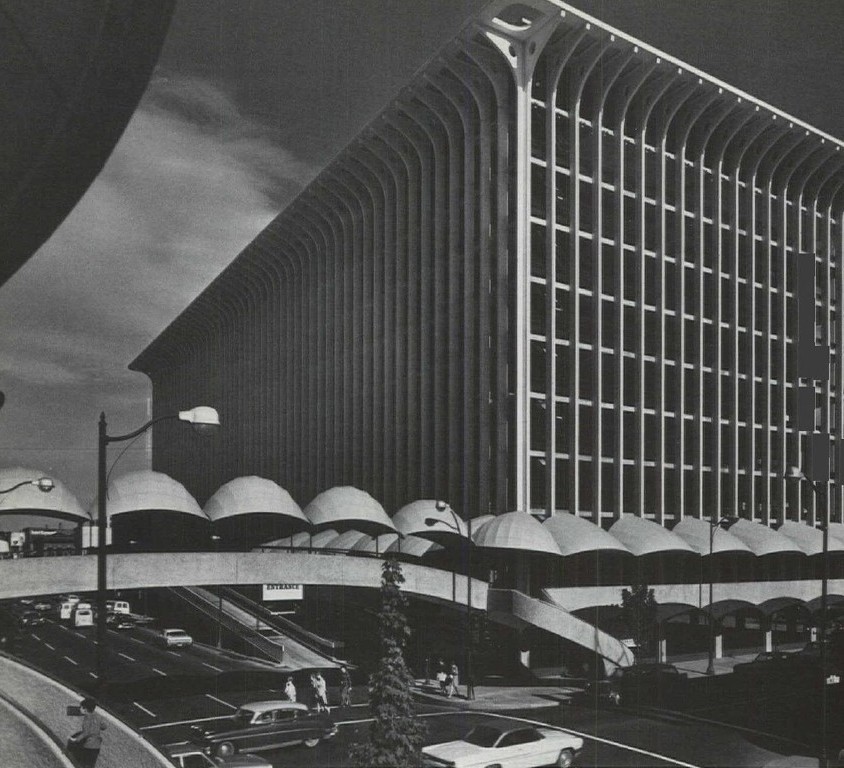
The official grand opening was on May 19, 1967. Philip W. Alexander, then managing director of the adjacent Bon Marche, praised the Parkade as a symbol of new life in Spokane and that it wasn’t just a parking garage. Those financing the project wanted and got a dramatic structure—aesthetic and functional.
Design of the Parkade and Skywalk System
The Parkade was designed by Warren C. Heylman, winner of six American Institute of Architects awards. He designed some very unique buildings that have stood the test of time and still look modern today including the original terminal of the Spokane International Airport, The Spokane Regional Health District building, the Riverfalls Tower on the downtown west end, and the Burlington Northern rail bridge over Hangman Creek.
In designing the Parkade, Mr. Heylman visited 20 cities to observe parking structures.
The Parkade is a 10-story structure located at 511 W. Main Avenue which is notable for its second-level skywalk system that increased its utility as a significant urban feature. The curved awnings over the skywalks echo the arched openings at the base of the building that frame retail uses, as well as the vaulting that supports entrance ramps. Light, long columns in the exterior design were used to create a vertical effect.
It was built with a steel and reinforced concrete frame, a concrete foundation, and a metal roof. The vertical concrete columns that extend outward from the building are visually dominant. It is a New Formalist building which is the name given to an architectural style that emerged in the 1960s and is most often seen in public or civic and commercial architecture. Character-defining features of the New Formalism style can include simple building forms with flat roofs, emphasizing the qualities of concrete, and geometric features that accentuate the roofline.
It has a rectangular footprint and a moderately pitched hip roof with a striking 175-foot-tall sculptured tower. The major function of the tower is the housing mechanism for the passenger elevators. The Parkade sign that rises high above the rear façade serves as a beacon for drivers seeking parking space. There was no platform built for sightseeing from the tower.

The building has a spiral exiting ramp, curved “eaves” punctuated by circular openings, and dramatic lighting at night. Arches create a wide overhang at the top protecting the white outer walls. The overhang offers shielding from rain and snow.


Opening Day May 19, 1967
The following is a description from the grand opening in The Spokesman-Review on May 19, 1967: “picture a charming byway one might see in San Francisco or New Orleans but instead it is in the center of Spokane. A quaint, colorful Plaza unique in all the West, it is nestled below a monumental cliff of gleaming concrete flanked by soaring spirals and topped by a story book tower.
A sparkling fountain mirrors itself in a tiled reflection pool flanked by rows of romantic gas lamps—all of this against a background colonnade of arches. Surrounding the Plaza, fascinating shops display a variety of intriguing wares; nearby a cluster of outdoor café tables—beneath radiant-heated hoods—beckon you for coffee and conversation. It’s a charming spot to meet friends and business associates, dine, or shop with space for 1,000 cars and close to downtown shopping within easy walking distance in the city center”.

Investors in the Parkade wanted an attractive structure which was to visually separate shoppers and their automobiles, shift downtown traffic patterns, and enlarge the tax base of the city’s core area.
Award for Civic Beautification
On July 27, 1967, at the Rotary’s fourth annual award for civic beautification, John G.F. Hieber, President of the Parkade accepted an award on behalf of the other principals from the following downtown businesses financing the Parkade in the $3.5 million private renewal project: the Bon Marche, the Old National Bank of Washington, Fidelity Savings & Loan Association, the First National Bank in Spokane, The Crescent, the Spokane and Eastern Region Branch of Seattle-First National Bank, Hieber Properties, and Deaconess Hospital.
The Parkade’s futuristic design incorporated several new ideas for parking structures. The skywalks that circle the structure on the second level with eight businesses were the first found on a parking center with a roof along with yellow awnings which were a realistic and sensible solution given the climate of the region. The latest in modern technology was used at the time to create an efficient and pleasant environment for pedestrians with striking colors and many attractive shops.
A Network of Skywalks
Over the years, the network of skywalks has developed into an interconnected web of pedestrian bridges, interior hallways, shopping areas, linking to other parking garages, the River Park Square downtown mall, and to public facilities such as City Hall and the downtown main branch public library.
The first segment of the skywalk system was built in 1963 linking the Ridpath Hotel with the Ridpath Motor Inn. The rest are linked together in a network of a 16-block skywalk system criss-crossing the retail and business core making it one of the most notable above-the-street pedestrian pathways in the United States. Much of the system was built in the 1970s and 1980s.

However, Spokane’s skywalks are not on par with the Minneapolis over 80 blocks (9.5 miles) of skyways–as they call them–to protect from the frigid winters there. Spokane’s system has survived and thrived since the initial construction in 1963. Skywalk use over the years has ebbed and flowed.
Perhaps at its best, the skywalk system of the early 1980s allowed shoppers to walk inside between four of downtown Spokane’s “retail heavyweights” at the time: Nordstrom, The Bon Marche, The Crescent, and J.C. Penney. By 2000, the skywalk system catered to the lunch crowd but it didn’t last. In 2005, the skywalk shop vacancy rate climbed to 40 percent. Much of the space was eventually absorbed by offices as downtown underwent an economic turn-around.
Introspection arose about the skywalk system and whether it would remain an asset to downtown given a decline in use and the focus of refilling downtown with people and businesses starting on the street.
Mark Richard, President and CEO of the Downtown Spokane Partnership, acknowledged concerns about online shopping and the need to keep shoppers on the streets but he also noted how the skywalks have offered benefits to the thousands of workers in downtown office buildings many of whom appreciate the convenience the skywalks have provided.

A Master Plan for the Future
In keeping with the change to Spokane’s downtown that has occurred over the past several decades, the city and a variety of stakeholders drafted a new Downtown Master Plan in 2021 which is intended to guide further development to include more public space, art, and emphasis on alternative transportation. The proposal includes eliminating surface parking lots and consolidating parking space to open up land for redevelopment. The Parkade is included in the plan to rehab and enliven downtown.
There has been replacement of two skywalks connecting the old Macy’s building to the system costing $800,000. It is anticipated there will be continued repair and replacement of these key links in the city.
Historic Landmark Status
In 2023, the Parkade was added to the city’s historic register which is a designation that allows for structure preservation for years to come.
The local recognition allows for modest local grants to be available to owners of historic properties for façade improvements. The real incentive comes in a property tax break. Starting in 2025, the ownership group will receive reduced tax bills for a decade to help offset the costs of rehabilitating the historic property. The Parkade had an appraised value of more than $10 million for 2026 taxes but only will be taxed for $1.6 million which is the balance left from subtracting the owners’ rehabilitation costs over the past few years. Spokane County property records include a number of building permits dating back to April, 2021, including concrete and rebar repair, electrical work, and upgrades to the commercial spaces on the ground level.
On October 20, 2025, the Parkade was officially recognized as a significant local historical landmark on Washington’s state registry. Properties receiving state level historic status often reach national recognition as well which is the hope for the future.
For Today and Tomorrow
The Parkade is an iconic fixture on the Spokane sky line and represents one of the first major investments in the city downtown area ahead of the transformations brought about by Expo ’74.
The Parkade together with a skywalk system will continue to evolve now and in the future. They are unique and set Spokane apart from the rest of the country as an example for other cities to emulate.
Sources
- “The Gala Garage”, the American Institute of Architects Journal (AIA), 1968 (https://www.usmodernist.org/AJ/AJ-1968-08.pdf) pages 71-73.
- “Parkade is Attractive Structure”, The Spokesman-Review, March 17, 1967, page 16.
- Parkade Plaza, Wikipedia (https://en.wikipedia.org/wiki/Parkade_Plaza).
- “Parkade Chosen for Club Award”, Spokane Chronicle, July 27, 1967, page 5.
- HistoricSpokane.org, 2017 Mid-Century Survey Report, Spokane Mid-20th Century Architectural Survey Report (https://www.historicspokane.org, MCM_Survey_082417.indd).
- “Cooperation”, Parkade advertisement from the Inland Empire Chapter of the Associated General Contractors, The Spokesman-Review, July 30, 1967, page 93.
- “Spokane’s Skywalks Offer a Retro Experience Linking Much of Downtown”, The Spokesman-Review, December 1, 2021, page d7.
- “Parkade Center to Open Today”, The Spokesman-Review, March 17, 1967, page 14.
- “Today Official Grand Opening Parkade Plaza in the Heart of Exciting Downtown Spokane”, The Spokesman-Review, May 19, 1967, page 15.
- Charles Apple, “Skywalking, Spokane’s Skywalk System”, The Spokesman-Review, December 1, 2021, page d8.
- NonStop Local KHQ, accessed December 31,2025 (https://www.khq.com/news/spokanes-parkade-parking-structure-recognized-as-historic-landmark/article_835f9025-8b79-4fb3-ac06-8b0ae91f95b3.html).
- Nick Gibson, “Getting There: Spokane’s Parkade becomes one of few parking structures on state’s historic register”, The Spokesman-Review, October 20, 2025, accessed December 31, 2025 (https://www.spokesman.com/stories/2025/oct/20/getting-there-spokanes-parkade-becomes-one-of-few-/).
Image Sources
- Spokane Historic Preservation Office, 2017 Mid-Century Modern Survey, historicspokane.org, accessed February 5, 2026 (Mid-Century Spokane)
- “The Gala Garage”, the American Institute of Architects Journal (AIA), 1968, Parkade pictures (https://www.usmodernist.org/AJ/AJ-1968-08.pdf) page 73.
- Leo Kiyohiro, “Parkade”, 1967, Kiro Postcards, Northwest Room, Spokane Public Library, accessed December 31, 2025 (https://lange.spokanelibrary.org/items/show/5131).
- Werner Leggenhager, 1899-1988, Spokane-Buildings-Parkade Spiral Exiting Ramp (#05), 1967, Northwest Room, Spokane Public Library, accessed December 21, 2025 (https://lange.spokanelibrary.org/items/show/1081).
- “The Gala Garage”, the American Institute of Architects Journal (AIA), 1968, Parkade picture showing exit ramp, accessed December 31, 2025 (https://www.usmodernist.org/AJ/AJ-1968-08.pdf) page 73.
- Werner Leggenhager, 1899-198, Parkade Courtyard and Fountain (#06), May 26, 1967, Northwest Room, Spokane Public Library, accessed December 31, 2025 (https://lange.spokanelibrary.org/items/show/1082).
- Molly Quinn, Aerial Map of the Parkade Skywalk System, The Spokesman-Review.
- Wikipedia, Downtown Spokane, Skywalk System image showing the Bennett Block building and yellow awnings; and interior walkway image, accessed December 31, 2025 (https://en.wikipedia.org/wiki/Downtown_Spokane).