
The focus of this article is on the evolution of one roller skating rink in Spokane first run by Silas Cook and then by the Pattison family. The rink ownership dates back to 1941. It has changed over time and has continued to thrive today. That is an impressive record considering the fate of many roller skating rinks over the years.
Silas Cook’s Background

Silas was the son of Francis H. Cook, who started the first newspaper in Spokane, the Spokan Times, and was a real estate developer. Silas, together with his father, built the first road to the top of Mt. Spokane and promoted the development of the summit as a state park. Francis Cook lost his fortune and South Hill land in the financial crash of 1893. He and his family then moved to the north of Spokane along the Little Spokane River and developed the area where the Wandermere Golf Course is now located.
Silas worked on various committees for the Spokane County Historical Society and became president of the Spokane County Pioneer Society. He also had experience in road building, auto freight transportation, and dairying. Silas ran for county commissioner in the First District in 1934 and again in 1938. He stated his experience in these different areas would be of use to a county commissioner. He did not get elected, however.
Cook’s Ice Skating Rink
Silas Cook originally started with an ice rink that was located in the Little Spokane River Valley. His rink was just to the north of the Wandermere Golf Course property.
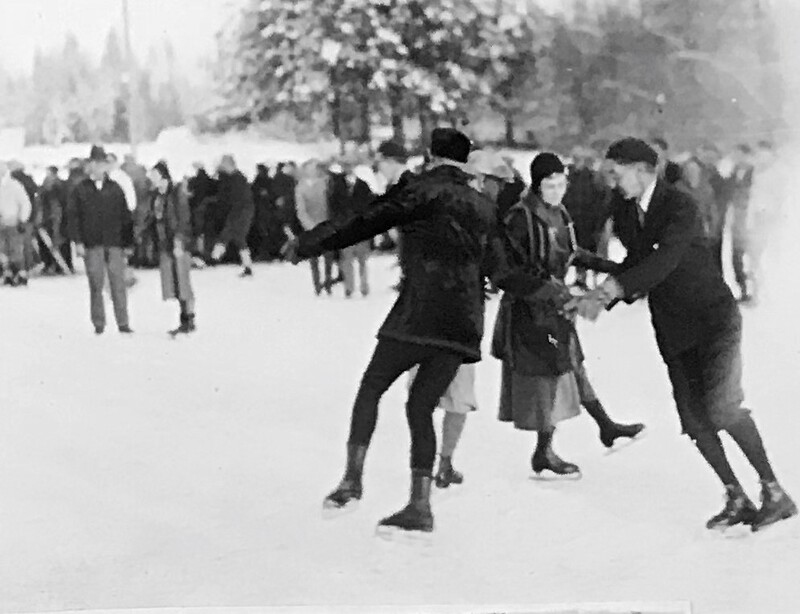

Ice skating was a very competitive business in attracting new customers and retaining old ones. At one point, there were three outdoor rinks within a two-mile radius. The Wandermere rink competed with a Greenleaf Park rink (present day Pine River Park) and the Silas Cook’s rink.
All three rinks needed to stay ahead of each other in amenities and condition of the ice. Night skating, music, the size of the rink, and concessions were big selling points. All three rinks did their best to accommodate customers. The Cook’s ice skating rink ads emphasized ice that was safe and in good condition; beautiful night lighting; a safe road direct to the rink; skate rentals; and a lunch counter.
A problem developed, however, with muskrats that impacted the outdoor ice rink. They bored holes in the dam that was used to hold back the water for the rink when the water froze. Silas was not able to stop the muskrats to keep the ice rink open and thus decided to build an indoor roller skating rink.
The decision to move to an indoor rink allowed Silas to transition from a seasonal, weather dependent business to a year round one. He also didn’t have to deal with muskrats any longer.
The Change to Roller Skating
There were two actions Silas took that supported his decision to build a roller skating rink. Five years before he decided to build a roller skating rink, he purchased a big crane shed at Sandpoint, Idaho. At that time, he did not have a particular purpose for it. He also visited big rinks back east to see how they were run. Silas thus decided a large indoor rink could be built in the crane shed and that he could manage the business.
Silas dismantled the crane shed and moved it piece-by-piece to Spokane including the 24 tons of nuts and bolts that held it together. He then had the shed reassembled on the property he purchased north of Spokane. The roller skating rink was built inside of it.
The roof of the big building is supported by 11 trusses (103 feet 4 inches in span). Eighteen tons of bolts and 2,500 pounds of nuts and washers were used in the construction as well as five tons of truss rods. There were 62 casement windows installed along with 437 concrete pillars under the floor joists. There was also 600,000 feet of dimension lumber used in the construction.
The entrance to the building is at one side with a long corridor running the full length of the building. The corridor contains spaces for the various concessions including the snack bar, skate shop, and rest rooms. There was also space provided for the electric organ for the skating music and an amplifying system.
Silas selected the best maple wood available for the floor. The skating floor was the largest in the Pacific Northwest at the time and intended for large public gatherings. The total cost of the rink was approximately $70,000. Silas admitted he was taking a risk and hoped it would pay off.
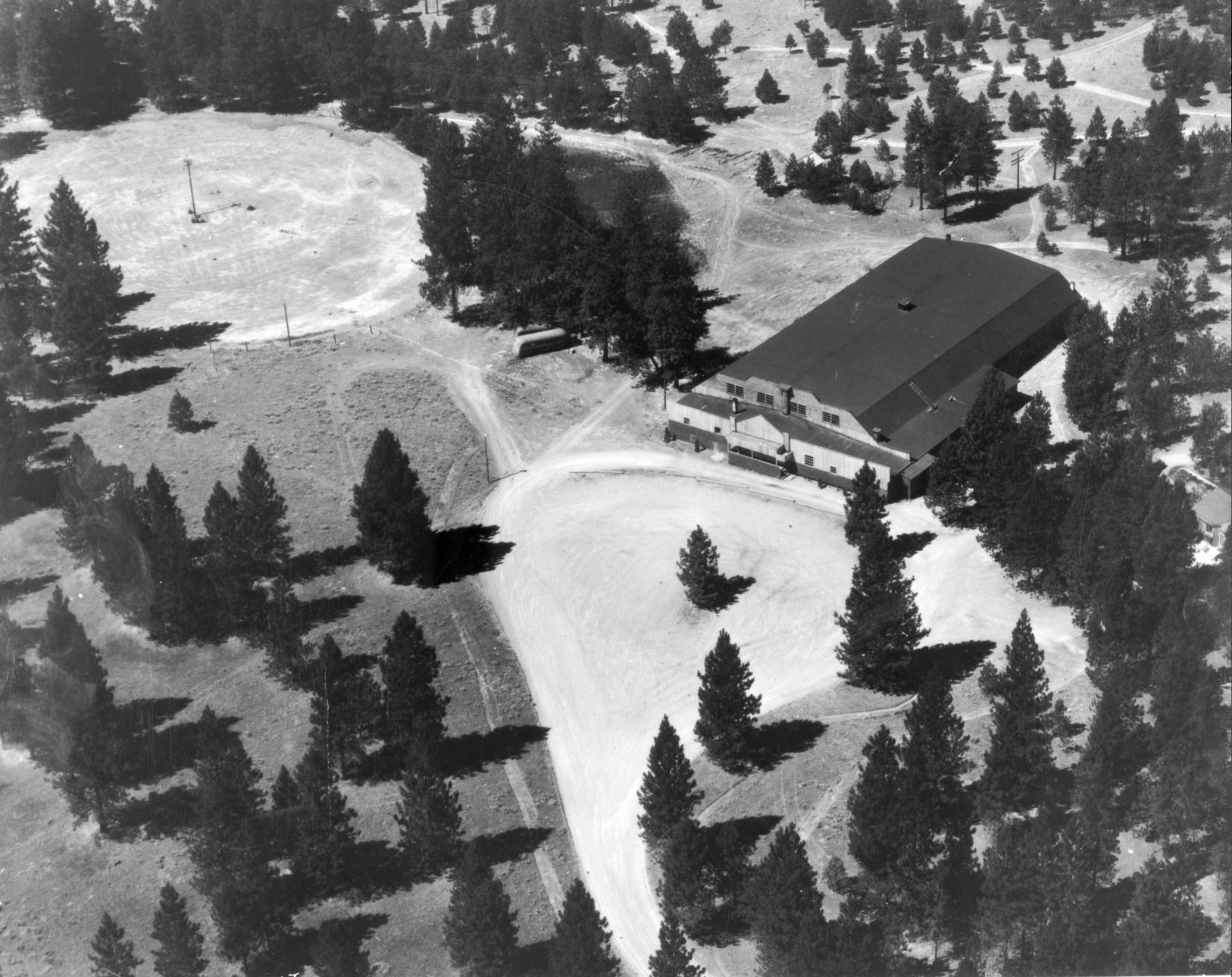
The address of the rink is North 11309 Mayfair Street (a North 11505 Division Street address has also been used). North Division Street is the main thoroughfare running north and south that runs parallel to North Mayfair Street. When the rink opened in October, 1941, the location was approximately three miles from the city limits.
An aerial picture of the Cook’s rink from 1950 showed how it first appeared in an undeveloped area near Whitworth college.
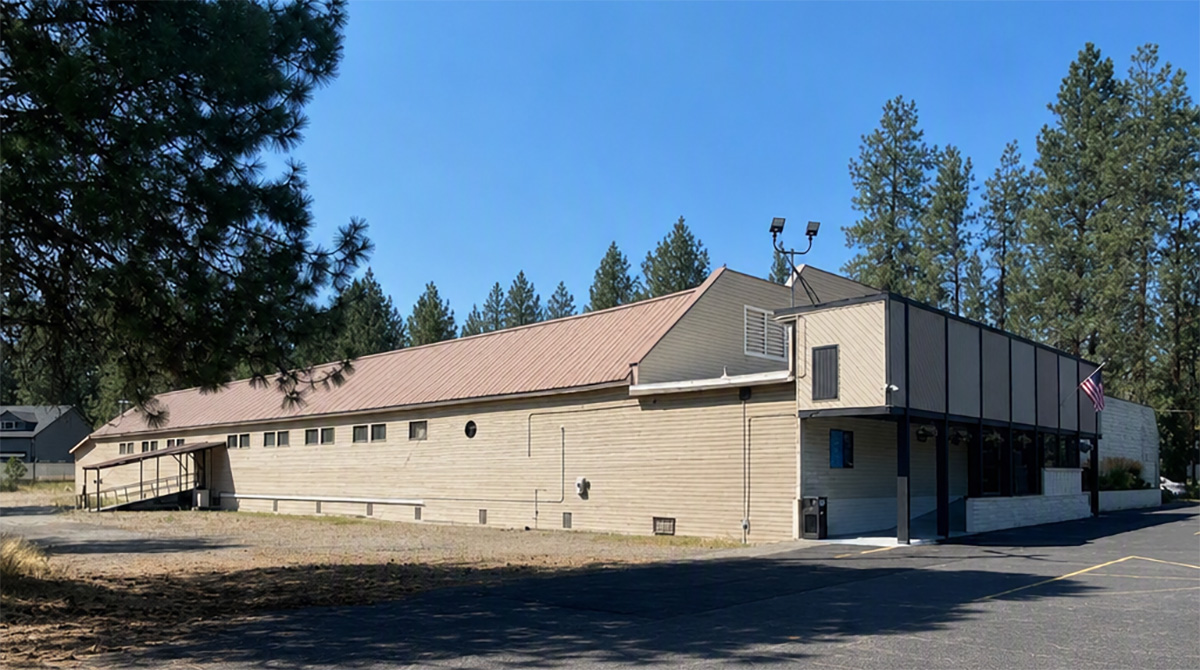
The Spokesman-Review published an article that appeared in the October 5, 1941, newspaper with a picture of the rink. The picture shows a side view of the immense size of the building.

The Large Rink Floor
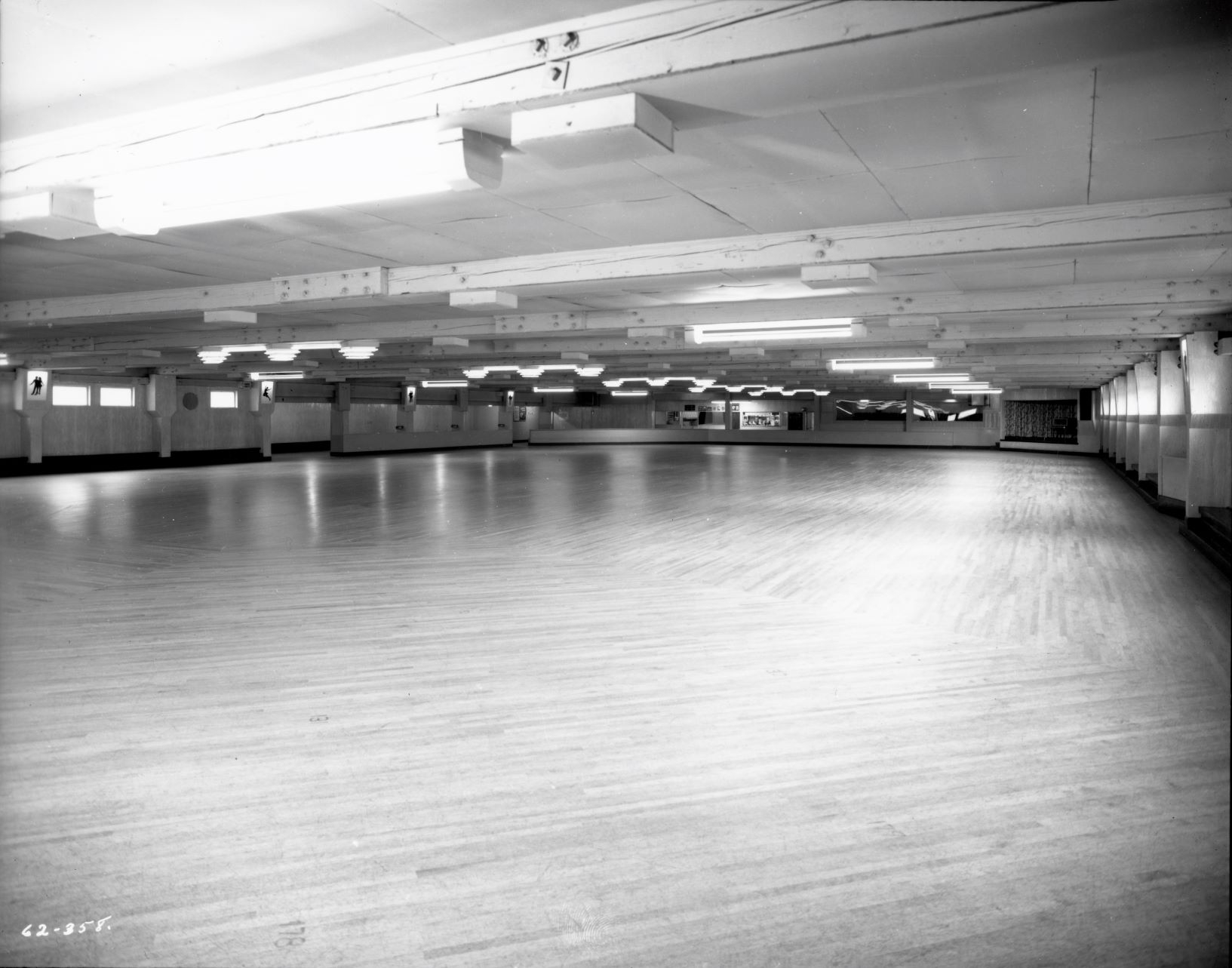
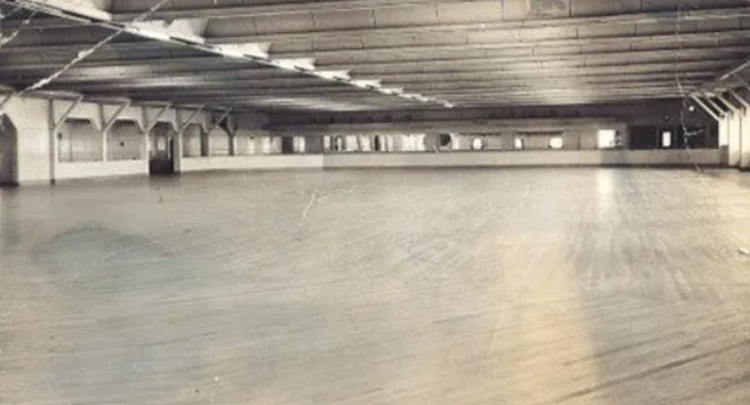
The “claim to fame” of the rink when it was built was it had the largest floor space of any such building west of Chicago. The floor has 27,000 feet of maple wood. The rink surface measures 95 feet x 176 feet.
The skating rink surface is described as a rotunda floor which means the boards are curved at the end. The planks are specially laid and steam-bent in curved, circular, or radiating patterns to create a seamless track without harsh corners. This allows continuous movement with the grain. When skating around the corners of the floor, the skates are going with the grain of the wood which results in a smoother, faster floor.
The Skating Experience and Events in the 1940s
Silas’ gamble in building the roller skating rink paid off. After it opened, folks began coming out by the hundreds. The huge rink was filled with as many as 500 to 600 skaters on Friday and Saturday nights.
As roller skating caught on in Spokane, a skating club was also formed for competitions and events. On November 8, 1942, the Cook’s roller skating rink hosted a skating revue to benefit the Geiger field athletic and recreation fund. The Geiger field dance band was featured with singles skating as well as group acts and duets along with precision dancing on roller skates. Silas donated the rink time and furnished transportation at no charge to the public in his own bus.
The rink was also used for community events, meetings, skating parties, dancing, and even shows with dance bands.


Music at the rink skating sessions in the 1940s was provided by Estelle Cashatt. She played the Hammond organ which was popular with service men and their gals at the time.
Skaters were also treated to neon rainbow lighting that was projected throughout the entire rink. A description of the effect was like “floating through the air with the greatest of ease”.
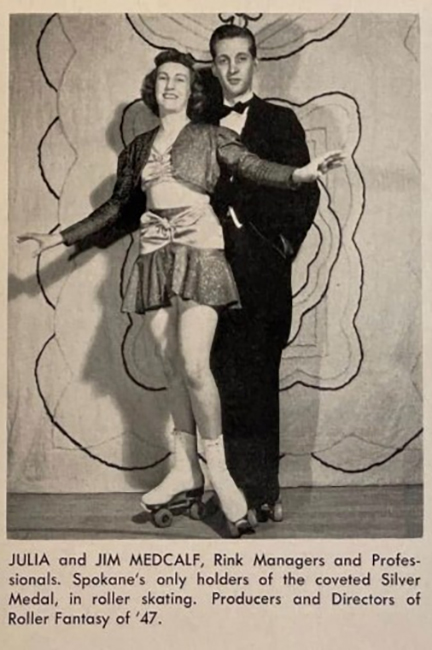
Aside from having a large floor, the best music, and the best skates at the time, Cook’s also offered the best instruction. National Silver Medalists in dance and figure skating, Julia and Jim Medcalf, were also instructors. They were members of the Society of Roller Skating Teachers of America.
Julia and Jim even produced a roller skating show called “Roller Fantasy” in November, 1947, at Cook’s. There were 100 skaters in the show including 11 national and two world champions. Seating at the rink was arranged in tiers to permit better viewing and special organ chimes were purchased to add to the background music.

The Redondo Beach Recreation Center and the Purchase of Cook’s Rink
In 1922, a recreation center and dance hall was built in Redondo, Washington. Redondo is within the incorporated boundaries of the city of Des Moines, Washington. The building was owned by Weston and Lauree Betts. In 1936, roller skating was incorporated into the facility.
The building burned to the ground in January, 1951. In that same year, the Betts’ eldest daughter, Evelyn, and her husband, Carroll “Pat” Pattison, purchased the Cook’s roller skating rink and moved to Spokane.


The Realization of a Dream
Pat Pattison had been skating since he was 4 years old. He was a professional skating instructor from 1938 to 1957. He taught roller skating at skating rinks in Vancouver, Redondo Beach, Tacoma, Portland, and Oakland. He always wanted a rink of his own and so when he and his wife had the chance to buy the Cook’s rink in 1951, he was able to realize his dream.

Pat and his wife worked together managing the rink, as it was a family business. Much of their revenue came from group patronage. Almost every day they would have a private party from one of the city or county schools, churches, or youth groups.
Pattison’s Attracts Skaters to the Rink in 1951
When Pat and Evelyn purchased the rink, the area around it was still largely undeveloped and surrounded by pine trees. They needed a way to get the public to the rink. Like Silas Cook, they also ran buses that stopped at various locations in Spokane.
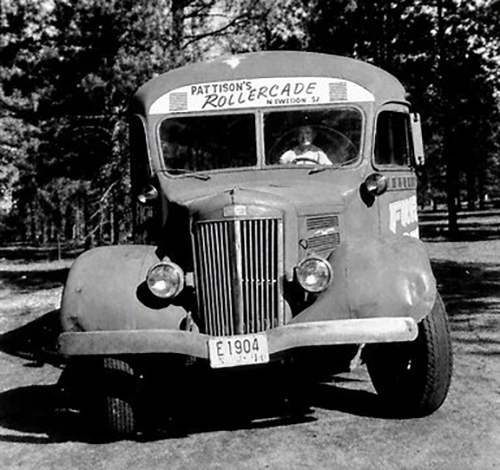

In addition to the free buses to and from the rink, Pat and Evelyn installed a large eye-catching neon sign with an arrow pointing drivers on North Division Street in the direction of the rink. The large sign made it much easier for drivers to find the rink.
The Skating Experience at Pattison’s Rollercade
Pat and Evelyn created an atmosphere in the rink as a good, wholesome place to skate. Pat would point out roller skating develops poise, muscular coordination, and how to get along with other people. He never put up with any problems. The rink was promoted as a safe place for the public to have a good time.
Rink Changes Over the Years
Pat and Evelyn owned and operated the rink until 1974 when it was sold to their daughter, Bobbie, and her husband, Ben Winkler. During the period of their ownership, the rink name changed to Pattison’s North. The Winkler’s owned and operated the rink for 34 years before retiring in 2006.
The third generation of the Pattison family running the rink is Shaun and his wife, Jericho. They purchased the rink from Bobbie and Ben Winkler on September 1, 2006.
The Family Legacy of Skating Lives On
Shaun was born into skating with his grandfather’s passion for the sport. His grandfather, Pat, was a speed skater winning races in the 1930s. His great grandfather was Weston Betts.
Shaun’s father, Mike, grew up at Pattison’s and was a big influence on his skating. Shaun became a champion indoor speed skater. He skated in rinks from Mexico to Denmark at speeds approaching 35 miles per hour. Pattison’s has a long history of speed skating in which Shaun has been involved. He has also coached inline speed skating for over 20 years.
Growing up in a roller skating family prepared Shaun to carry on the tradition of the family rink ownership.
The Skating Experience Today
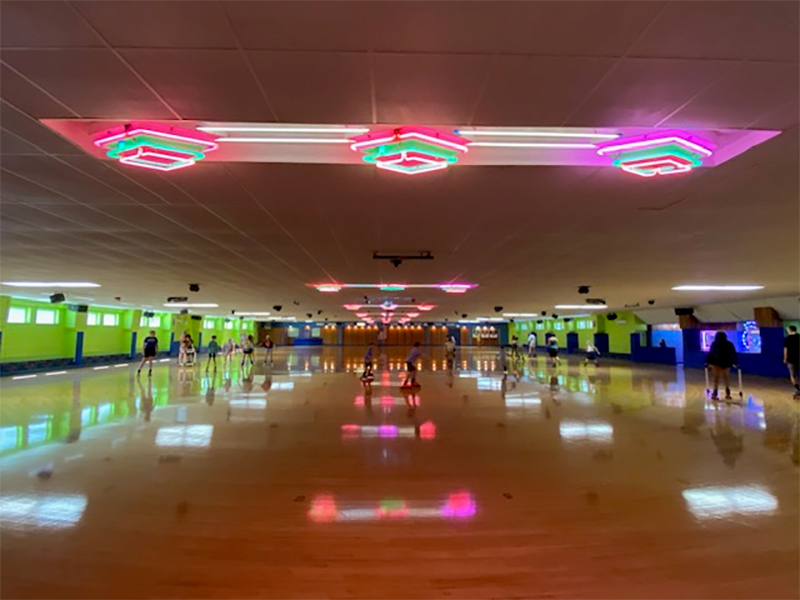
Shaun and Jericho have focused on making the rink an affordable, fun, and safe place for the whole family to enjoy.
With so many entertainment options available today, they have worked to keep the sport of roller skating alive with offerings appealing to many age groups. They host general skating sessions during the week and on weekends and on school holidays, church and school events, birthday parties, and family nights. There are skating sessions that appeal to all age groups.
On an ordinary Saturday afternoon, preteens could be found skating to the beat of the cartoon-inspired “Crazy Frog”, “The Bird Dance”, or the long-standing “Hokey Pokey”.
Teenagers flock to the rink on Saturday evenings to skate to pop tunes under flashing lights and even a fog machine.
There are adult skate nights on Sunday evenings. There is a variety of oldies and music to dance to such as the waltz and the cha-cha. The Sunday sessions are so popular that they even attract skaters from outside the area. Pattison’s North also participates and hosts speed skating meets.
Making It Through the Pandemic
During the pandemic, Shaun used the time to do maintenance work on the rink which included refinishing the skating floor and painting the interior. In the back of his mind, though, he worried if going for a long period of time without skaters would be the end of the family business.
Due to his creative thinking, Shaun made a request to the governor to allow the rink to reopen as a fitness center in October, 2020, during the lockdown. In making his request, he cited examples of other rinks which were given such approval. As a result, Shaun was able to keep the rink operating successfully.
He started slowly opening the rink for 90-minute private fitness skating sessions for up to 25 people. The arcade games and concession areas were closed, hand sanitizing stations were installed, masks were provided, and the rink areas were sanitized during and after each session.
After that initial opening, Shaun was gradually able to increase the number of skaters at public fitness sessions. His goal was to make sure they could operate safely, not contribute to the problem but be part of the solution.
Pattison’s North – The Roller Skating Rink Staple Today and Beyond
Shaun and Jericho are survivors having adjusted their operation with the times. They have even expanded to hosting home coming events, reunions, proms, and corporate skating parties.
The sport of roller skating has recently benefitted by a renewed interest partly due to videos, postings on Facebook, and other social media outlets. Sales of roller skates at the rink are also doing well.
Shaun and Jericho continue to make improvements to enhance the skating experience. They’ve made it through the up’s and down’s to emerge victorious.
They are a shining example to other rink operators across the country of their ingenuity, determination, and hard work which have made them successful.
Sources
- Silas Cook ran for County Commissioner, First District, Republican, The Spokesman-Review, August 26, 1934, page 20;
- “Silas Cook Sues State Game Men”, The Spokesman-Review, December 26, 1935, page 24;
- “New Roller Skating Rink Provides Mammoth Floor Space”, The Spokesman-Review, October 5, 1941, page 24;
- “Roller Skating Rink Will Open”, The Spokesman-Review, October 5, 1941, page 24;
- Herb Ashlock, Sports Editor, “From the Bench”, Spokane Chronicle, August 7, 1942, page 11;
- “Roller Revue to Aid Geiger”, Spokane Chronicle, November 3, 1942, page 3.
- “Skating Rink Show to Benefit Geiger”, The Spokesman-Review, November 9, 1942, page 6.
- “Cool-Off Spots Plentiful Here – Cook’s Roller Skating Arena, Nat Park, and Newman Offer Recreation”, The Spokesman-Review, July 30, 1943, page 19;
- “More Gas will Boost Outings”, The Spokesman-Review, June 15, 1945, page 14;
- “100 to Take Part in Skating Show”, The Spokesman-Review, November 2, 1947, page 16;
- “Rollercade Sets Date for Opening”, Spokane Chronicle, August 28, 1951, page 3;
- “Silas W. Cook, Pioneer, is Dead at Age of 80”, The Spokesman-Review, April 21, 1966, page 12;
- “Winter Travelers Return from Golf Trips”, Nila Hagood, Correspondent, The Spokesman-Review, April 9, 1989, page 37;
- “Skating Becomes Family Activity”, People & Business, Spokane Chronicle, February 4, 1969, page 29;
- Bruce Krasnow, “Memories Hardly Rinky-Dink as Skater Pattison Marks 80th”, The Spokesman-Review, October 10, 1994, page 7;
- Stephanie Pettit, “Honoring Cook’s Legacy – Memorial Pays Tribute to the Spokane Developer’s Story”, The Spokesman-Review, September 5, 2013, page v5;
- Nina Culver, “Pattison’s North Trucks Along as Fitness Facility”, The Spokesman-Review, October 8, 2020, page n7;
- Pattison’s History, A Family Legacy on Wheels, accessed June 15, 2026 (https://pattisonsnorth.com/pattisons-history/);
- Ty A. Brown, “Ice Skating in the Little Spokane River Valley”, SpokaneHistorical.org, accessed June 18, 2026 (https://spokanehistorical.org/items/show/936);
- Redondo Recreation Center and Skating Arena circa 1936, The Northwest Roller Rink Preservation Project, Larry Pattison Facebook post, December 16, 2018, accessed June 17, 2026 (https://www.facebook.com/groups/therinkregistrar/posts/779757269030662/).
Image Sources
- Featured Image: Aerial view of the Cook’s roller skating rink in 1950, Northwest Museum of Arts and Culture/Eastern Washington State Historical Society, Charles Libby Collection, L87-1.63967-50;
- Silas Cook, Owner of Cook’s Roller Skating Rink, Larry Pattison Facebook post, January 5, 2023, accessed June 17, 2026 (https://www.facebook.com/photo/?fbid=10226460956643120&set=pcb.1874336639572714);
- Cook’s Ice Skating Rink in the Little Spokane River Valley, SpokaneHistorical.org, Ty A. Brown, Ice Skating in the Little Spokane River Valley, accessed June 22, 2026 (https://spokanehistorical.org/items/show/936);
- Cook’s ice skating rink advertisement, December 8, 1932, The Spokesman-Review, page 12;
- Aerial view of the Cook’s roller skating rink in 1950, Northwest Museum of Arts and Culture/Eastern Washington State Historical Society, Charles Libby Collection, L87-1.63967-50;
- Cook’s roller skating rink outside of the building in 1941, The Spokesman-Review, October 5, 1941, page 24;
- Pattison’s North present day side view of the rink showing the original building with an updated front that was added in approximately the early 1960s, author’s image;
- The large Pattison’s skating rink floor in 1962, Northwest Museum of Arts and Culture/Eastern Washington State Historical Society, Charles Libby Collection, L87-1.358-62;
- Cook’s roller skating rink newspaper advertisement, November 15, 1941, offering free bus transportation to and from the rink, The Spokesman-Review, page 3;
- Roller skating dance skaters to organ music, Pattison’s History, A Family Legacy on Wheels, accessed June 15, 2026 (https://pattisonsnorth.com/pattisons-history/);
- Julia and Jim Medcalf, Skating Professionals, Larry Pattison Facebook post, January 5, 2023, accessed June 17, 2026 (https://www.facebook.com/photo/?fbid=10226460956643120&set=pcb.1874336639572714);
- Cook’s Roller Fantasy of ’47, skating show poster advertisement, Vintage Spokane, accessed June 17, 2026 (https://vintagespokane.blogspot.com/2015/03/cookes-roller-rink.html);
- Redondo Recreation Center and Skating Arena circa 1936, The Northwest Roller Rink Preservation Project, Larry Pattison Facebook post, December 16, 2018, accessed June 17, 2026 (https://www.facebook.com/groups/therinkregistrar/posts/779757269030662/);
- Redondo Beach Recreation Center, side view of building, circa 1936, Pattison’s North, Facebook post (scroll down post list to view), accessed on June 16, 2026 (https://www.facebook.com/p/Pattisons-North-100063749102539/);
- Redondo Beach roller skating rink, Pattison’s History, A Family Legacy on Wheels, accessed June 16, 2026 (https://pattisonsnorth.com/pattisons-history/);
- Grand Opening poster, North Division Rollercade, September 1, 1951, Spokane Chronicle; September 1, 1951, page 11;
- Pattison’s Rollercade free bus; Pattison’s family album collection;
- Rollercade Neon sign from the 1950s to direct drivers to the roller skating rink, Pattison’s History, A Family Legacy on Wheels, accessed June 16, 2026 (https://pattisonsnorth.com/pattisons-history/);
- Pattison’s North present day rink with historic neon lighting, author’s image.