
The small farming town of Spangle was established in the eastern part of Washington State. It was named after William Spangle, Senior, an early settler in the area. He was born on December 4, 1834, in Jersey, Illinois, and was a veteran of the Civil War serving under Union Army General Tecumseh Sherman.
Gateway to the Palouse
Spangle has come to be called the “Gateway to the Palouse”. It is located on US Route 195, approximately 18 miles south of Spokane and is bordered by the rolling farmland of the Palouse. It is one of the oldest Euro-American settlements in the Inland Empire. The highway used to run through Spangle; however, a re-alignment of US Route 195 bypassed it and several other small towns. An alternate route is the old highway that is still open between Spangle and Rosalia which is 14 miles to the south.
A Stopping Place on the Mullan Road
The first house built in the Spangle area was erected in 1862 and for years served as a stopping place on the Mullan Road which ran from Fort Benton, Montana Territory, to Fort Walla Walla, Washington Territory. The Mullan Road was the first wagon road to cross the Rocky Mountains to the Inland Pacific Northwest. It was a military road and a principal thoroughfare into the eastern reaches of Washington Territory and a major arterial into the interior connecting the Columbia and the Missouri rivers. It was built by U.S. Army troops under the command of Lt. John Mullan between the spring of 1859 and the summer of 1860.
The first family to settle in Spangle was in 1869 when T.A.E. Philleo came from Oregon on horseback driving a herd of cattle in the summer. He found a good lake with lots of bunch grass for his cattle that was three and a half miles from Spangle. Fearing his cattle would be unable to winter in the climate, he drove them back to Oregon. However, he liked the area so much that he and his family returned in the spring of 1870 and took up a homestead. The lake was named after him and is known to everyone as Philleo Lake.
In 1871, families came by wagon trains from Walla Walla to settle in the area. One of which was Wiliam Spangle, Senior, the founder and father of Spangle. In 1872, he built a house of hewn logs with his two sons, William H. and John F. Spangle. The house was finished with carefully made sills, frames, and doors and roofed with pine shakes. Hand-wrought nails used in building the house came from Walla Walla and the flooring was obtained from Scranton and Downing’s little sawmill on the Spokane River.
Spangle was initially part of Stevens County, not Spokane County, even though it is closer to Spokane being only 18 miles away.
Spokane County was established by the Territorial Legislature on June 29, 1858. The initial plat for the town by William Spangle and his wife Christina was recorded with the Stevens County Auditor and Spangle was annexed to that county on January 19, 1864. Spokane County was re-established on October 30, 1879. The change from Stevens to Spokane County was made thereafter when Spangle then became part of Spokane County.

Town Offerings
There was a post office and store combined about three miles northwest of Spangle in Pine Grove. Mail was carried on horseback from Colfax and later by stagecoach. The post office was moved to Spangle and run by William Spangle who was appointed postmaster in 1876 and served until 1883. Mr. Spangle was also in charge of the stagecoach station.
Supplies were brought from Walla Walla by wagon train which took several weeks. The only roads were Indian trails; and as there were no bridges, the settlers crossed the rivers by ferry and forded the smaller streams. Wheat that was farmed was carried by wagon to Walla Walla and ground into flour.
In 1873, an acre of land was donated by William Tiffin for a burial ground and was subsequently enlarged several times. For many years, it was the only cemetery around in the area.
In 1880, William Spangle had 80 acres of his land claim re-surveyed in which he sold lots to people wishing to build homes and also donated land for a school and two churches. In 1887, a two story schoolhouse was built for the community.
There were reasons why settlers came to the area. They were close to timber, water, plenty of land for farming, and to the rumored right-of-way by the Northern Pacific. There was also talk that James J. Hill, the builder of the Great Northern Railroad, would be building another transcontinental line.
Word spread that the railroad planned to build a line of track into the Palouse country south towards Colfax. Railroad development was a big draw for the settlers, as it was anticipated that homesteaders would pour into the area looking to stake out their land claims.
William Spangle wanted to take advantage of the building of the railroad through Spangle. He built his cabin on what turned out to be railroad land.
In 1874, once he verified his property was on railroad land, William Spangle bought 160 acres adjoining his current property.
An Inn for Travelers
In 1875, he began construction on a big two-story log building a short distance from his cabin on what became known as Main Street. The building was named Spangle House and served as an inn/stagecoach stop. It was a landmark and the central location for the new settlement. The building offered travelers a place to eat, rest, and stay over on their way north or south. It was located three miles east of the Mullan U.S. mail route, as the Mullan Military Road had come to be called locally.
William’s wife, Christina, wasn’t initially receptive to the idea of the inn but acknowledged it would be a living for her and her husband. She already kept an immaculate cabin and a spotless pantry, set a good table, washed, mended, scrubbed floors and cleaned their meager furnishings and could also do so for the inn. She came around to the idea that an inn would be interesting to run in which she could hear tales by travelers bringing news from the outside world.
The Impact of Railroad Development
The Northern Pacific Railroad built its transcontinental line across the northern United States. As it reached Spokane from the west in 1881, Spokane quickly became the axis for railroad feeder lines servicing nearly every region in the Inland Northwest. The railroad resulted in rapid population growth in towns which included Spangle.
In 1881, the first grading was done on the right-of-way so that the Northern Pacific Railroad could go through Spangle.
William Spangle donated grounds for a depot to the Northern Pacific Railroad and to the Palouse Land Company to build through the town. He continued to generously donate still more portions of his quarter section of land for development of Spangle.
In 1886, the railroad was finished from Spokane to Belmont. Belmont is south of Spangle and is located in Whitman County.
Homesteading
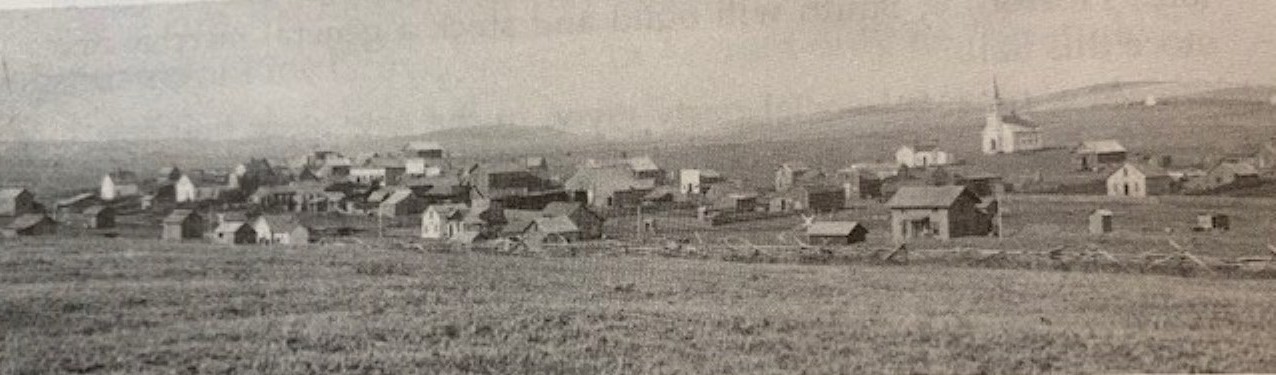
By 1884 almost all of the land for homesteading had been platted in every direction from Spangle with 160 acre parcels with cabins and modest frame houses completed or in some stage of construction. Most of the homesteaders were also building rail fences to contain their cattle or to divide their lands from their neighbors. The fences ran in lines across wide stretches of ground often terminating at several wood outbuildings, a farmhouse, barn, and windmill.
Some of the homesteaders were increasing their holdings by taking out timber cultures. The Timber Culture Act of 1873 was a federal law passed to encourage the planting of trees in the West to address the scarcity of them. It allowed individuals to claim additional land (up to 160 acres) if they planted trees on a portion of it. The homesteaders would have orchards and the trees would shade them during the summer months when the grain they had planted turned from green to gold.
Community Support for those in Need
“Project Poor Farm” was created on May 24, 1888, when county commissioners recognized that Spokane and the rest of the county had reached a population that necessitated a facility for the unfortunate people of their community including patients with smallpox which was very prevalent at the time. The farm became a place for the homeless, disenfranchised individuals, the socially marginalized which included those with cognitive decline or developmental disabilities, as well as widows and orphans. A quarter section of farmland was purchased in the Spangle area for the farm and in 1889 it was built.

William Spangle acknowledged the potential for business in helping the poor. Members of the community could supply medical services, provisions, supplies, and food. Those able-bodied persons who wound up there because they were down on their luck could also pitch in and garden, milk cows, tend hogs and chickens and take care of the orchards to help earn their keep.
There were six “inmates” as they were referred to originally. The number would continue to grow through the years with 186 in 1929 and 336 in 1934.
Spangle Incorporated December 13, 1888
As a result of Spangle’s early growth as a town, it was incorporated on December 13, 1888, under Washington Territory laws. It was first run by a board of trustees with Rodman Drake as chairman and T.R. Gildea as the clerk. After Washington became a state on November 11, 1889, Spangle had to reincorporate like many other cities and towns in the state such as Ritzville. Spangle was reincorporated on August 23, 1890. The first mayor was J.W. Smith.

Spangle had fixed boundaries and a local power of government. Ordinances were written by the town’s trustees for the rules to govern how the community lived after it was incorporated.
There were ordinances on a variety of subjects such as: time and place for holding trustee meetings; licensing and regulation of liquor; keeping an orderly house; control of animals, sidewalk and street crossing requirements; lamp post construction and lighting requirements; garbage and waste management; no shooting of fire arms inside city limits; speed limits—even then—were written to prevent fast driving and riding through the town which included cattle control to protect the safety of the public in town.
In all, almost 30 ordinances had been written in the initial work in setting up Spangle.
Telephone Service in Spangle
The telephone came to Spangle before electricity did. On June 23, 1887, the telephone reached Spangle from Rosalia. There were two long distance lines running on poles to Spokane. Calls to cities other than Spokane were handled by the Pacific Telephone and Telegraph Company operator in Spokane.
It was not only the town folk who were enjoying Alexander Graham Bell’s fascinating invention. Farmers who wished to get the service could also do so. They had to erect their own line of poles or to spike poles to existing fence posts. Several farmers living along the same section of road might use the same poles in which they would add their own wire and insulators.
Continued Growth of Spangle
Through the years, Spangle continued to grow. By 1903, the town had three churches with two resident ministers and a Catholic mass every Sunday in what was known as Woodman Hall. There were two hotels, three general stores, two saloons, two livery stables, two meat markets, a harness shop, two blacksmith shops, two hardware stores, one drug store, one confectionary, a doctor’s office, and a post office. The town pump and a watering trough were in the middle of Main Street.

The town had a Masonic lodge, I.O.O.F.; Woodman of the World and Modern Woodman; Women of Woodcraft; a Ladies Aid; Baptist Missionary Society; a good grade school system; and a prize winning brass band.
The Spangle orchestra was organized in 1904 and practiced in different homes in the evenings. Dances were held in the Woodman Hall in which people would come from miles around to attend them. The dances would start at 9 p.m. and had been known to last as late as 5 a.m. the next day.

The first bank was organized in 1906. The first automobiles purchased by local residents were bought around 1910.
The dominant feature of Spangle today is the Upper Columbia Academy which is a Seventh Day Adventist boarding high school for grades 9 through 12. It was originally founded in 1921 as the Yakima Valley Academy but by 1944, it had outgrown its quarters. The Upper Columbia Academy took over in the fall of 1945.
The Spangle City Hall houses all government functions which include the water department, police department, emergency services department, etc. The City Hall also hosts government meetings and events which the public can attend.
The mission of the Spangle City Government is to support the values that residents hold dear to them. They include promoting growth guided by the strong ethical values of the community and preservation of the area’s heritage with a sense of community and close-knit neighborhoods.
Spangle’s core principles make it a desirable place to call home.
Sources
- Nona Hengen, Gateway to the Palouse 5th Edition, (Spangle: Palouse Press, 2000), pp. 73, 78, 117, 118, 129, 183, 202, 207, 248, 249, 251, 253-255, 257, 259, 260, 261, 731;
- Lulu Smith, Memory of Spangle, (Spokane: Self Published 1934, Spokane Public Library), pp. 1-3;
- Tony Bamonte and Suzanne Schaeffer Bamonte, Spokane and the Inland Northwest Historical Images, (Spokane: Tornado Creek Publications, 1999) pp. 162, 163;
- David H. Stratton, Spokane and the Inland Empire – An Interior Pacific Northwest Anthology, (Spokane: Washington State University Press, 1991), page 39;
- Washington State Archives, Secretary of State, Corporations and Trademarks, Incorporated Cities and Towns, (Olympia: Digital Archives), 1890);
- Nona Hengen, Spangle Christian Church Celebrates Its Centennial, (Cheney: Cheney Free Press, 1982), page 5;
- Spangle, Wikipedia, website accessed March 12, 2025 (Spangle, Washington – Wikipedia); Mullan Road, Wikipedia, website accessed March 12, 2025 (https://en.wikipedia.org/wiki/Mullan_Road);
- Edith E. Erickson, Colfax 100 Plus, (Spokane: Self Published, 1981), pp. 43-46; Richard Scheuerman and John Clement, Palouse Country – A Land and Its People (Oral History Edition), (Walla Walla: Color Press, 2003), page 73, 74. Spangle, “Revisiting Washington by the Washington Trust for Historic Preservation, website accessed March 12 and 26, 2025 (https://revisitwa.org/waypoint/spangle/).
- “Father of Spangle Dead”, The Spokesman-Review, October 12, 1912, page 11.
Image Sources
- Spangle Main Street 1891, Northwest Museum of Arts & Culture/Eastern Washington Historical Society, Charles Libby Collection, L94-24.131.
- Spangle Plat Map recorded in Stevens County, Washington State Digital Archives, March 18, 2025.
- Spangle Town Picture 1883, Nona Hengen, Gateway to the Palouse 5th Edition, (Palouse Press, 2000), photo by H.M. Rice 1883), page 182.
- Spokane County Poor Farm in Spangle, 1925, Northwest Museum of Arts & Culture/Eastern Washington University Historical Society, Frank Guilbert Collection, L95-111.P-383.
- Spangle Record of Vote to Reincorporate, August 18, 1890, Washington State Digital Archives, March 18, 2025.
- Spangle Market 1900, Northwest Museum of Arts & Culture/Eastern Washington University Historical Society, Charles Libby Collection, L94-24.95.
- William Spangle 1912, William Spangle Obituary, The Spokesman-Review, October 12, 1912, page 11.