
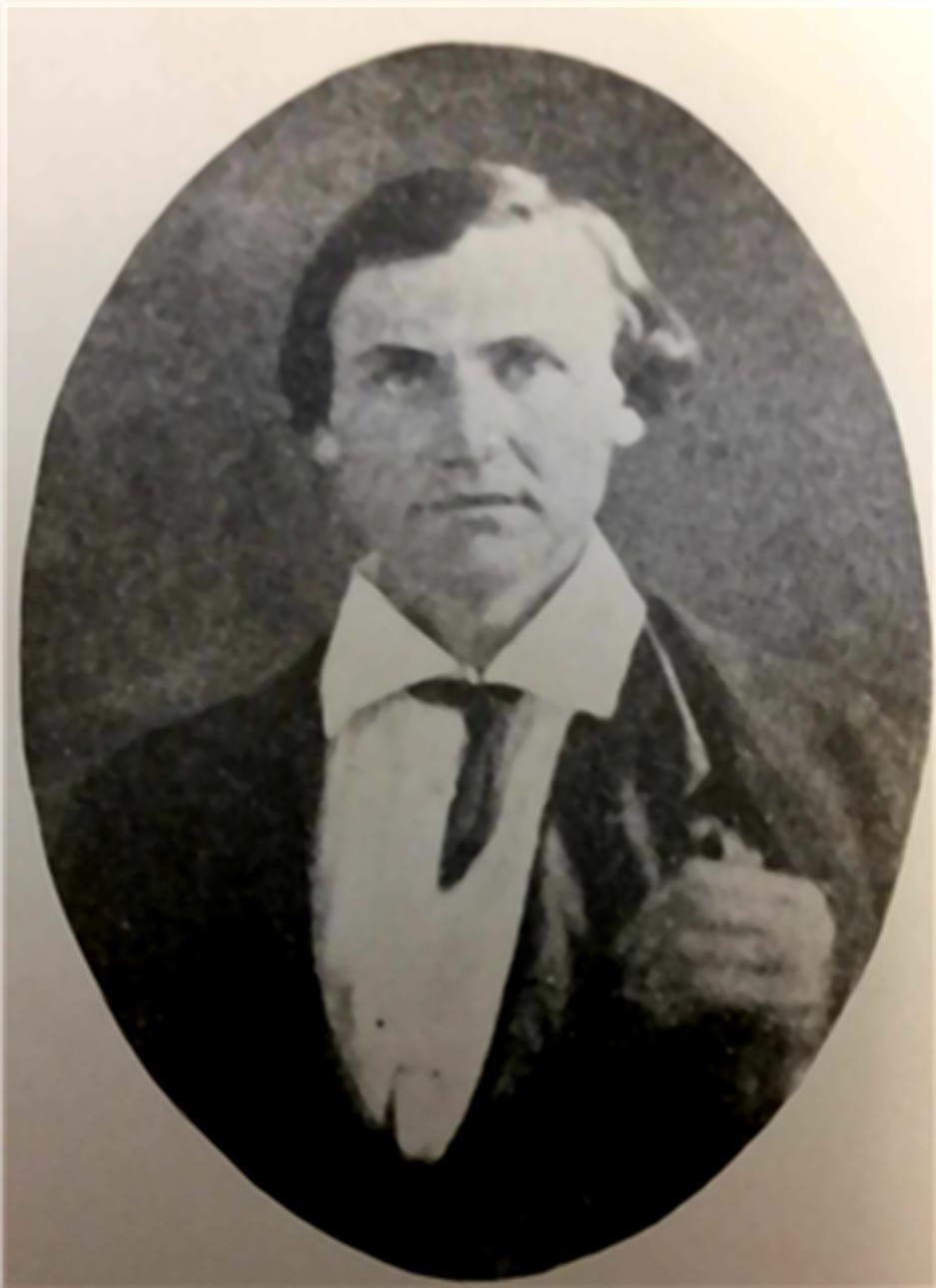
A brutal Eddyville, Iowa, winter, the opportunity for a better life, and the lure of free land enticed Ezra Meeker (1830-1928) and his wife, Eliza Jane (1834-1909), to make the journey to the Oregon Territory on the Oregon Trail in 1852. They were accompanied by Ezra’s older unmarried brother, Oliver Perry Meeker (1828-1860).
The Oregon Trail was 2,000 miles long and went from Missouri to the Oregon Territory. The journey took nearly six months. It is important to note that in 1852 the Oregon Territory included Oregon, Washington, Idaho, and parts of Montana and Wyoming. The Oregon Treaty between the United Kingdom and the United States in 1846 brought an end to the Oregon boundary dispute by settling competing American and British claims.
In 1853, the Washington Territory separated from the Oregon Territory and took the land north of the Columbia River, parts of the present day Idaho, and Montana.

After a few months spent near Portland, Ezra, Eliza Jane, their infant son, Marion, and Oliver reached Puget Sound in the spring of 1853 and built a cabin on McNeil Island across the sound from the village of Steilacoom. There they received a letter from their father, Jacob Meeker, saying that if Oliver would come back to Eddyville to accompany him and other members of the family, they would join them out west.
Oliver jumped at the opportunity especially since it would allow him to get reacquainted with young Amanda Clement who he met a year earlier. She was the daughter of Walter and Melina Clement who also lived in Eddyville. Oliver was quite taken with her when they first met but she was only 13 and too young to marry at that time.
The journey Oliver would have to take in order to meet up with his family in Eddyville was arduous. It involved him taking a steamer down the West Coast to Panama, crossing the Isthmus of Panama, taking a steamer to New York, and finally traveling by train to where his parents lived in Indiana.
On their way to the location on the Missouri River where the wagons and the ox teams were outfitted and the wagon trains organized for the trip, overnight stops were made at farmhouses and where there had been some prior acquaintances.
The Meekers stopped overnight at the home of the Clements in Iowa. Oliver and Amanda—who was then 15 years old—fell in love during the one evening they had together. Amanda accepted Oliver’s marriage proposal. In the morning, Oliver went to the girl’s parents seeking their approval that they be married. Oliver suggested he go west to build a home and then return for Amanda. The parents decided the best thing would be for the couple to marry so that Amanda could go west with Oliver and help with setting up a home there.
Tragedy on the Oregon Trail
On the way west to Steilacoom in 1854, the family experienced two disasters.
The Oregon Trail followed the Platte River in the future states of Nebraska and Wyoming. While the river was unusable for boat travel, the Platte River and North Platte River valleys provided an easily passable wagon corridor going almost due west with access to water, grass, buffalo, and buffalo chips for fuel. The river was described by travelers as “too thin to plow and too thick to drink”. The water was silty and bad tasting but it could be used if no other water was available. Letting it sit in a bucket for an hour or so or stirring in a quarter cup of cornmeal allowed most of the silt to settle to the bottom of the bucket.
Because of the Platte’s brackish water, the preferred camping spots were along one of the many freshwater streams draining into the Platte or the occasional freshwater spring found along the way. These preferred camping spots became sources of cholera in the epidemic years (1849–1855), as many thousands of people used the same camping spots with essentially no sewage facilities or adequate sewage treatment.
Jacob’s wife (Oliver’s mother), Phoebe Shaw (Baker) Meeker, died of cholera on June 18, 1854, while traveling west over the Oregon Trail. She was buried in an unmarked grave just west of Henry, Nebraska, on the very eastern edge of Wyoming on the north side of the Platte River.
On July 6, Jacob’s young son, Clark, drowned in the Sweetwater River at Devil’s Gate in the Wyoming Territory.
Delays along the trail resulted in the party running low on supplies and word was sent forward to Ezra who rode out to meet the train near present-day Richland, Washington. Ezra guided the party over Naches Pass in the Cascade mountains—their wagon train was the last one in that year.
Within a year, Jacob married Nancy Burr who had also lost her husband to cholera on the same trip west.
Meeker Family Business Established
The party initially settled on Ezra’s claim on McNeil Island. However, Jacob saw limited prospects on the island and encouraged Oliver, Ezra, and Eliza to settle on the mainland. The family moved to Swamp Place near Fern Hill (southeast of Tacoma) where they began to improve the land planting a garden and an orchard.
Jacob, along with his sons (Oliver and Ezra) opened a general store in Steilacoom, Washington, called J.R. Meeker & Sons. They tried general merchandise, then expanded into the sale of beef, but later returned to the general merchandise business.

SS Northerner and the Steam Tug Resolute Collision
As commerce was developing along the West Coast, steamships traveled between the towns along the Pacific coast transporting mail, freight, and passengers. The ships were a vital commercial link between the small communities.
The SS Northerner sailing for the Pacific Mail Steamship Company was one such ship on the San Francisco, Columbia River, and Puget Sound routes. The SS Northerner was built in 1847 by William H. Brown, from New York City. It went to the Pacific to provide service for mail, freight, and passengers.


On October 10, 1858, sailing from Olympia to San Francisco on a clear starlight night with no fog, the SS Northerner collided with the Steam Tug Resolute in Dana Passage, a mile-wide channel a few miles north of Olympia.
The SS Northerner was moving at 12 miles per hour and the Resolute was traveling at 9 miles per hour. A passenger on the Northerner noticed lights in the distance and could see the impending collision but neither ship blew a whistle nor reduced speed until just before the collision. The Resolute struck the Northerner on her starboard bow and slide along aft until clear. Since thousands of dollars of damage was done to both vessels, both the owners of the SS Northerner and the Resolute filed cross-suits in the Washington Territorial Court.
After the collision with the Steam Tug Resolute, the SS Northerner continued to sail after it had been repaired from the thousands of dollars of damage that had been done to it.
Oliver’s Final Trip to San Francisco and the Wreck of the Northerner
The Meeker family had achieved some success with the general store and Oliver was sent to San Francisco carrying the family’s savings to buy goods for the store. Oliver booked passage to return on the Northerner with supplies for the store.
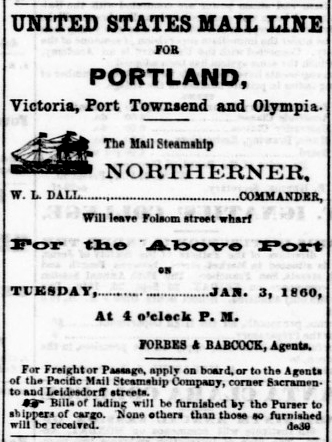
The SS Northerner left San Francisco at 5 p.m. on January 4, 1860, for Olympia via Portland. On the afternoon of January 5, the ship was sailing in smooth waters with a brisk south wind when a slight scraping of the ship’s bottom was heard and felt. It had struck a rock several miles offshore from Cape Mendocino which is south of Humbolt Bay, California. Captain William Dall was on deck at the time and thought it was a whale. He soon discovered that a breach in the hull from 15 to 20 feet in length had occurred and scraped off several of the planks from its bottom resulting in the ship taking on water. All the pumps were put into action. They were within about 20 or 25 miles of Humbolt Bay which they hoped to reach before the ship would sink but the water continued to rise.
Captain Dall, finding that the ship was filling with water rapidly and that it would be impossible to save it, turned the ship toward land. It arrived in an hour and just in time to prevent it from sinking.
The way the SS Northerner was originally built contributed to its eventual wreck. It was built as an open bottom boat with cross timbers in which the planking was nailed and were not close and caulked. If it had been built as a close bottom boat, as the Columbia, another Pacific Mail Ship, and struck the rock in the same manner, it would not have been in danger.
Between the time when it scraped the rock and got to shore, the wind had increased to a storm with a terrible surf raging on the beach. The surf was so fierce it was almost impossible for a boat to sail in it.
Realizing the ship would go down, they fired off their distress rockets and made for the sandy beaches south of the Eel River in northwestern California. It was a full gale with drenching rain and large breakers on the shore when the ship came to rest in the sand near the shore. The women and children were put into the largest lifeboat and they made it to shore. One woman, Miss Gregg, refused to go unless her brother could accompany her. She ended up staying on the ship. The next two lifeboats were loaded and capsized.
A line was run from the ship to the shore and one by one the remaining men tried their luck with the surf and waves. Some made it all the way to shore on the rope while others either were washed ashore and survived or drowned.
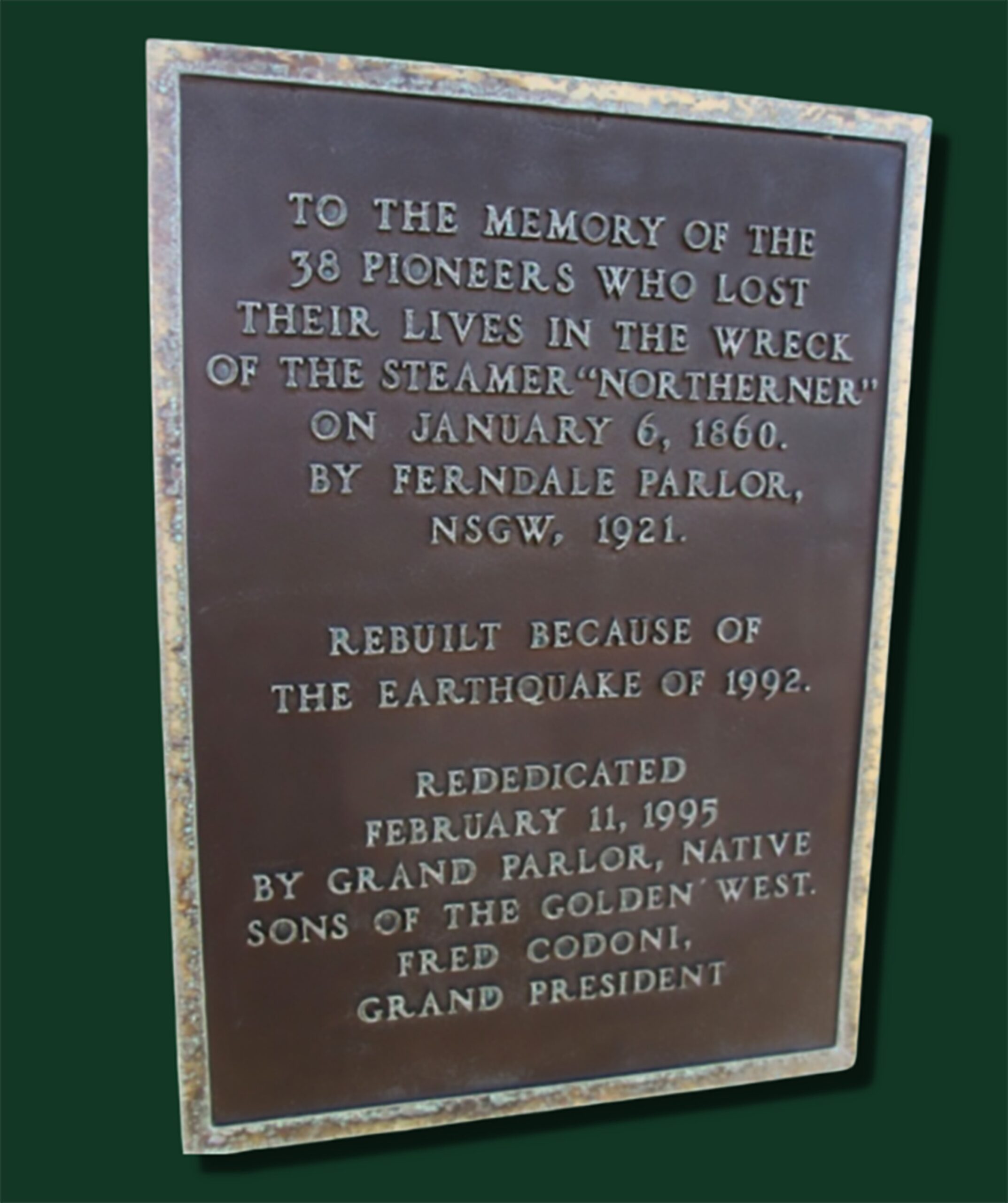
The SS Northerner had 108 people on board at the time of the wreck with 53 crew. All of the women survived, except for Miss Gregg. Thirty-eight people died including 17 passengers and 21 crew.

Unfortunately, Oliver also drowned while trying to make it to shore on January 6, 1860. A cross was erected at Centerville Beach, California, to remember those who lost their lives in the wreck.

Washington Territorial Opinion from the Second Judicial District Court in Olympia in 1859
After the SS Northerner was hit by the Steam Tug Resolute on October 10, 1858, the incident went to court. The court ruled that a case of mutual fault was involved by both the SS Northerner and the Steam Tug Resolute and that the damage cost be divided equally. The court relied in part on the rules established for the United States Navigation districts.
The owners of the Resolute were not satisfied with the Washington’s court decision and filed their case in the United States Supreme Court in December 1859.
Decision by the United States Supreme Court on the SS Northerner in 1863
The United States Supreme Court ruled in case 68 U.S. 682-684 the SS Northerner was at fault for steering across the path of the Resolute. The court noted that at the time of the incident, the Washington Territory was not included in any of the nine districts established by the supervising inspectors.
The Resolute conformed in all respects to the general rule of navigation and consequently was not at fault. The SS Northerner was ordered to pay for the damages done to the Resolute.
Meeker Family Business After Oliver’s Death
After the shipwreck, the family went into debt and Ezra suffered through a poor harvest. Ezra and his father supplemented their store business by a failed attempt to manufacture soap.
In 1865, a friend of Jacob Meeker, Charles Wood, encouraged him to grow hop roots that were used in beer production. Charles operated a small brewery in Olympia and had been importing them from England. The hop roots added flavor and aroma complexity to beer. Over the next few years, both Jacob and Ezra grew acres of hops and continued to expand their production.
Oliver’s Wife Amanda – Life After His Death
After Oliver’s death in 1860, Amanda lived with Ezra Meeker’s family until she married Frank M. Spinning in 1870. In 1883, the General Land Office of the United States recognized the claim of Oliver Meeker and his wife Amanda Meeker of 320 acres south of Tacoma. They divided the land one half to the heirs of Oliver Meeker and one half to Amanda Meeker and her heirs. Also, in 1883 Amanda’s husband Frank died and she went to live with the son she had with Oliver who was Frank O. Meeker who lived in Holland, Oregon. She died on February 1, 1917, at the age of 78 and is buried in Kerby, Oregon.
Closing Remarks
The objective of this article was to bring awareness of an Oliver Meeker story separate from his famous brother, Ezra; the ordeal involved in migrating west; Oliver’s death; and the businesses the family built in Steilacoom, Washington.
It also provided insight into differing court decisions on the fate of the SS Northerner Steamship and the Steam-Tug Resolute which went as high as the United States Supreme Court.
This information gives an historic example and a lesson for all of us of the courage and determination of early pioneers in searching for a better life.
Sources
- Findagrave.com, accessed March 8, 2026 (https://www.findagrave.com); searched on Oliver Perry Meeker.
- Supreme Court, United States (1912). “United States Supreme Court”. Lawyers Co-operative Pub. Co. 17: 496-499; U.S. Supreme Court Resolute and Northerner, 68 U.S. (1 Wall). 682 (1863).
- Allen, John B. (1879). Reports of cases determined in the Supreme Court of the Territory of Washington: from 1854 to 1888, Volume 1. C.B. Bagley. pp. 78-88.
- Seacrest, William B. Sr., William B. Seacrest Jr. (2005). California Disasters, 1812-1899: Firsthand Accounts of Fires, Shipwrecks, Floods, Epidemics, Earthquakes and Other California Tragedies. Quill Driver Books; pp. 85-88. ISBN 1-884995-49-7; link: California Disasters, 1812–1899: Firsthand Accounts of Fires, Shipwrecks, Floods, Epidemics, Earthquakes and Other California Tragedies.
- Wikipedia link to SS Northerner, accessed March 8, 2026 (https://en.wikipedia.org/wiki/SS_Northerner).
- Wikipedia link to Oregon Territory, accessed March 8, 2026 (https://en.wikipedia.org/wiki/Oregon_Territory).
- Findagrave.com, accessed March 8, 2026 (https://www.findagrave.com); searched on Phoebe Baker Meeker.
- Findagrave.com, accessed March 8, 2026 (https://www.findagrave.com); searched on Jacob Redding Meeker.
- Pioneer and Democrat (Olympia, Washington), Friday, January 20, 1860, page 2.
- Wikipedia Ezra Meeker, accessed March 8, 2026 (https://en.wikipedia.org/wiki/Ezra_Meeker).
Image Sources
- SS Northerner Wreck off Centerville, California, January 6, 1860, Granger Art on Demand, accessed March 15, 2026 (https://grangerartondemand.com/featured/ss-northerner-1860-granger.html).
- Photo of Oliver Perry Meeker: Findagrave.com; I searched on the name of Oliver Perry Meeker to obtain his picture; link accessed March 8, 2026 (Oliver Perry Meeker (1828-1860) – Find a Grave Memorial).
- Washington and Oregon Territories Map 1853, Colton, accessed March 8, 2026 (https://www.geographicus.com/P/AntiqueMap/waor-colton-1853).
- Newspaper ad for J.R. Meeker & Sons general store in Steilacoom: Puget Sound Herald (Steilacoom, Washington) Friday, March 12, 1858, page 2.
- SS Northerner Pacific Steam Ship, 1849/1850, Calisphere University of California, The Huntington Digital Library, Jay T. Last – Collection of Graphic Arts and Social History, accessed March 15, 2026 (https://calisphere.org/item/935f6df120072da70c7b5c9a22e5e37b/).
- Map of Dana Passage from Map from Mapcarta.com (https://mapcarta.com/23929184/map).
- Sailing notice of the Northerner from the Daily Alta, San Franisco, California, January 3, 1860, page 4; link accessed March 8, 2026 (Northerner Sailing Notice DailyAlta January 3 1860 – File:Northerner Sailing Notice DailyAlta January 3 1860.jpg – Wikimedia Commons).
- Newspaper depiction of the wreck of the Northerner: Frank Leslie’s Illustrated Newspaper, February 25, 1860, page 195; link accessed March 8, 2026 (Northerner (paddle steamer) wrecked near Humboldt Bay, CA, 1860 – PICRYL – Public Domain Media Search Engine Public Domain Search).
- Lost at Sea Memorials of Centerville Beach Cross monument above burial site for SS Northerner accessed March 8, 2026 (https://lost-at-sea-memorials.com/?p=2888).
- Picture of the beach cross marker at Centerville Beach, California, to those who drowned from the wreck of the SS Northerner: HMdb.org (The Historical Marker Database); link accessed March 8, 2026 (Centerville Beach Cross Historical Marker).
