
It isn’t often in the Northwest that we find a merger of history involving agriculture, commerce, the successes and failures of economics, and a surviving industry that all span the life of a building. Such is true of the Broadview Dairy building located at 411 W. Cataldo Ave.
The Early Days of Dairy Farming
The Broadview Dairy was one of several commercial dairy operations established in the Spokane area around 1900. Broadview Farms, later the Broadview Dairy Company of Spokane, was established in Marshall, Washington, in 1893 by Allen Henry Flood with his sons Frank and Edmund. They built up a dairy herd gradually beginning at Marshall which is on the old Northern Pacific railroad line approximately eight miles southwest of Spokane.

As Spokane grew, residential development left less room for dairy herds and Broadview Farms moved further south to Rosalia, Washington. They had over 500 acres of grazing land for their herd of 200 cows in 1909 and it was the largest dairy ranch west of the Rocky Mountains. The barns and facilities were modern and extensive for the time and continued in use until 1917 when the practice of purchasing of milk from dairy farmers became prevalent. The herd was gradually sold to dairy farmers who shipped milk to Broadview Dairy in Spokane.

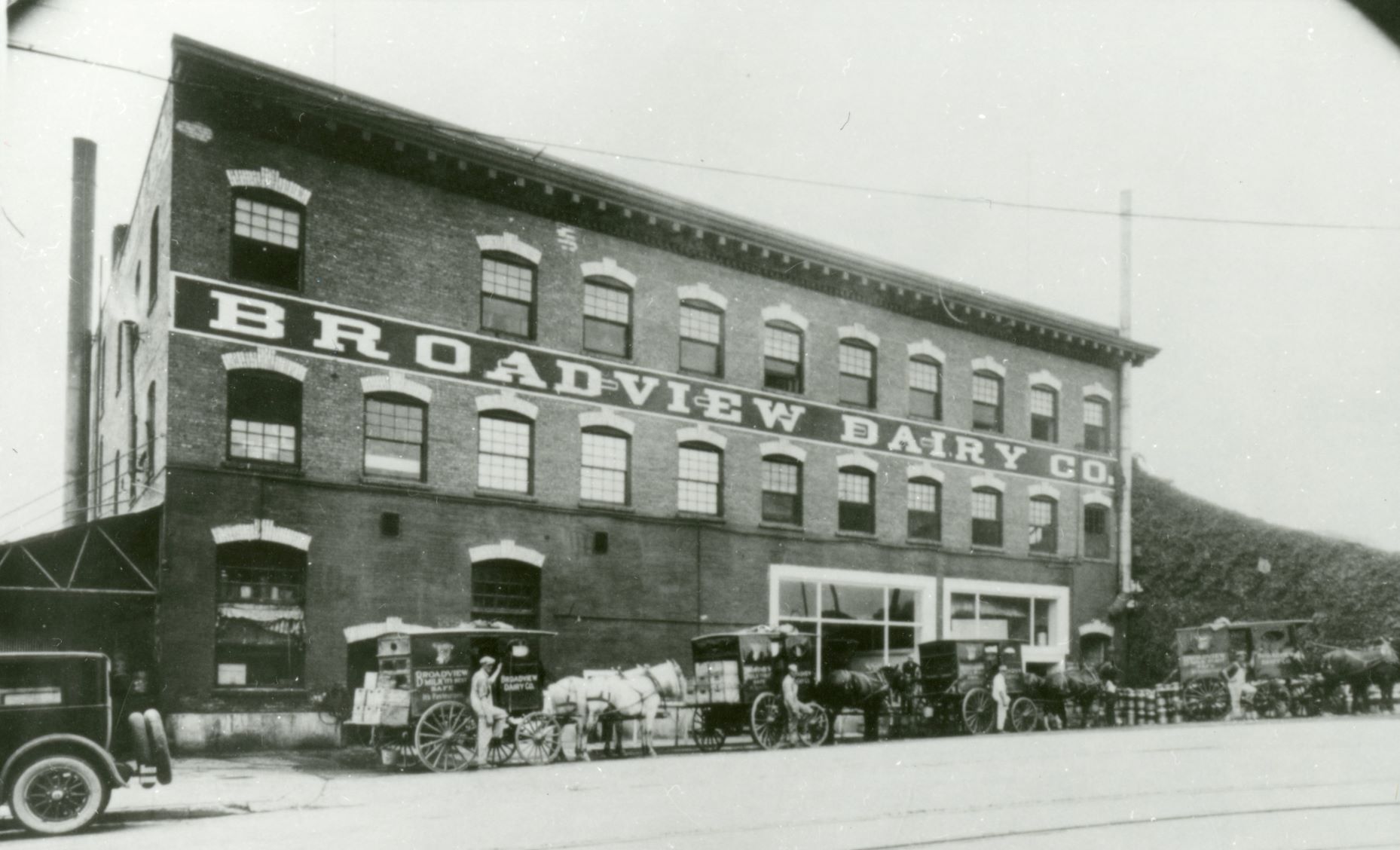
The processing and distribution side of the business grew along with the development of Spokane. The straining, cooling, and filling of cans and bottles for distribution and loading of the delivery wagons took place at various locations in the city. In 1910, the Floods completed the large modern brick building at Washington and Cataldo in Spokane. The building cost $35,000 to construct. The brick and rubble rock building had power and lights, electrical heat, steam, and city water. It was built in two different sections. Section one housed the horse stalls, hay storage, and wagons. The basement was used for horse stalls. The first floor was for wagon storage. The second floor was the storage area for hay.
The second section was the creamery and ice cream facility which occupied the first and second floors. The pasteurizing room was also located on the first floor. Overall storage took up most of the room on the third floor.


The Floods advocated for better health and safety in dairy production. They led the initiative in the Northwest of testing cattle for disease, bacterial testing of raw milk and finished milk products, and the pasteurization of milk. Their commercial dairy was the first in the state to test for tuberculosis to protect the health of consumers.
The dairy began with two small horse driven wagons serving stores and restaurants and expanded to serve residential areas. The dairy grew and at one time had a nearby stable of 65 horses. Horses were cheaper and better for delivering milk because horses could be trained to walk the driverless wagon down the block while a milkman ran from door to door. Horses also knew the routes and how long each stop should take. If the milkman got delayed talking to a customer, the horse would just take off for the next stop. If there was a string of houses on a block, the milkman could hop off with his bottle carrier and the horse would continue on and wait for him at the end of the block.
Fond Memories of the Milkmen
In the late 1920s delivery changed to trucks as growing ice cream sales to outlying areas made speed essential. Delivery by traditional milkmen—the friendly faces who knew customers by name, exchangers of advice and gossip, friends of children and dogs—diminished over the years victim of changing economics and social habits.

Fond memories, however, of the milkmen in days gone by especially in the ‘50s and ‘60s evoke recollections such as:
The glass milk bottles and the insulated dairy boxes milkmen left on the doorstep. There was also the inch of cream that rose to the top of the bottle if the milk sat too long which was a real treat for some.

Milkmen in the day knew their jobs could involve much more than just delivering milk. Approaching the American home every other day via the back door, they found handy such things a diplomacy, a liking for people (especially kids) and a knowledge of simple mechanics and plumbing.
Chores milkmen would do for their customers included lighting ovens, keeping an eye out for stray dogs, feeding goldfish for vacationers, and picking up Sunday’s breakfast rolls for delivery with the milk, butter, and eggs. Milkmen also watered lawns for people on vacation—turning the sprinkler on as they continued delivery up the street and turning it off later when they came back down the street.
Milkmen never knew what they may be asked to do—fix breakfast for bedridden elderly; leaving their routes to rush expectant mothers or injured children to hospitals; a driver found a housewife in terror thinking she’d seen a wild-eyed man hiding behind her couch and when the milkman jumped behind it he only found a wild-eyed owl!
There were milkmen who would put the milk in the icebox and have coffee in the kitchen like they were part of the family. Some remember milkmen who would be in and out of their homes before 6 a.m. and recall hearing while still in bed the soft clanking of milk bottles being stocked in the refrigerator along with eggs and orange juice. Some milkmen would even leave a quart of eggnog as a thank-you gift at Christmas.
Customers would leave all kinds of notes for their milkmen including requests to borrow money; to wake them up when making deliveries; when and when not to leave deliveries; what items to leave even if they didn’t carry them; to help themselves to cake; to feed milk to the cat; and even a request to run the milk through the cow again as it was too thin! Boxes would even be built into home walls next to back doors so that milkmen could put deliveries in from the outside and customers could take them out from the inside.
There were even customers who would collect enough paper milk bottle lids from milkmen deliveries to ride free all day at Natatorium Park!
Major factors that played a part in the ultimate end of an era of home delivery were: an increase in the number of supermarkets and convenience stores; more women working and unable to care for milk dropped off at home; the trend toward smaller families; milk that lasts longer; better refrigeration; and the advent of the second car in families which allowed wives easy transportation to the store; the additional and increasing cost of home delivery; and stiffer price competition from the supermarkets and convenience stores.
Changing Hands
The Broadview Dairy became part of the Carnation Co. in an exchange of stock in 1929. Carnation, an evaporated and fresh milk producer, was founded by the Stuart family of Kent, Washington, in 1889.

The Spokane operation of Carnation continued to be known as the Broadview Dairy Co. until 1946 when the Carnation name was adopted for all products and operations. All entities of the business expanded during these years and a cream plant was purchased in Stevensville, Montana, and an evaporated milk plant established at Sunnyside, Washington.
In 1948, Carnation rebuilt, remodeled, and expanded by building a brick addition on the westernmost portion of the former Broadview plant at Washington and Cataldo at a cost of $400,000. Upstairs in the building there was a public viewing room overlooking the milk processing equipment.

The remodeling of the plant increased the capability to process 15,000 gallons of milk products per day compared to only 2,500 gallons a day in 1930. The plant consisted of over 175 employees, an extensive fleet of delivery trucks, and land holdings surrounding the plant.
The Carnation Company operated its plant in Spokane until the sale to the Nestle Company of Geneva, Switzerland, in 1985. In 1989, Nestle sold all Carnation fresh milk plants which included the Spokane, Portland, and Seattle plants and the name was changed to Foremost Dairy Co. However, Foremost lost the business in bankruptcy.
Inland Northwest Dairies, Inc., a subsidiary of Goodale & Barbieri Cos., bought Broadview in 1991 and continued dairy production. In 1997, the plant was closed and production moved to the Darigold plant at 33 E. Francis.
With the move to Darigold, the four-story Broadview Dairy building, a city-registered historic structure, was ultimately sold by the Barbieri family to a Seattle company in 2018. The building has leased office space on the upper levels with retail space on the street level.
Local dairies such as Darigold, Inc., consolidated their milk processing and delivery operations to meet the demands of increased competition, regulatory changes and new technologies. The companies needed to join forces to stay competitive.
The Broadview Dairy will be remembered as having played a part in the evolution of the industry and of the fond memories of milkmen!
Sources
- Jesse Tinsley, “Then and Now: Broadview Dairy”, February 4, 2019, The Spokesman-Review, page c1.
- HistoricSpokane.org, Broadview Dairy, with link to Register of Historic Places Nomination Form, July 29, 1991, accessed March 5, 2026: https://properties.historicspokane.org/property/?PropertyID=1733 and https://properties.historicspokane.org/_pdf/properties/property-1733.pdf.
- Hannelore Sudermann, “The Broadview Dairy Finally Runs Dry; Broadview Dairy Leaves Its Historic Home at Washington and Cataldo”, The Spokesman-Review, September 27, 1997, page 14.
- Lee J. Sahlin, “The Broadview”, Northwest Room, Spokane Public Library, July 10, 1991, reference file accessed November 21, 2022.
- United States Department of the Interior, National Park Service, National Register of Historic Places Registration Form, Broadview Dairy.
- Lacey Sipos and Caitlin Shain, SpokaneHistorial.org, Broadview Dairy, accessed November 19, 2022 (https://spokanehistorical.org/items/show/277).
- Carole Currie, “Notes Found in a Milk Bottle”, The Spokesman-Review, October 12, 1969, page 128.
- Cathy Free, “Milkmen Serve a Cold Drink of Nostalgia”, The Spokesman-Review, December 1, 1993, page 4.
- “Shelves of Plastic Replace Milkman and Glass Bottles”, The Spokesman-Review, July 20, 1983, page 19.
- Ron Shaffer, “Friendly Milkman Victim of Shifting Social Scene”, The Spokesman-Review, August 3, 1975, page 35.
- Jim Spoerhase, “Milkman Delivers, Neither Snow, Nor Rain . . .”, The Spokesman-Review, January 8, 1985, page 55.
- “Nothing is New to the Milkman”, The Spokesman-Review, May 7, 1950, page 57.
- Clarissa Lorenz, “Keep Those Bottles Quiet”, The Spokesman-Review, February 29, 1948, page 76.
- “Here’s How You can Help to Keep the Cost of Milk Down”, The Spokesman-Review, December 16, 1947, page 19.
- Jack E. Fischer, “Milk Price-Fixing Bill Passes 26-22”, The Spokesman-Review, February 22, 1967, page 6.
- United States: Milk Pricing and It’s Future, Dairy Global, September 3, 2022, accessed March 5, 2026 (https://www.dairyglobal.net/industry-and-markets/market-trends/united-states-milk-pricing-and-its-future/).
- “Charge Leveled on Milk Prices”, The Spokane Daily Chronicle, November 7, 1968, page 3.
- “Spokane’s Milk Price War Over, Official Announces”, The Spokesman-Review, December 30, 1965, page 1.
- “City Milk ‘War’ Officially Ended”, The Spokane Daily Chronicle, December 24, 1959, page 5.
- “Milk Price War is Held to be Legal”, The Spokesman-Review, November 17, 1959, page 5.
- “Measure Aimed at ‘Milk Wars’”, The Spokesman-Review, March 2, 1955, page 15.
- “Producers Must be Spared”, The Spokane Daily Chronicle, February 2, 1955, page 4.
- “Area Farmers to Seek Laws Curbing Milk Price Wars, New Cuts in Prices Here are Cause for Jitters”, The Spokane Daily Chronicle, January 21, 1955, page 1.
- “Truce Declared in Milk Battle”, The Spokane Daily Chronicle, December 30, 1954, page 3.
- “Merger of Dairy Firms Announced”, The Spokane Daily Chronicle, September 1, 1937, page 1.
- “Group to Mull City Milk War”, The Spokesman-Review, August 7, 1954, page 6.
- “Milk War End Not Yet Likely”, The Spokesman-Review, August 2, 1927, page 6.
- “Waikiki Ranch to Lower Milk Price, The Spokesman-Review, April 29, 1914, page 6.
- “Milkmen Deadlock Over Six Cents Boost Asked by Producers, The Spokesman-Review, November 1, 1917, page 6.
Image Sources
- Broadview Dairy Building, 1935, 411 W. Cataldo, Northwest Museum of Arts & Culture/Eastern Washington State Historical Society, Charles Libby, L87-1.6886-35.
- Dairy Herd Ranch, Northwest Museum of Arts & Culture/Eastern Washington State Historical Society, Charles Libby, L91-157.44.)
- Broadview Dairy Farm near Rosalia, Washington, 1925, Washington Rural Heritage, Whitman County Heritage, WCLRO069, accessed March 4, 2026 (https://www.washingtonruralheritage.org/digital/collection/whitman/id/1302/rec/5.)
- Broadview Dairy Milk Processing Equipment, Northwest Museum of Arts & Culture/Eastern Washington State Historical Society, Charles Libby, L91-157.11
- Broadview Dairy Milk Bottling, Northwest Museum of Arts & Culture/Eastern Washington State Historical Society, Charles Libby, L91-157.13.
- Broadview Dairy Co, Building with Horse Drawn Milk Delivery Wagons, Northwest Museum of Arts & Culture/Eastern Washington State Historical Society, Charles Libby, L2004-32.37.
- Line Up of Milkmen with Horse Delivery Wagons, Northwest Museum of Arts & Culture/Eastern Washington State Historical Society, Charles Libby, L91-157.46
- Broadview Dairy Milkman and Delivery Truck, Northwest Museum of Arts & Culture/Eastern Washington State Historical Society, Charles Libby, L87-1.20190-41.
- Carnation Milk Processing, Northwest Museum of Arts & Culture/Eastern Washington State Historical Society, Charles Libby, L91-157.31.
- Carnation Dairy Building with Delivery Trucks and Large Neon Sign, Northwest Museum of Arts & Culture/Eastern Washington State Historical Society, Charles Libby, L87-1.60811-49.