
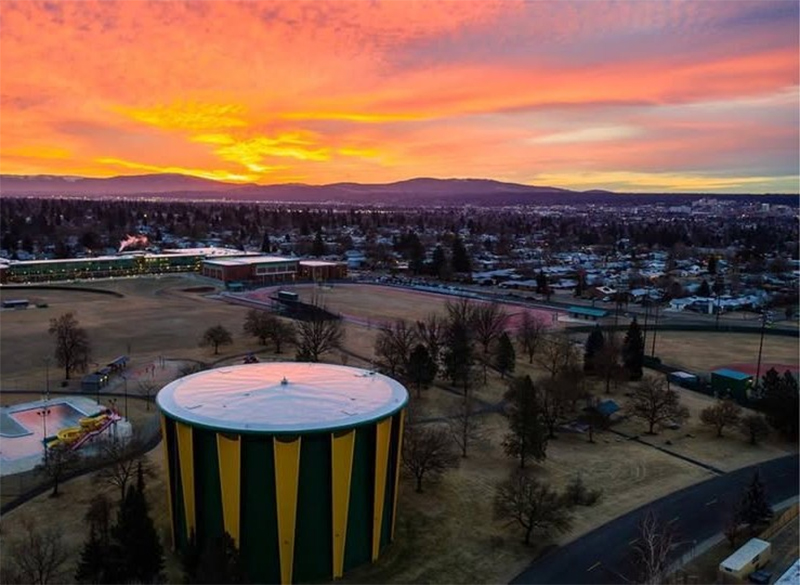
If ever there was a symbol for Shadle Park and the surrounding northside of Spokane, it is the green and gold massive steel water tank. It functions as an enclosed municipal reservoir and is also referred to as a water tank.
Shadle Park is located in northwest Spokane. The water tank is on the western side of the park with an address of 4302 N. Belt Street which intersects Wellesley Avenue.
The water tank became operational in September, 1965. It has been referred to as a “community show place” and a distinct landmark. The Shadle Park water tank received national recognition in the October 22, 1965, edition of The New York Times for its aesthetic beauty as well as for its functional qualities.
There was also an award by the Pacific Northwest Section of the American Water Works Association on May 17, 1966. The award was given for the bold design of the water tank.
In addition, the iconic drum-shaped water tank was awarded the “Steel Water Tank of the Year Award for 1969” by the Steel Plate Fabricators Association.
The water tank was widely praised in engineering and design literature for its combination of aesthetic beauty and progressive functionality.
The Shadle Park water tank became the model of new design in the construction of steel reservoirs. It stands as an example of what can be done with steel, paint, and imagination to create an attractive structure in a residential district.
There was also an important connection between both the Shadle Park water tank and the 9th and Pine reservoir that will be explained in this article.
An Historic Look at Spokane Water
In the early days, water was supplied to towns by people transporting it in barrels and wagons. In 1883, a private enterprise was organized by 35 individuals to supply Spokane’s growing demand for water. Their interest in water works was sold to the City of Spokane with money obtained by the sale of bonds. The initial facility consisted of one pump driven by a hydraulic turbine and a 3/4-mile of pipe that delivered two million gallons of water per day drawn from the Spokane River.

The source of water for Spokane has been through an underground stream flowing through an overlay of gravel and sand fed by Lake Pend Oreille in North Idaho.

The water system includes pumps, reservoirs, source wells, and more than a 1,000 miles of water mains and smaller water lines that bring water from the wells to homes and businesses. Spokane’s water system is the third largest in the state behind Seattle and Tacoma.
The chief functions of the Department of Public Utilities – Water Division in Spokane have been to safeguard water purity, transmit and distribute the water efficiently to the user, and provide adequate storage for peak, low water, and emergency usage.
The Need for Sanitary Water Storage
The reason that both the new Shadle Park water tank and the new 9th and Pine reservoir were built was because of the need for sanitary water storage.
In 1968, Glenn A. Yake, City Director of Public Works and Utilities, said “water is Spokane’s greatest asset”. He went on to say in order to have an adequate water system, a city must have sanitary water storage. He explained that most of the problems with water shortages throughout the country were not one of supply but of clean storage and distribution.
Good water supplies are of little value unless the proper sanitary facilities are built. Their function is to assure sanitary water is available in sufficient quantities and under proper pressure where and when it is needed which includes fire protection. If a break in a major water supply line in Spokane should occur, the storage system in the city should be able to provide water for days.
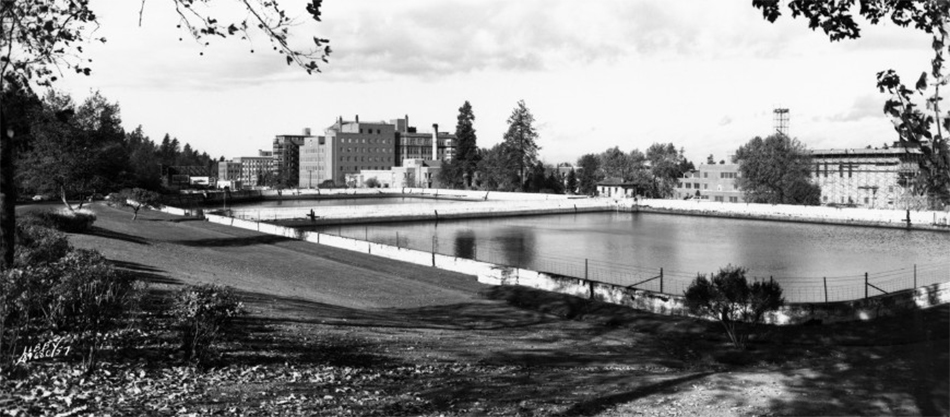
The original 9th and Pine reservoir was built in an open-basin style in 1903. The open water surface attracted man-made and airborne pollution. After a thorough investigation, it was decided it would be demolished but not without additional action taken as well.
Closed roofs were incorporated in the designs going forward for sanitary water storage. The Shadle Park closed roof water tank was built in 1965; the 9th and Pine closed roof reservoir was built in 1969. Later in this article, an explanation will be provided as to why and how these two water storage facilities became interlinked.
A Generous Donation of Land
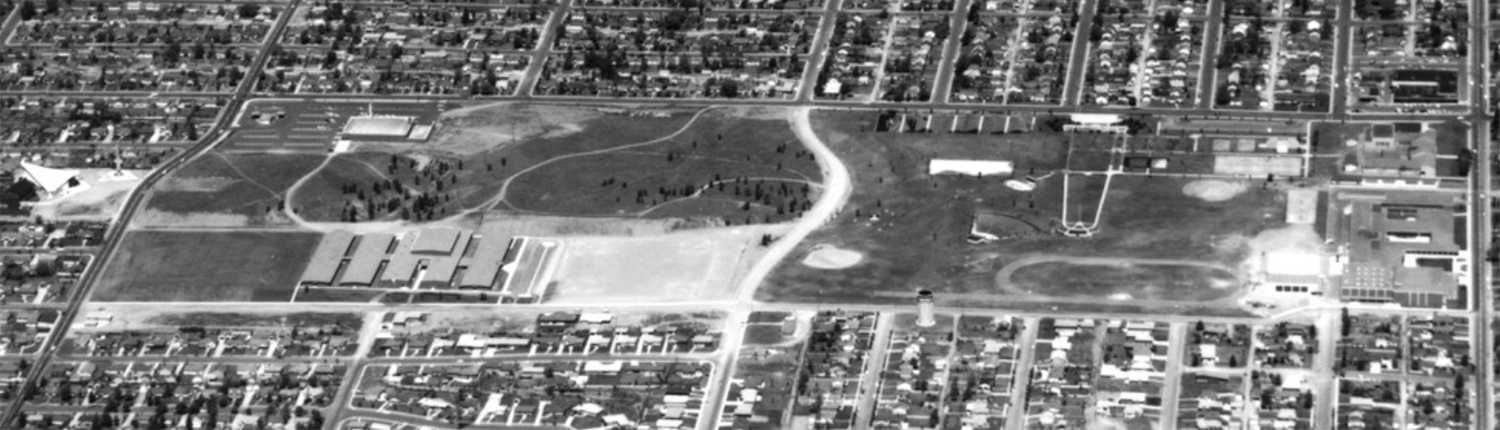
Shadle Park, on which the water tank is located, was established through a generous donation of land in 1944. The land was donated to the city by Jessie Comstock Shadle, the widow of Eugene Shadle, for the city to build a park.
Only a small fraction of the land on the eastern side of the park was taken to build Shadle Park High School in 1957 and Field Elementary school in 1946.
Shadle Park was an engineeringly desirable location for a water tank. The elevation was perfect, the location was right for distribution purposes, and the cost of the land acquisition was minimal. Thus, the Department of Public Utilities – Water Division decided to build the water tank on a site of city-owned property.
During that first year at Shadle Park High School, the students held an election and chose green and gold as their colors and to be known as the Highlanders. As the Shadle Park water tank was so close to Shadle Park High School, the students wanted it to reflect their school colors.
The colors also helped to further identify the water tank with the neighborhood and were ultimately approved by the Park Department and the Department of Public Utilities. Choosing a gold paint color for the water tank, however, was a bit of a challenge. The Department of Public Utilities – Water Division ultimately chose a yellow shade that was as close as they could come to the gold color given the financial limitations on the cost of the paint.
Public Opposition to the Shadle Park Water Tank
Early on, the public was “vehemently” opposed to the water tank being built in the city park that was in a residential area and across the street from the Shadle Shopping Center.
Both residents and business owners opposed it, as they thought it would be an eyesore and deprive children of space to play.
To address the opposition, the Department of Public Utilities – Water Division engineers developed a design that addressed the objections. They understood that not only were the placement and function of water tanks important but that public works projects should be designed and painted with aesthetics in mind to make reservoirs look good.
A public information program was carried out prior to awarding the construction contract. It emphasized the need for the extra expense to provide the aesthetic treatment. The information program provided wide-spread knowledge and understanding.
The end result was that the Shadle Park water tank was built in 1965. From the public information campaign, the residents “softened” to the idea. There were even comments to the effect that it didn’t look as bad as they thought it would!

The Innovative and Trend-Setting Design of the Shadle Park Water Tank
The Shadle Park water tank was designed by the Spokane Department of Public Utilities – Water Division engineering staff under the direction of the City of Spokane Utilities Engineer, George R. Oslund.
It was built tall primarily to use gravity to create the necessary water pressure for the surrounding Spokane neighborhoods. By storing millions of gallons of water high above the ground, the city’s water system could deliver consistent pressure to homes and ensure an emergency water supply for firefighting.
The new design featured a storage tank shape with a cylindrical drum-like form and a flat roof protected by a cover for sanitation purposes. The cover eliminated algae growth, prevention of dust, bacteria, and water contamination.

The Shadle Park water tank was noted for its modern design as well as its functionality.
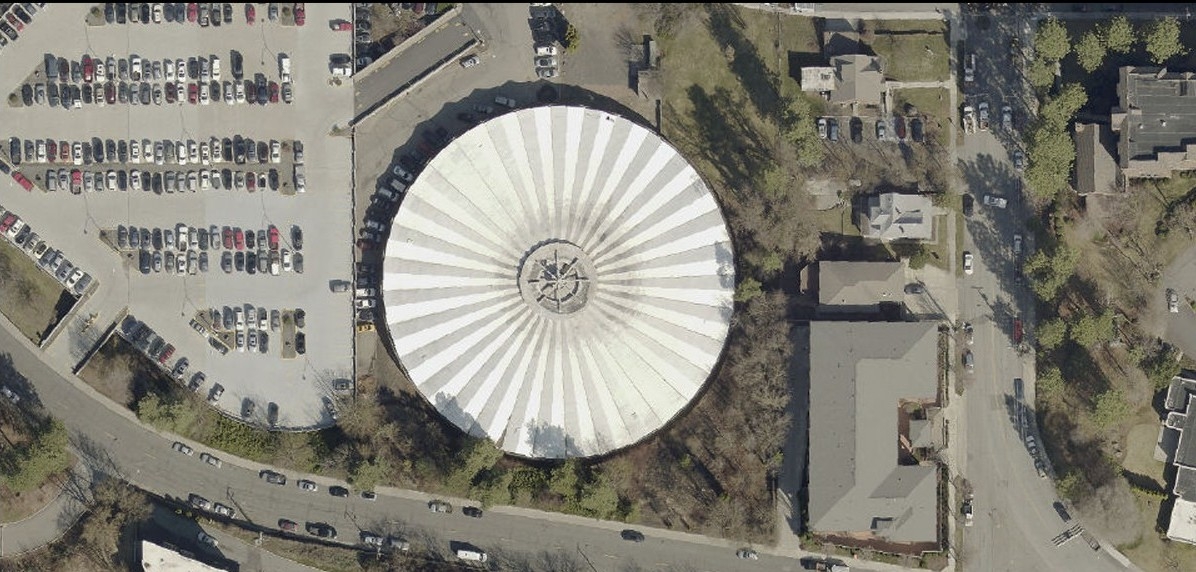
The roof line was extended eight feet beyond the sidewalls and mounted with 15 pilasters or flutes equally spaced around the tank perimeter. The ribs or flanges that encircle the tank are tapered with the smaller end at the ground level and the larger end terminating at the curved soffit at the top of the water tank. Together, they form a half circle. The residents thought in the daylight the tank displayed interesting shadow effects with the rich green and gold colors.

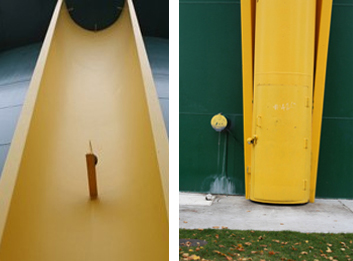
From the beginning, the Shadle Park water tank was envisioned to be dramatic when lit at night. That vision was carried out in its construction which included subdued columnar lighting. At night, the residents really liked how the water tank was dramatically lit with the uplights a third of the way up and the downlights at the top.
The new and improved closed design didn’t look like a reservoir but more like a water tank. It was constructed of steel with a concrete foundation.
The Shadle Park water tank has 10 times the storage capacity of the standpipe and the water tower it replaced. It was built with a 4.8 million gallon storage capacity for a cost of $267,156 in 1965. It is 72.5 feet in height with a diameter of 107 feet.
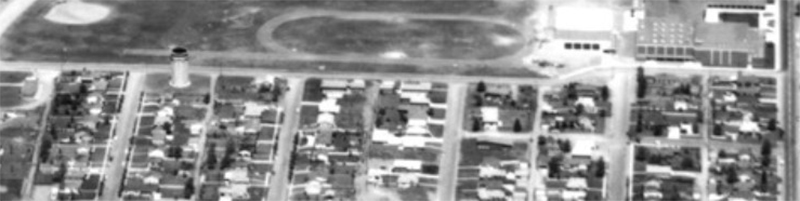
The old concrete standpipe on Longfellow Avenue and Elgin Street and the steel water tower at Wellesley Avenue and A Street were torn down. The standpipe was a vertical pipe used for pressure balancing and for fire protection. The water tower was an elevated water tank designed to pressurize a water distribution system using gravity.


The Shadle Park water tank received national publicity for its aesthetic beauty as well as its functional qualities.
The new design of the Shadle Park water tank was praised in an article with a description of “Like a lighted fountain” that appeared in the August, 1966, issue of The American City. In the article, it indicated that future water storage facilities would receive treatment in painting and lighting effects. The Shadle Park water tank was used as the example of creative thinking.
In a 1969 brochure on the city’s water system, “Spokane Water, The Best in the West”, it was noted progressive thinking by utilities personnel kept pace with the steady growth through construction.
An article entitled “You have to make reservoirs look good” was also in the August, 1971, issue of The American City. The article was written by Richard E. Saty from the Spokane Department of Public Works & Utilities – Water Division. In the article, he stated management must continually emphasize the need for the extra expense to provide aesthetic treatment by keeping the entire public well informed. Mr. Saty also indicated that the use of all forms of communication media is needed to achieve project acceptance.
The Shadle Park water tank became a show place for future such projects through creative design, the use of paint, and decorative lighting.
The Shadle Park Water Tank a Reflection of Mid-Century Googie Architecture
Both the Shadle Park water tank and the 9th and Pine reservoir were in the 2017 Mid-Century Survey on the Spokane Historic Preservation Office website. The 9th and Pine reservoir was noted for its pleated roof line (also known as a “folded plate” style) and an innovative gutter system.
The unique appearance of the Shadle Park water tank lends itself to a mid-century “Googie” style of design of architecture known for its unusual, eccentric building shapes.
Googie architecture is named after the 1949 Googie coffee shop in Los Angeles designed by John Lautner. Googie is a vernacular style—sometimes called Roadside Architecture—that emerged in the 1930s in Los Angeles, Las Vegas, and other areas around the country that catered to automobile travelers.
Googie architecture popularized the future. Its design was in keeping with a time when the public was fascinated by technology including space travel and the atomic age. This enthusiasm could be seen in building design and even in the area of entertainment such as with The Jetsons’ cartoon and Disneyland’s Tomorrowland.
Googie buildings are known for their eye-catching forms and signs that can be easily seen at the speed of automobile travel. Characteristics of this architectural style include bold angles and eccentric rooflines, colorful signs with pop culture images, large plate glass windows, and sweeping cantilevered roofs over exterior areas.
An example of Googie architecture in Spokane includes the former Denny’s Restaurant at 1412 W. Second Avenue.

Another example is Dick’s Hamburgers at 10 E. Third Avenue. The slogan “Hamburgers Buy the Bagful” appears on the Dick’s Hamburgers’ sign today along with the panda at the entrance.

The Connection Between the Shadle Park and the 9th and Pine Reservoir
Given the problems with sanitation, the old 9th and Pine reservoir played a role in changing the concept of design and the building of the Shadle Park water tank. The original 9th and Pine reservoir was built in 1903 and held 17.5 million gallons of water.
It had an open basin and looked like a reservoir. It was built when the focus was on engineering and getting the most value for the money spent.
At the time, it was thought that reservoirs should be uncovered, open to the air and exposed to the purifying effects of natural sunlight and surrounded by fences. However, it was found that sunlight stimulated algae growth and that an open water surface caused problems including: capturing man-made and airborne pollution, contamination, and evaporation.
The Water Division had been forced to drain and clean the big basin reservoir twice a year. Over the years, the concrete lining of it deteriorated badly which required a major decision after six decades went by of either demolition or major repairs.
Knowing the continued potential for contamination, evaporation, and future federal regulations, enclosed water tanks were being built instead of open ones.
After a thorough investigation, it was decided demolition would be done to the original 9th and Pine reservoir. However, before it could be removed, another reservoir had to be built to provide some compensation for the equalizing storage of the original. Out of this requirement came the proposal of the Shadle Park water tank.
The Shadle Park water tank and the new 9th and Pine reservoir were “interlinked”. The closed Shadle Park water tank was built with 4.8 million gallons of storage; the new closed 9th and Pine reservoir was built with 7.2 million gallons of storage. Together, they replaced the original 17.5 million gallon 9th and Pine reservoir with their new designs which prevented pollution.
The Shadle Park water tank serves the surrounding area on the northside. The 9th and Pine serves the South Hill and the neighborhoods surrounding the Sacred Heart Medical Center and the downtown district.
Design of the New 9th and Pine Reservoir
In keeping with the aesthetic trend which started with the building of the Shadle Park water tank, the new 9th and Pine reservoir also incorporated some dramatic features. It is located near the intersection of 40 E. 9th Avenue and S. Pine Court.
It was designed by the Spokane Water Department utilities engineering staff under the direction of the City Utilities Engineer, George R. Oslund. The engineers and designers decided on a wide, low-profile reservoir. As it would be highly visible, by keeping the structure low the design helped it fit better into the residential neighborhood. Being just uphill from the medical district, the design also minimized its visual footprint on the landscape.
After much deliberation, the designers agreed and the city approved a steel design with a “pleated roof line” (also known as a “folded plate”) with horizontal peak lines and sloping valley lines with a slope lower at the perimeter than at the center.
The peak-to-peak distances around the perimeter are 24 feet. The roof overhangs the sidewalks by six feet. The roof drains were designed with rectangular tubing installed in a V-shape to give the illusion of tying down the roof in the valley points. The roof design accomplishes two functions: 1) it provides for good roof-surface drainage (is self-cleaning); and 2) it breaks up the huge roof expanse producing an ever-changing pattern of shadows.
The reservoir was initially painted with an orange-and-black color scheme which are the colors of Lewis and Clark High School. The sidewalls were a pumpkin orange color with the downspouts and gutter painted black and the roof was painted in a wheat color. Soft floodlights were installed to illuminate every other sidewall panel.
To make the roof appear even more attractive, the engineers designed an all-welded night-lighted, roof-top fountain. It featured eight “outrigger-type” pedestals; each with a 1.5 inch smooth-bore nozzle discharging a stream of water into a reflecting pool 33 feet in diameter. An upper basin, 12 feet in diameter, was designed to release a sheet of water around its perimeter. Soft under water and pedestal lights were installed around the entire fountain.
The fountain was painted blue and trimmed in the colors of black and wheat. The 9th and Pine Reservoir cost $590,452 to build in 1969. It stands 26 feet in height with a diameter of 260 feet.


One of the reservoir’s final touches that was mounted on the roof was a 15-foot tall replica of “Willing Water”(which came to be known as “Willy Water”)—a service symbol of the American Water Works Association. Willy Water was affixed to the reservoir’s roof-top fountain.
Willy Water became the mascot but was taken down in October, 2014, because of health regulations. It was deemed to be potentially hazardous to the water inside the tank.

A bid to repaint the reservoir was awarded in April, 2014. It was painted in a neutral cream color. In comparison, the Shadle Park water tank has kept its green and gold colors since it was built in 1965.

The reservoir received national recognition by the Steel Plate Fabricators Association in 1969 with a “Tank of the Year” award.
Enduring Landmark
The Shadle Park water tank stands out like a beacon visible from many viewpoints in Spokane. It creates a sense of place for the Shadle Park neighborhood and is a landmark in the community. Its green and gold colors are distinctive to this day and certainly make it stand out from the others in the area.
Together, the Shadle Park water tank and the 9th and Pine reservoir interlink to provide major sources of water for Spokane. They both have made their mark on Spokane with their innovative, distinctive, and award-winning designs. They are examples for future such projects both locally and nationally.
As the decades have passed, the Shadle Park water tank has become far more than an engineering achievement. It has become a familiar companion in the landscape, a marker of neighborhood identity, and a testament to Spokane’s willingness to blend innovation with imagination.
From its award winning mid century design to its enduring green and gold presence, it continues to symbolize the pride, history, and character of the community it serves.
For generations of Shadle Park High School Highlanders—and this author is one of them from 1976—and northside residents, the Shadle Park water tank remains not just a reservoir but a beloved landmark woven into the story of Spokane itself.
Sources
- Glen A. Yake, Assistant City Manager-Engineering, “Spokane Water, The Best in the West” (brochure), Department of Public Utilities, Water Division, City of Spokane, 1969, pages 1-4, accessed at Spokane Public Library, Northwest Room;
- Richard E. Saty, P.E., Water Division, Department of Public Works & Utilities, “You have to make reservoirs look good”, The American City, August, 1971, pages 58, 59;
- Glen A. Yake, Director of Public Works and Utilities, “Like a Lighted Fountain”, The American City, August, 1966, pages 147-149;
- Spokane Historic Preservation Office, Mid-Century Spokane.org, Inventory Form, Historic Property Report, The Shadle Park Reservoir, December 23, 2016, pages 6, 7, accessed June 6, 2026 (https://midcenturyspokane.org/property/shadle-park-reservoir/);
- “Water Tanks, Too, Are Changing with the Times, Industrial Designer Pictures Future Towers as Lovely as well as Functional”, New York Times, October 22, 1965, page 1;
- “Award Earned for Reservoirs”, Spokane Daily Chronicle, May 17, 1966, page 18;
- “Completion Near”, Spokane Daily Chronicle, June 24, 1965, page 8;
- “Council to Award Landscaping Pact”, Spokane Daily Chronicle, August 23, 1965, page 3;
- “Reservoir Base Low Bid $17,983”, The Spokesman-Review, March 6, 1965, page 7;
- “Reservoir Site Talks Resume”, Spokane Daily Chronicle, January 14, 1965, page 3;
- Jack Roberts, “Big Water Tank Rises at Shadle”, The Spokesman-Review, May 23, 1965, page 6;
- Jack Roberts, “Costly Reservoir Projects Moving”, The Spokesman-Review, June 13, 1965, page 24;
- Water, City of Spokane, Public Works and Utilities, my.spokanecity.org, February 5, 2021;
- “Shadle Reservoir Nearly Ready”, Spokane Daily Chronicle, September 1, 1965, page 16;
- “Yellow, Not Gold, Shadle Park Tank Adding Brightness”, Spokane Daily Chronicle, July 30, 1965, page 5;
- “Green, Yellow Hues Considered for Tank”, Spokane Daily Chronicle, July 21, 1965, page 6;
- “Oft-Maligned Reservoir Brings Plaudits to City”, Spokane Daily Chronicle, November 1, 1965, page 3;
- Googie Architecture, Wikipedia, accessed June 7, 2026 (https://en.wikipedia.org/wiki/Googie_architecture);
- Happy Retirement Willy Water, Marlene Feist, Utilities Communications Manager, My.SpokaneCity.org, accessed June 2, 2026 (https://my.spokanecity.org/news/stories/2014/03/17/happy-retirement-willy-water/);
- A bid for repainting the reservoir was awarded by the Spokane City Council, April 21, 2014, The “Willy Water” mascot was taken down in October, 2014, accessed June 4, 2026 (https://static.spokanecity.org/documents/citycouncil/advance-agendas/2014/04/city-council-advance-agenda-2014-04-21.pdf), page 4;
- Nicholas Deshais, “Water Willy Removed from Reservoir, The Spokesman-Review, October 2, 2014, page s1;
- “Chick, Duckling Sales Regulated”, Spokane Daily Chronicle, March 19, 1968, page 3;
- Jesse Tinsley, “Then and Now: Water Tank Located on East Ninth”, The Spokesman-Review, July 31, 2017, page c1;
- “Pipe Work Starts for City Reservoir”, Spokane Daily Chronicle, November 24, 1966, page 73;
- City of Spokane Utility Rate Study: Water Utility GFC, Plant in Service, accessed June 6, 2026 (https://static.spokanecity.org/documents/publicworks/general-facilities-charges/water-plant.pdf).
Image Sources
- Featured Image: Shadle Water Tank, My Spokane 311, Jeff Stevens, Audubon Downriver Neighborhood Council Vice-Chair, Transforming the Shadle Area, May 22, 2019, accessed July 2, 2026 (https://my.spokanecity.org/news/stories/2019/05/22/transforming-the-shadle- area/);
- Crystal Island 1890/1895 (later known as Canada Island and then Havermale Island), Site of the original city-owned pump station, Spokane Public Library, accessed June 6, 2026 (https://lange.spokanelibrary.org/items/show/2632);
- Direction of Underground Water Flow, “Spokane Water, The Best in the West” brochure, Department of Public Utilities – Water Division – City of Spokane, 1969 pages 1-4, accessed at Spokane Public Library, Northwest Room;
- Shadle Park aerial showing 40 acres covering the area of Wellesley Ave. to the north; Longfellow Ave. to the south, Alberta St. to the west, and Ash St. to the east, 1960, Northwest Museum of Arts & Culture/Eastern Washington State Historical Society, Charles Libby collection, L87-1.995C-60;
- Shadle Park Water Tank built in 1965, Spokane Historic Preservation Office, Historic Property Report, December 23, 2016, page 3, first image, accessed June 6, 2026 (https://midcenturyspokane.org/wp-content/uploads/2016/12/Shadle-Park-Reservoir.pdf);
- Aerial Image of the closed top of the Shadle Park water tank, Surdex 2007 Imagery, iGIS Map Export, City of Spokane GIS, Spokane Public Library, Northwest Room;
- Shadle Park Water Tank images of a Sidewall with a Curved Pilaster (Flute) and a Curved Pilaster mounted around the perimeter, Spokane Historic Preservation Office, Historic Property Report, December 23, 2016, page 4, accessed June 6, 2026 (https://midcenturyspokane.org/wp-content/uploads/2016/12/Shadle-Park-Reservoir.pdf);
- Shadle Park Water Tank Narrow-Beam Spotlight in a Pilaster (Flute) and door on north Side, Spokane Historic Preservation Office, Historic Property Report, December 23, 2016, page 4, accessed June 6, 2026 (https://midcenturyspokane.org/wp-content/uploads/2016/12/Shadle-Park-Reservoir.pdf);
- A View of the Standpipe on Longfellow Ave. with Elgin St. as the cross street in 1965, the Standpipe is to the left of the Shadle Park water tank, Spokane Historic Preservation Office, Historic Property Report, December 23, 2016, page 3, accessed June 6, 2026 (https://midcenturyspokane.org/wp-content/uploads/2016/12/Shadle-Park-Reservoir.pdf);
- Another view of the Standpipe on Longfellow Ave. with Elgin St. as the cross street in 1960; the Standpipe is to the left of the Shadle Park High School track, Northwest Museum of Arts & Culture/Eastern Washington State Historical Society, Charles Libby collection, MAC L87-1.995C-60;
- The old water tower on Wellesley Ave. and A St. in 1960; the water tower is at the far left on the image; Northwest Museum of Arts & Culture/Eastern Washington State Historical Society, Charles Libby collection, MAC L87-1.996B-60;
- Diner in Spokane in 2021; formerly a Denny’s Restaurant; author’s image;
- Dick’s Hamburgers at 10 E. Third Avenue in 2021; author’s image;
- The original 9th and Pine reservoir in 1957; Northwest Museum of Arts & Culture/Eastern Washington State Historical Society, Charles Libby collection; MAC L87-1.89680-57;
- Aerial view of the Pleated Roof of the 9th and Pine reservoir 2024, Surdex 2024 Imagery, iGIS Map Export, City of Spokane GIS, Spokane Public Library, Northwest Room;
- 9th and Pine reservoir in the colors of Lewis and Clark High School, Spokane Historical Preservation Office, Historic Property Report, December 23, 2016, page 3, accessed June 6, 2026 (https://midcenturyspokane.org/wp-content/uploads/2016/12/Shadle-Park-Reservoir.pdf);
- Lighted Image of the 9th and Pine reservoir at night with the fountain on top in 1969, Then and Now, Water Tank on East 9th”, The Spokesman-Review Photo Archive, Jesse Tinsley, July 31, 2017, page c1;
- Willy Water Mascot on top of the 9th and Pine Reservoir in 2014 Prior to Removal, The Spokesman-Review Photo Archive, Nicholas Deshais, October 2, 2014, page s1;
- 9th and Pine reservoir in 2017, Then and Now, “Water Tank on East 9th”, The Spokesman-Review Photo Archive, Jesse Tinsley, July 31, 2017, page c1;
- Good Morning Shadle Park! Photo by Anthony Guzzo, Spokane Parks and Recreation post on Facebook, January 14, 2019.